Smart land development protects agriculture
NH Food Alliance explores how to strengthen housing alongside farmland
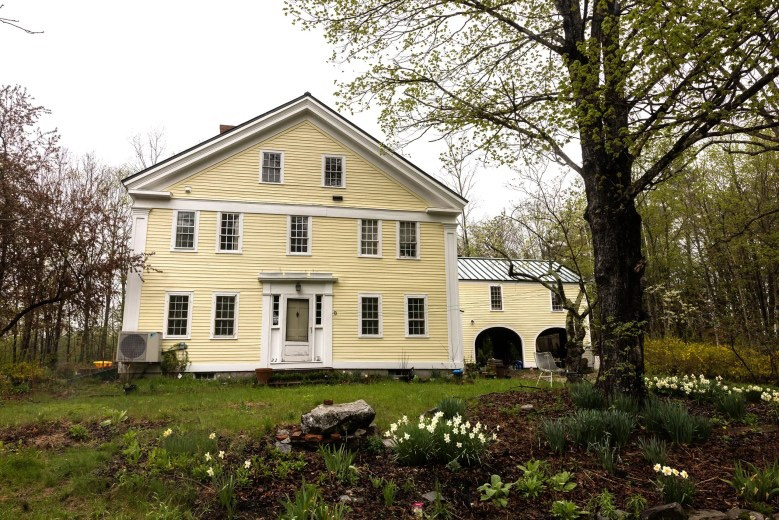
The farm house on the Foster Farm land in Warner. (Photo by Geoff Forester, Concord Monitor)
Strategic plans aren’t made to sit on the shelf, but Jamie Pottern knew that making a concerted effort to improve the food system of an entire state — with its moving parts and ingrained habits —would be a lofty undertaking.
The New Hampshire Food and Agriculture Strategic Plan, released last year by the New Hampshire Food Alliance, issued over 140 recommendations across 27 different subject areas, galvanizing stakeholders across every sector of the state’s agriculture industry.
The 143-page document laid out the path for meeting an ambitious regional goal. In 2022, a local food count estimated that 3.1% of the food consumed in New Hampshire originated from within the state. A compact of New England states would like to see that benchmark reach 30% by 2030 across the region.
“Some are more low-hanging fruit, some are longer term, some are policy. Some are very practical things that we can do to try to bring in those experts, to come together and try to digest those things and see what we can actually move the needle on,” said Pottern, the New England program manager at the American Farmland Trust, an eminent voice on agricultural issues across the country.
When the time came to execute the plan’s recommendations, Pottern joined experts on two issues that, in her experience, “tend to get pitted against each other when really the solutions tend to have a lot of the same tools and overlap.”
For the last several months, their working group has explored a fundamental question: How can New Hampshire strengthen its housing supply without encroaching on valuable, already-vanishing farmland?
Farmland loss has not been linear in New Hampshire, but it has experienced a marked decline. Census data shows 463,383 acres held in farms across the state in 1997, a total that grew to 474,065 by 2012 but dropped to 417,187 acres only 10 years later.
The American Farmland Trust paints three different scenarios for the future in New Hampshire, projected to be one of the 10 states with the highest percentage of agricultural land conversion.
In one, development continues “business as usual,” and farmland continues being fragmented and converted into subdivisions, shopping centers, office parks and large-lot housing. From 2016 to 2040, the organization estimates the Granite State would convert 8.3% of its agricultural land into either urban and highly developed land or low-density residential land.
In another, runaway sprawl chews up farmland at an even more aggressive pace, leading to as much as 10% of agricultural land lost to conversion. Another future, with “better-built cities” where development is denser and investments are made into repurposing old buildings and underutilized land, could come to pass. Farmland attrition would be limited, in this case held to about 5.2%.
Pottern sees eye-to-eye with her working group partners. Sarah Wrightsman, community engagement coordinator at New Hampshire Housing, wants to see “smart land development” that adheres to a community’s priorities, like preserving rural character, protecting conserved land and enhancing walkability.
Often framed as competing land uses, housing and farmland preservation are even more extensively interconnected than most realize, Wrightsman said.
“The people who work on a farm and the farmers also need somewhere to live. We’ve talked about things, even like using accessory dwelling units to support succession planning on a farm,” she said. “So, there are all these ways that housing and agriculture are not opposing forces, and they actually support each other.”
As they mulled how to continue picking up productive momentum, their group prepared case studies to present at the Food Alliance’s second annual statewide gathering last month.
Their message, put simply, would be: “We want to see high-value conservation land put in conservation, good ag land used for ag, but then we also want to see land that does not have very high conservation value used for housing,” Pottern said.
Overgrown and unattended, a couple dozen acres of farmland in Warner sit opposite a wetland, its edges surrounded by brambles and bordering an affordable housing project years in the making.
Known as Foster Farm, the 70-acre historic homestead hasn’t been in active agricultural use for decades.
In November of 2022, Andy Duncan, a buyer from Concord, purchased the property with the intention of transferring ownership at a discounted price to the Kawasiwajo Community Land Trust, which would enter into a use agreement with Duncan the following month, allowing the trust to act as the homestead’s property manager.
After six years of robust planning, fundraising and extensive work to rehab the 2.5-story colonial, on March 19, the land trust closed on Foster Farm, buying it from Duncan for $160,000, one-quarter of the appraised value. The sale marked a crucial milestone for what the organization envisions as the first of many combined affordable housing and farmland preservation projects.
“There’s a lot of energy and belief in this group that change can be made to make our communities more self-sufficient, and to the degree that we can help, we’d all like to,” said Ben Frost, a professional planner and member of Kawasiwajo’s board of trustees.
Frost said Kawasiwajo is not interested in behaving as a large landlord; on the contrary, by late fall, the land trust plans to sell the house to an income-qualified buyer. The board intends to maintain a renewable 99-year lease on the land surrounding and underlying the house, a deed restriction designed to steady the property at an affordable rate for generations independent of future sales.
“That separation of the interests of the land has worked really well in other areas of the country. We want to demonstrate that it can work really well in New Hampshire,” Frost said. “We talk a lot about these issues and they show up in our master plans, but then we don’t translate that to changes in our zoning. […] Warner’s done a pretty good job.”
As the land trust begins to search for its next project, it is convening a farmer advisory council to determine the agricultural enterprises that might make sense on the property’s viable farmland, said board president Ellie Brown.
“It’s certainly not a turnkey operation, but with some time and effort, it can be brought back,” Brown said of the land. “Foster Farm is part of the greater story of our work. This is phase one.”
This article is being shared by partners in the Granite State News Collaborative. For more information, visit collaborativenh.org.