New state law empowers homeowners with ‘balcony’ solar panels
With a new state law set to go into effect with the dawn of a new year in 2027, Granite Staters will be able to install so-called “balcony solar” panels for home use.
With a new state law set to go into effect with the dawn of a new year in 2027, Granite Staters will be able to install so-called “balcony solar” panels for home use.
But a recent panel of experts on these plug-in devices caution that it might not be as simple as plug and play, set it and forget it.
DIY solar power users still need to do their homework to understand the technology, the safety requirements, and their own home’s potential — and possible limits.
“Make sure you’re doing your homework if you’re just buying some device off Amazon or LinkedIn or whatever,” said Vaughan Woodruff, principal of EquinoxDG, a national consulting firm on solar power.
“Like if you’re just buying that, you don’t know the listing, you don’t know this, you don’t know that, and you’re just plugging in an outdoor outlet, you are taking on the responsibility of that risk,” he added.
Woodruff was part of a webinar Aug. 5 put on by Clean Energy New Hampshire as a way for interested parties to familiarize themselves with the new law that gives homeowners and renters the right to install plug-in solar panels as a way to offset their power company electric bills.
SB 540, the bi-partisan work of the 2026 legislative session, was signed into law by Gov. Kelly Ayotte in early July. It has an effective start date of Jan. 1, 2027.
The law defines “portable solar generation devices” and exempts them from utility interconnection requirements and net metering provisions. The bill also directs the building code review board to update codes for portable solar devices and authorizes the state Department of Energy to adopt rules relative to interconnection requirements for portable solar generation devices.
Key elements of the law include:
- Utility companies are prohibited from charging any extra fees or requiring prior approval for plug-in solar systems that meet safety requirements;
- Plug-in systems are capped at 1,200 watts AC output per electrical meter, which is consistent with other state plug-in solar laws;
- Systems that meet safety code requirements can be installed by the homeowner or renter without a building permit.
“Anybody who wants to have one of these devices, you can generate your own power cheaply and save money,” said state Sen. David Watters, D-Dover, the primary sponsor of SB 540.
“Plug it in up to 1,200 kilowatts. It’s kind of the average power used for a lot of apartments. No regulation, no net metering, no burdensome costs. Plug it in, save some money,” he added in a social media commentary.
The Clean Energy NH webinar featured presenters Woodruff and Stephan Scherer, founder of Craftstrom, a Houston, Tex., based company that develops and seels plug-in solar systems.
It was hosted by Chris Skoglund, director of energy transition at Clean Energy NH, which advocated for the bill.
“We really kind of like began the conversation with Senator Waters and others, and that helped us reach out to Bright Saver and other organizations and build the kind of understanding that was needed to create a bill that is particular to New Hampshire, and we think a great example for how these sorts of bills and these sorts of systems should be considered in the state,” said Skoglund. Bright Saver is a plug-in solar advocacy group.
The webinar featured background on plug-in solar, as well as some technical and safety-ratings discussion.
The units are known as plug-in photovoltaic (PIPV) systems. Compared to the traditional rooftop units installed by a specialized contractor, these systems — also known as “balcony solar” — are more affordable and more simple to install. They are particularly popular in Europe, especially in Germany where some 5 million units are currently in use.
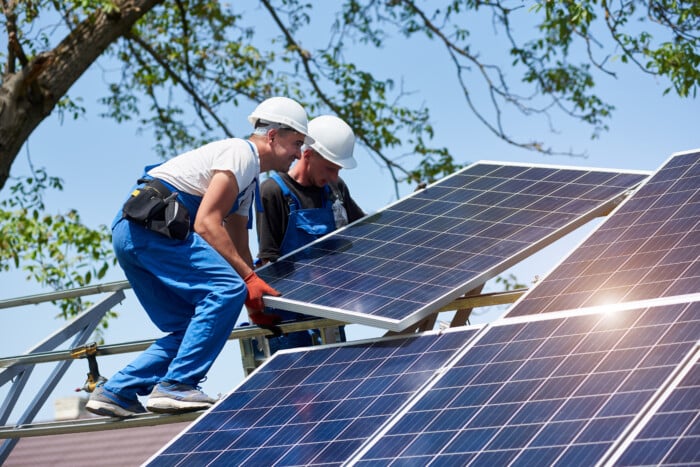
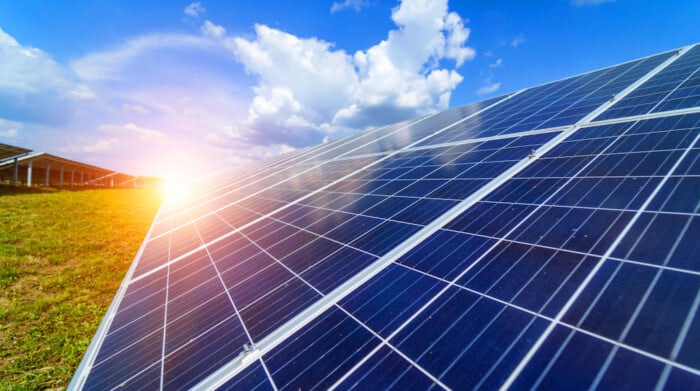
Simply put, these solar panels plug into an electrical socket, usually an outside plug on a porch or balcony or patio. They create direct current (DC), then a small micro-inverter changes the DC power into alternating current (AC) power, which is the type of power a home uses. Basically, electricity flows through your wall plug and into your home’s electrical system.
At a limit of 1200 watts, that generates roughly 3.6 to 4.8 kWh of electricity per day under optimal sunlight, enough to offset or power household appliances like refrigerators, Wi-Fi routers, lights, TVs, laptops, and intermittently run small-to-medium window air conditioners or coffee makers.
There are several factors to consider, however.
Scherer pointed out during the webinar that the effectiveness of a panel can be affected by its location, its azimuth (horizontal direction), its angle, the season, shade, temperature, and overall weather.
Homes have a two-phased electrical system. The solar panel that plugs into that outside outlet will feed electricity into only one phase, so it’s good to know what phase is being fed and what appliances, etc. are on that phase.
Older homes face overload — and potential fire — risks from plug-in solar due to degraded wire insulation, outdated fuse boxes or ungrounded circuits. There is also something called “breaker masking.” This is a safety risk where a plug-in solar device puts electricity into a shared household circuit, offsetting the load current. The circuit breaker sees less current than what is actually flowing through the wires, masking the breaker, allowing dangerous overloads and overheating to happen without tripping the breaker.
To prevent breaker masking, you need a dedicated branch circuit installed by an electrician, a Power Control System (PCS), or oversized wiring/conductors.
All ranges of plug-in solar panels can be found online. Amazon, for instance, features them for as little as $100 up to several hundred dollars.
The new law in New Hampshire comes about as a new safety rating system is being put in place for plug-in solar.
UL 3700 is a standard and testing framework established last year specifically for PIPV. Unlike other UL designations for roof-top solar, UL 3700 governs power generated into standard residential circuits by addressing back-feed, circuit overloads, and shock hazards.
Though not required as a safety rating for all plug-in systems currently for sale, many states with plug-in solar guidelines (such as Maine, Maryland, and Colorado) explicitly reference or require safety compliance like UL 3700 for balcony units.
The New Hampshire law makes no reference to UL 3700, saying the state in establishing its guidelines that “Such rules shall not exceed applicable test standards of the American National Standards Institute (ANSI) or Underwriters Laboratory (UL).”
“It’s an umbrella certification. It touches upon subjects that are typically not dealt with in other standards,” said Woodruff. “But before we get to UL 3700, every manufacturer has to go through various other safety certifications that are not being replaced by this.”
One of the largest solar installers in the Granite State — ReVision Energy — hails the advent of plug-in solar here and says it opens a larger discussion.
“Plug-in solar identifies the right problems (permitting and interconnection cost and complexity, and equitable access for renters/apartment dwellers) but doesn’t provide the full scope of a solution,” it said in a recent blog post. “If we can get the cost of full-scale, professionally designed and installed solar down to $1 per watt (as they’ve done in Australia), solar adoption would soar – without anyone having to zip tie a panel to their railing.”
For reference, here is the full video recording of the Clean Energy NH event: https://www.youtube.com/watch?v=oVEhloLS2ZY
There is also a FAQ that was generated from the webinar discussion here: https://docs.google.com/document/d/1-qqzQS_Kt4Dyq8RFTFx6qNv-atbyJRyt/edit