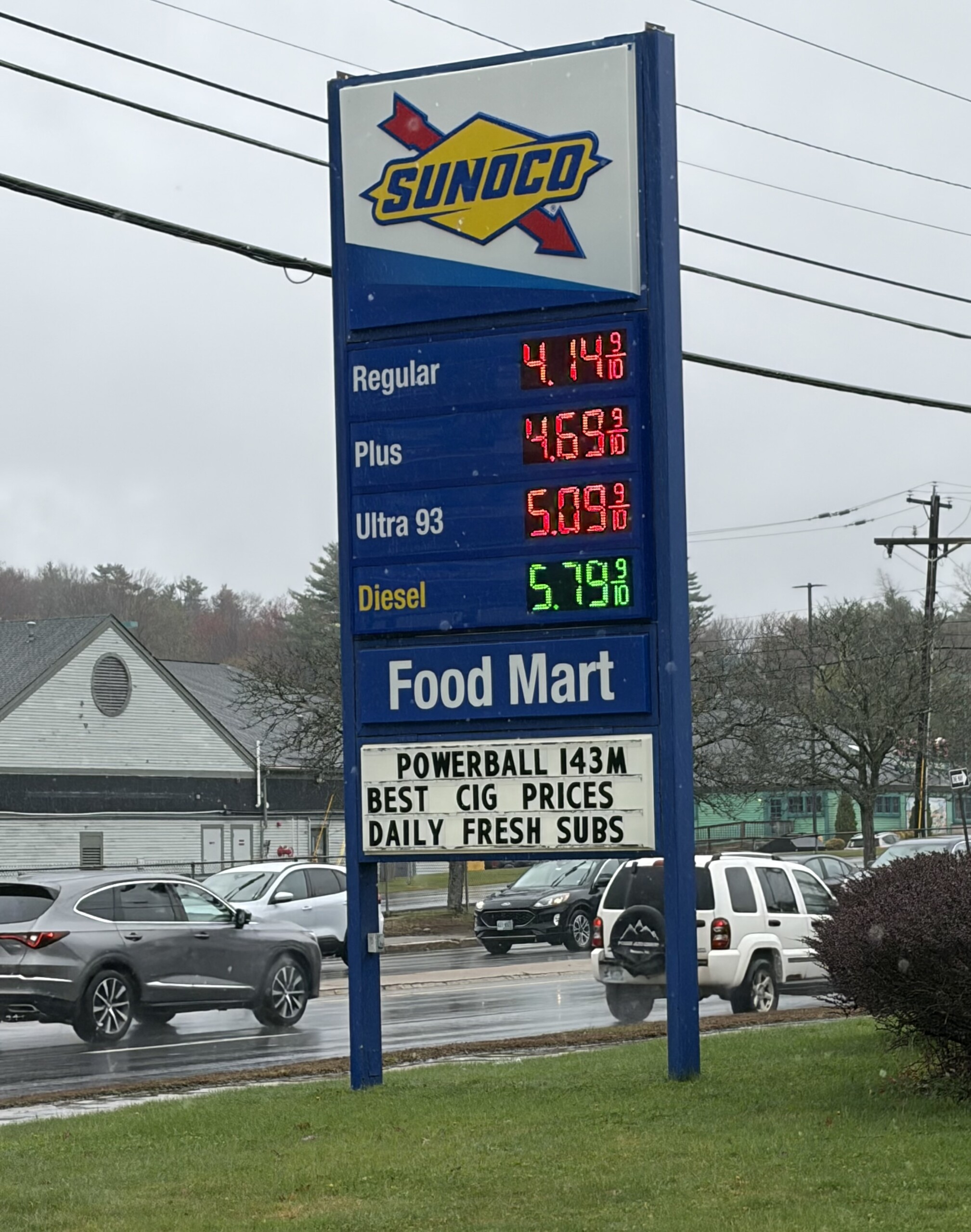
New Hampshire is feeling some economic indigestion at the start of the summer season, and the main culprit is gas.
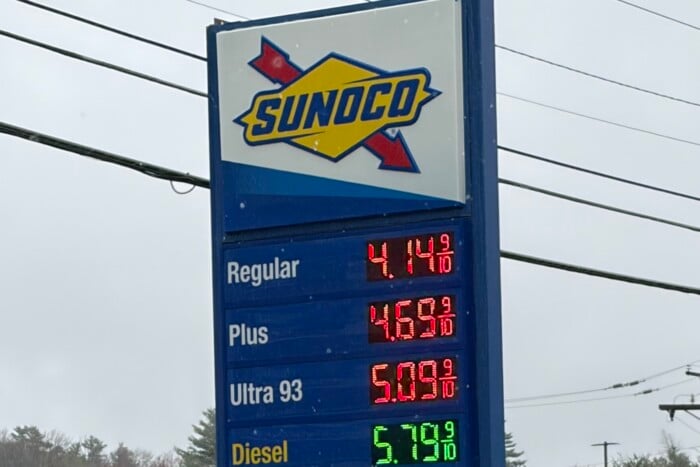
Six in 10 (61%) of respondents to a new University of New Hampshire poll are worried about the current and future price of gas, and a clear majority put the blame on President Donald Trump.
Their angst over gas prices was part of an overall concern about the state of their finances with nearly half of respondents anticipating a worsening economy over the next year.
Gas prices have topped $4 in New Hampshire. (NHBR file photo by Mark Hayward)
There was a tone of caution in remarks Michael Skelton, president and CEO of the state’s Business and Industry Association (BIA), offered upon release of the survey, done on the BIA’s behalf.
“Rising and volatile gas prices are adding to the economic uncertainty that consumers have been feeling for months and pose a real risk to spending and the overall health of the economy,” said Skelton, whose association is the statewide chamber of commerce and state manufacturing association.
“The U.S. and New Hampshire economies have shown tremendous resilience over the past several years despite the impact of inflation, geopolitical risks and trade uncertainty,” added Skelton. “Fast rising gas prices are now another concerning factor that will test consumer spending and the economy as we enter the summer vacation and travel season.”
As of this writing, the average price of a regular gallon of gas in New Hampshire was $4.41, according to the American Automobile Association (AAA). A year prior it was $2.91.
Gas prices started their meteoric rise with the start of the joint U.S.-Israel Operation Epic Fury against Iran on Feb. 28, 2026, which immediately affected oil shipments through the Iran-controlled Strait of Hormuz.
Less than 10% of U.S. oil imports come through the strait, where shipping traffic has all but stopped, but the chilling effect on the world oil market has had a direct impact on U.S. oil gasoline prices. Once the conflict provocateurs come to terms, analysts say it will still be another nine to 12 months before the oil market completely sheds its nervousness and returns to its pre-conflict pulse. Some analysts project that a full return to prices under $3 per gallon may not happen until between 2029 and 2032.
With that uncertainty, state officials are putting their best face forward with their prediction about summer tourism here in the Granite
State. At an event May 21, the Department of Business and Economic Affairs (BEA), Division of Travel and Tourism Development (DTTD), said it expects 4.8 million visitors generating approximately $2.6 billion in visitor spending statewide during the summer season. That’s the same expectation they had for the summer of ‘25.
The officials cited national data that show resilience in domestic travel, with people prioritizing vacations, outdoor recreation, and time spent with family and friends. The local data from the new UNH survey showed only 12% planned to alter their vacation plans because of high gas prices.
The summer theme trumpeted by tourism officials and Gov. Kelly Ayotte was the 2026 launch of the newest New Hampshire Ice Cream Trail with 69 stops across the Granite State.
There remains from the summer of ‘25 a holdover concern about the number of visitors from Canada during the summer of ‘26. Visits by Canadians to the Granite State were down 30% because of White House inflicted bad feelings about tariffs and annexation as the 51st state.
U.S. Sen. Jeanne Shaheen (D-NH) on May 29 held a tourism roundtable in Meredith, where Lake Winnipesaukee and the Lakes Region are a big summer tourist draw.
Aboard the docked U.S.S. Winnipesaukee Spirit, she met with representatives from Mount Washington Cruises, Lakes Region Travel Association, Laconia Motorcycle Week Association, BEA,, Winnipesaukee Railroad, Meredith Village Savings Bank, Gunstock Mountain Resort, Ames Farm Inn and Castle in the Clouds.
“President Trump’s insulting rhetoric and reckless tariffs are pushing visitors away from our state while gas prices and inflation are spiking due to the war in Iran — burdening Granite State small businesses with rising costs and shrinking revenues,” Shaheen said in a statement.
Participants in her roundtable expressed some cautious optimism about the tourist season, despite the gas prices and tariff/51st state hangover. There were other issues they also wanted to discuss: workers, which there seem to be enough of, and housing, which there isn’t enough of.
U.S. Sen. Maggie Hassan (D-NH), as ranking member of Congress’s Joint Economic Committee, said in a report about declining tourism nationwide: “States across the country have been forced to shoulder job losses and watch their economies suffer ahead of peak travel season this summer.”
She, too, laid the blame on what she described as “President Trump’s reckless tariffs and other actions.”
The report cited data showing that in 2025 about 9.9 million fewer Canadians visited the U.S. compared to 2024 and that the number of jobs in the hotel and lodging sector declined last year for the first time since the Great Recession, aside from a brief drop in 2020 due to the COVID pandemic.
The report said that the large decline in visits from Canada and overseas is especially “damaging because these visitors tend to spend more on lodging and meals.”
One canary in the coal mine in terms of how summer tourism might affect state finances is future revenue from the meals and rooms tax
(MRT). There is an 8.5% tax on meals, alcohol, rooms and motor vehicle rentals paid by residents and visitors alike. The greater the revenue from that tax, the greater we can assume residents and visitors are making use of restaurants, bars, hotels, motels, etc.
According to state Department of Administrative Services data for September 2025 (which would have captured the summer months) MRT revenue to date for the fiscal year was 0.1% above plan and 4.2% above prior year, with taxable meals showing gains of 5.3% and hotels up 1.9% — not great, but not a disaster, either.
The April 2026 revenue report thus far this fiscal year shows MRT total revenue is $4 million below plan (a 1.3% difference) but $8.9 million (3.1% to the good) ahead of the prior year.