Business by business, and quietly over time, the Granite State has become a platform and launch pad for research, innovation and manufacturing and in space, aerospace and national defense.
Products in this arena are now New Hampshire’s number one export, Lucy Lange, commissioner of the New Hampshire Department of Business and Economic Affairs, said Oct. 28 at the Northeast STTAR Expo at the University of New Hampshire in Durham.

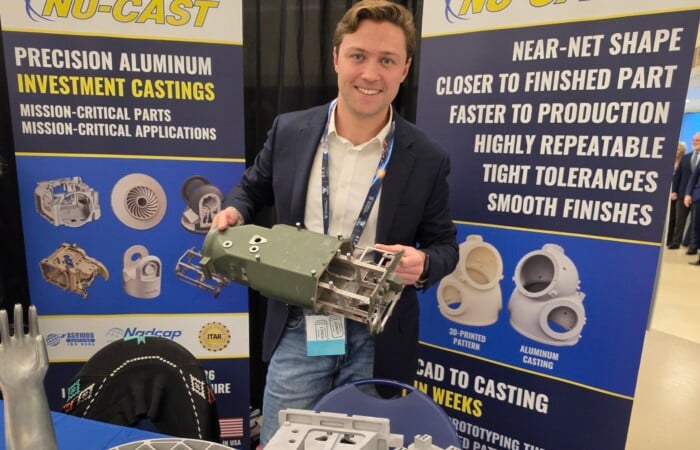
Cole Tavani, CEO of Nu-Cast Inc. in Londonderry, holds a cast aluminum chassis for optics in a tank made for the space and aerospace industry. (Photo by Roberta Baker)
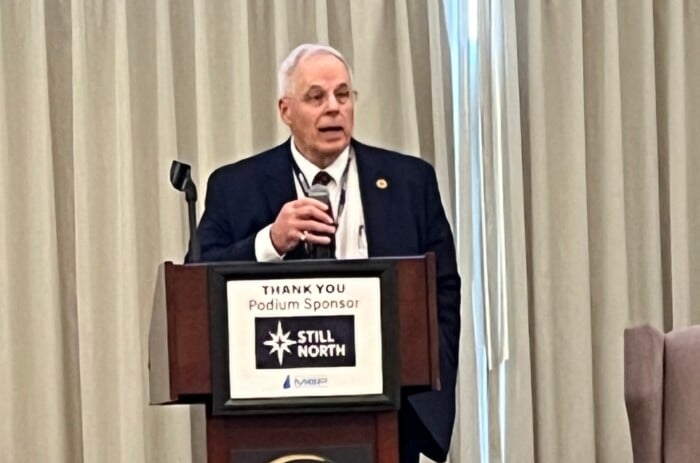
This state is “home to one of the most advanced aerospace and space manufacturing ecosystems in the world,” said Randy Makee, executive director of the NH Aerospace and Defense Consortium. “New Hampshire is far and away the biggest state for space and aerospace in New England.”
STTAR stands for Space, Technology, Trade and Research. The two-day expo on Oct. 28 and 29, the first of its kind in the region, convened innovators, producers, scientists, engineers, investors, bankers, students and representatives of the U.S. Space Force and Department of War. The goal: Increase networking, collaboration and awareness of what’s happening here, including on the campus of UNH, which provides tools, expertise and facilities for product development and testing.
“New Hampshire is vital to the space industry in a variety of ways — from researching solar storms to building rocket components,” UNH President Elizabeth Chilton said when the event was announced in August.
Today the space, aerospace and defense sector accounts for 8% of New Hampshire’s GDP and 22 percent of its exports, industry experts report. More than 300 New Hampshire businesses currently support space flight, aviation and defense in areas including propulsion, materials science, advanced manufacturing, autonomous systems, software, hardware, cybersecurity and securing the supply chain. They’re creating, scaling and distributing components used on rockets, satellites and the International Space Station.
New Hampshire’s role is expansive, comprising education, innovation, manufacturing and workforce development.
From industry leaders such as BAE Systems, Collins Aerospace, General Electric and GKN Aerospace to startups and small, specialty fabricators, “We are awesome at component manufacture and assembly,” Makee said.
“We’re faster to market, less expensive and more innovative. Everyone’s ready to go,” he said, adding the space economy in the Northeast is expected to “grow exponentially.”
Until now, this industry has operated mostly under the radar in New Hampshire.
The STTAR Expo was a showcase, bringing about 440 visitors the first day. The 57 exhibitors included Nu-Cast in Londonderry, a family business that casts aluminum for planes, missiles and satellites.
“We specialize in aerospace and defense but can make anything out of aluminum,” said Cole Tavani, the CEO. That includes joysticks for helicopters, chassis for optical systems on tanks, engine caps, impellers and camera parts for night vision. “We make aluminum parts for anything that’s going into space that requires aluminum parts.”
Integer Technologies, headquartered in Columbia, South Carolina, opened an office in Durham on the UNH campus in May, in partnership with UNH. The company provides science and technology-focused software that “accelerates research into capacity in the workplace,” said Tyler Johnson, engineering manager for Integer.

Randy Makee, executive director of the New Hampshire Aerospace Defense Consortium. (Photo by Roberta Baker)
“We work closely with academia, government and boots on the ground,” translating research into reality, Johnson said. “What do you need today? I can deliver this to a warfighter.”
Frontgrade in Exeter focuses on RF (radio frequency) components, including antennas, rotary joints that allow antennas to spin and wave guides, which are transmission lines that carry RF energy.
Tech NH in Marrimack specializes in plastic injection molding and makes fuel cells for the defense industry, including for submarines and fighter jets. Ken Wolfe, director of sales and marketing, held a sample product: a transparent yellow dome-shaped cover for the electronic controls that guide missiles.
“New England is full of mold makers,” Wolfe said. “It has been historically. Right now, there’s government money pushing out for defense.”
SVT, based in Hampton with a warehouse in Lee, provides inventory management and supply chain solutions.
“Supply chains are very volatile. Things come up continually. We try to manage those gaps,” said Brandon Stower, co-owner of SVT. “It’s almost like forecasting, looking historically at what happened to other clients.”
Data centers, with massive growth, “have soaked up the semiconductor industry,” said co-owner James Wedge.
With global wars has come increased defense, and procurement has emerged as the company’s fastest-growing business.
“Our goal is to work with someone and to go out and secure and procure parts” to ensure “the longevity of production required,” Wedge said.
Elektrisola Inc. in Boscawen is the North American headquarters of the world’s largest supplier of fine copper wires. It provides brass, silver plated, silver and enameled alloy wires, as well as communication cables for data centers — a “demand that has exploded,” according to Josh Pearl, vice president of sales and marketing.
Ramy Rahimi, vice president for research and innovation at UNH, said the university offers expertise in space science, space technology, materials and advanced manufacturing, and provides facilities to support companies of any size.
“The vision is to make UNH a hub for the space and aerospace industry and attract workforce and companies through partnerships,” Rahimi said.
Stan Ellis, a technician at the UNH Space Science Center, described the center’s collaboration with businesses, engineers and entrepreneurs.
“Projects come in. Scientists come up with ideas. We do the building and testing. For instance, we might be building a plasma detector” to measure and analyze space weather. The center has state-of-the-art clean rooms.
“We have to make sure we don’t cross-contaminate” or affect the accuracy of other instruments that will operate in the same space, Ellis said.

Adria Bagshaw, chief validation officer and vice president, left, and Kyan Bagshaw, manufacturing and sales associate, represent W.H. Bagshaw, one of the country’s oldest pin manufacturers in the U.S., founded in Lowell, Mass., in 1870, and currently headquartered in Hudson. (Photo by Roberta Baker)
Prototypes are tested in the center’s thermal vacuum chamber before they’re approved by NASA and ultimately deployed in space. NASA certification requires a menu of tests.
A metal room lined with blue foam spikes which absorb electromagnetic waves functions as a test chamber for electromagnetic radiation.
Vibration testing occurs at BAE Systems in Nashua.
John Karp, executive director of Maine Space Corporation, said the company is working on converting wind power platforms to floating launch pads.
“The idea is to treat it like a barge, tow it out, launch a rocket and tow it back,” said Karp.
New Boston, New Hampshire, is home to the nation’s oldest U.S. Space Force base.
Major Gen. Kim Crider of Nashua, an electrical engineer who retired from the U.S. Air Force and served as the Space Force’s first technology and innovation chief officer, addressed a crowd.
New Hampshire embodies “the courage to take risks and the ingenuity to do what others can’t do,” she said. “Aerospace is the state’s largest export industry.” Approximately $1.7 billion in technology projects and services come out of New Hampshire businesses. The global space economy is predicted to reach $1.8 trillion by 2035, she said.
NASA is currently examining logistics for developing a base on the moon, funding research into the lunar environment, “studying what’s going to happen on the moon and hopefully evolving towards Mars,” she said.
The goal is to increase America’s capabilities “to control and protect space, and look at what industries can do in space. Commercial innovators are seeing dual use capabilities, serving commercial and military markets simultaneously. Where New Hampshire is coming from, there’s an extraordinary opportunity right now” for manufacturers, innovators, researchers and investors, said Crider.
“The nature of the workforce is changing and a focus on space is essential,” she said. “The demand in military and commercial isn’t just for building more satellites and putting payloads into orbit. It’s for building capabilities for the manufacturing lines that make that happen. A lot of this can be built on what is already in New Hampshire.”