A tech town for Hackett Hill
Freedom Village – the tech-oriented work-live-play community envisioned in a remote corner of Manchester — would be one of several outposts for tech- and startup-minded people across the globe.
Freedom Village – the tech-oriented work-live-play community envisioned in a remote corner of Manchester — would be one of several outposts for tech- and startup-minded people across the globe.

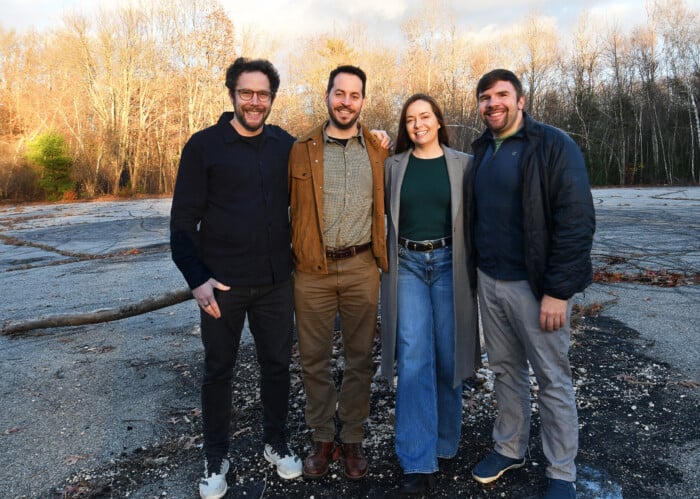
The Freedom Village Team, from left: Ben Sachs, Ryan Lambert, Rae Lambert and Jeremy Hitchcock gather on the property off of Hackett Hill Road in Manchester, where they propose to develop a tech-driven work-live-play community. (Photo by Jodie Andruskevich)
In locations as far flung as Texas, Honduras, Kazakhstan and Thailand, visionaries are laying the conceptual groundwork — and in some cases actual foundations — for self-governing hubs of tech creation.
Outside Austin, Texas, a development named Proto-Town houses several startups and trailers where people live. One blogger describes Proto-Town as “a commune of people building cool stuff.”
And in July, Kazakhstan signed a 5-year deal to locate a self-improvement, co-living, incubator community in that central Asian country.
They follow a vision spelled out in tech-entrepreneur Balaji Srinivasan’s “The Network State,” where digital communities crowd fund a location and lure in residents and startups. Some envision a society with their own laws, an economy run on crypto-currency and diplomatic recognition.
On its website, Freedom Village highlights Srinivasan’s philosophy. But the driving force behind Freedom Village — tech entrepreneur-turned-venture-capitalist Jeremy Hitchcock — said he’s happy with the U.S. dollar and New Hampshire laws.
“I don’t know how far we’re going to go down that road. Our own currency, our own laws? We’re not interested,” he said in an interview.
Over the summer, plans emerged for building Freedom Village on a 250-acre tract of largely undeveloped city-owned land at Hackett Hill in Manchester.
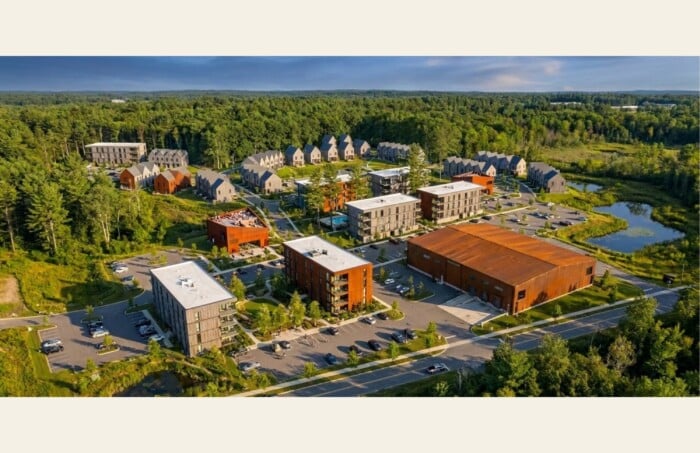
Plans show several alternatives, but its core would be anywhere from 120 to 240 living spaces spread out among apartment buildings, townhouses and stand-alone houses.
Alongside them could be flexible office space, a research lab, maker space, a gym, space for startups and a clubhouse.
Hitchcock said the project already fits in with the city “innovation village” concept spelled out in city zoning laws. The project could amount to $200 million in investment, which would likely be a mix of bank, private and equity financing. Unit rents and prices wouldn’t be too expensive — “obtainable,” in the words of Raechel Lambert, who is also a principal in the project.
They can keep prices obtainable because tech people don’t demand luxury features such as brass fixtures and granite countertops. Rather, they expect the basics: a comfortable bed, hot water, a giant desk and fast Internet speeds, Hitchcock said.
The development would be on heavily forested, hilltop land in the northwest corner of Manchester. The spot is just minutes from highways and downtown Manchester. Even closer: a Wal-Mart, Bass Pro Shop and Market Basket. The land is also adjacent to the Nature Conservancy’s Cedar Swamp Preserve, which includes nature trails, rare plants and a boardwalk that snakes through a cedar swamp.
“This is a pretty unique place for deep tech to experiment,” said Danny Weddle, co-founder and chief design officer for Terran Robotics, which is using 3D-printer technology to build homes at Proto-Town.
Hitchcock said Freedom Village is a throwback to the original neighborhoods in Manchester where tight, walkable communities centered on church, school, factory and neighborhood grocery.
But rather than coalesce on ethnicity or economic class, as those neighborhoods did, Freedom Village would focus on tech.
Other partners include Benjamin Sachs, an architect with Massachusetts-based Reframe Systems; Ryan Lambert, a data scientist now working on startups; Raechel Lambert, who works on startups and is marketing Freedom Village.
Last month, Freedom Village representatives appeared before a committee of Manchester aldermen to propose buying the city-owned land where Hitchcock and his team hope to locate Freedom Village.
The committee rejected a proposal to sell the land to Hitchcock and his partners. The city is expected to issue a request for proposals for the land, basically putting a For Sale sign on the property and see what offers come forward.
Yet, the notion of a self-contained community of creators doesn’t fit well with everyone in the tech world.

The proposed Freedom Village in Manchester would feature as many as 240 apartments, townhouses and stand-alone homes. (Courtesy)
Bill Larkins, 64, is a Manchester engineer who worked at DEKA before launching two companies and now working as a consultant.
A former chairman of the Manchester zoning board, he likes the idea of locating residences, work places and stores together, which is termed mixed use in the zoning world.
Otherwise, Larkins asks what problem Freedom Village is trying to solve. Opportunities to network already exist in a small city such as Manchester. Downtown offers entrepreneurs and designers exposure to a broad range of people poised to network, Larkins said. Restaurants and office space abound. And if the next step is manufacturing, industrial space is located near the airport.
“To have all the techies live in a techie community, do you really want 24-7 of that life? We have enough bubbles already,” Larkins said.
Some adherents see Freedom Village more a castle than a bubble.
Feelings of distrust and distaste are growing about tech, said Thomas Haffenreffer, a network engineer who lives in Cambridge, Mass., and is following Freedom Village with the hopes of moving there.
Witness backlashes to AI and data centers. Scorn grows toward Elon Musk over his political activities, an issue that dominated the midterms.
“I prefer to be around people who are optimistic,” said Haffenreffer, who subscribes to the Network State outlook. “This idea that groups that are Internet natives come to life in reality is what I find incredibly fascinating.”
Raechel Lambert lists the benefits of tech entrepreneurs living together: They can brainstorm a problem, celebrate an accomplishment and dissect a setback. A lot of context is already known, mutual experiences abound, conversations have somewhere to go.
“Think about watching a game,” she said. “Would you rather watch it in a room full of people who don’t care about sports, or with people who are just as invested as you are?”
And with social media and remote work what lives aren’t bubbles already? Hitchcock asks. Freedom Village would be more like a campus, where you bump into someone thinking what you’re thinking. “Those accidental interactions are what I really miss,” he said.
Lambert believes Freedom Village will draw New Englanders who moved to California for tech jobs but have grown disenchanted with life there.
How to keep it tech-exclusive could become a challenge.
Zoning codes, declarations and deed restrictions can generally control what takes place on a property. But if a developer tries to limit who can live on a property, he could run into Fair Housing and anti-discrimination laws, said John Cronin, a Manchester lawyer whose practice includes real estate.
While typical discrimination laws protect gender and racial, religious and ethnic minorities, courts have expanded protections to “suspect classes,” which include groups historically discriminated against, non-citizens and the politically powerless.
“That suspect class list grows every day,” Cronin said.
Economically, it can hurt, too.
“To exclude somebody, that’s generally never the goal of a developer. They want a bigger market so they can get better rates,” he said.
Lambert dismissed a reporter’s question of whether residents would have to take an IQ test: Attracting the residents they have in mind will happen organically.
She said creative means are available to keep Freedom Village tech focused: For example, condo-type fees to pay for the maker space, research lab and other amenities. That would limit appeal to Freedom Village outside the tech community.
Hitchcock said Freedom Village would welcome artists and anyone who really who wanted to could move in. But at its core, it would be creators and innovators.
“It’s getting a chance to choose your neighbors,” Hitchcock said. “I want to live near people I build stuff with and be continually inspired.”
Freedom Village – the tech-oriented work-live-play community envisioned in a remote corner of Manchester — would be one of several outposts for tech- and startup-minded people across the globe.
Former New Hampshire Supreme Court Justice Anna Barbara Hantz Marconi has resolved an ethics case against her, acknowledging conversations she had with a former governor and others during a criminal investigation into her husband had the appearance of impropriety.

To many people, prediction markets and sports gaming are a distinction without a difference. Which begs the question: Should New Hampshire be regulating prediction markets, especially as they apply to sports, the same way it regulates — and draws revenue from — sports betting via DraftKings?

An analysis of economic impact reports of the Portsmouth Naval Shipyard by the Seacoast Shipyard Association from calendar year 2020 to 2025 shows that payroll value increased by 15.3% — from $671.4 million to $774 million.

The two-day Space, Technology, Trade and Research expo on Oct. 28-29 in Durham convened innovators, producers, scientists, engineers, investors, bankers, students and representatives of the U.S. Space Force and Department of War. The goal: Increase networking, collaboration and awareness of what’s happening here, including on the campus of UNH, which provides tools, expertise and facilities for product development and testing.

The Hudson campus of BAE Systems was the setting for the signing of a multiyear agreement with the U.S. Department of War to increase production capacity of the company’s APKWS laser-guidance kits up to 35,000 units per year. The kits, which transform unguided 2.75-inch rockets into precision-guided munitions, are used by the Air Force, Army, Marine Corps and Navy, and are available to U.S. allies.

The exit of two Medicare Advantage carriers from the state will affect 14,200 current enrollees, while changes to other plans could mean a decline in overall enrollment in Advantage plans by 18,104 beneficiaries in 2027
A tech-entrepreneur turned venture capitalist is eyeing one of the largest undeveloped tracts in Manchester for a community where tech- and startup-minded people would live and work. Freedom Village would be located on 250 acres of mostly wooded land at Hackett Hill, which is located in the northwestern corner of Manchester.
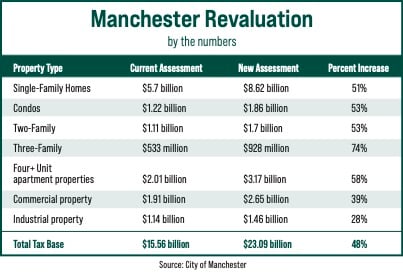
The value of all property in Manchester increased by almost half — 48% ‑ over the past five years, according to preliminary data released by city officials on Oct. 13 The valuations, compiled due to a citywide revaluation, add up to $23.09 billion. The current value of city properties is $15.56 billion, which was based on assessments made during the city's last revaluation.