New Hampshire’s life sciences industry is expanding quickly, but the workers employers need range far beyond biomedical scientists — from manufacturing technicians and engineers to project managers, supply-chain specialists and finance professionals.
At the Empower Life Sciences event hosted by NH Life Sciences (NHLS) at the University of New Hampshire Durham on Sept. 9, employers and educators argued the state may already have much of that talent. The problem is connecting people, programs and employers quickly enough.

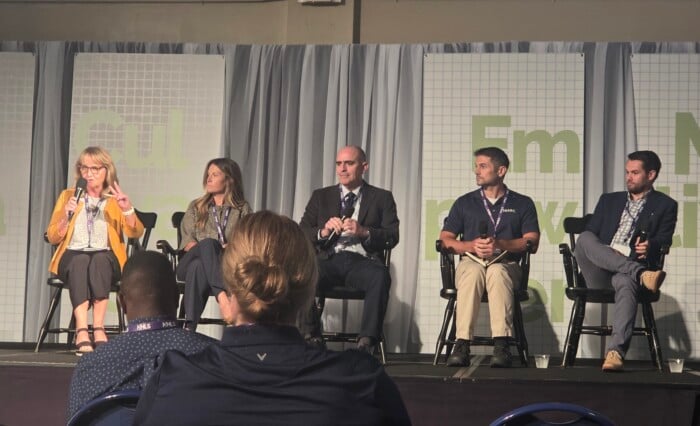
Moderator Cindy Conde, co-founder of NH Life Sciences, makes a comment during a “demand side” panel, which featured Theresa Edick of BA Sciences; Jean-Paul Ouellette of Lonza; Dan Harris of HiArc; and Conor Cullinane of Pirouette Pharma during Empower Life Sciences in Durham on Sept. 9. (Photo by Sarah Pearson)
“We don’t have a talent problem,” said Matt Simon, executive director of UNH’s Biotech Innovation Center and ReGen Valley Common Campus. “We have a talent alignment problem for the life sciences.”
Simon cited recent data from the New Hampshire Department of Employment Security that overall private-sector employment grew 4% from 2019 to 2025. During that same period, employment in the core life sciences sector grew 24%.
“Higher education wasn’t built to respond to that level of growth,” he said.
Simon was among the speakers on a “supply side” panel, along with UNH professors Sherine Elsawa, chair of the UNH College of Life Sciences and Agriculture; AI specialist Samuel Carton of the UNH College of Engineering and Physical Sciences; and Peter Lane of the UNH Paul School of Business and Economics.
The “demand side” panel featured industry representatives Theresa Edick of BA Sciences, Dan Harris of HiArc, Jean-Paul Ouellette of Lonza and Conor Cullinane of Pirouette Pharma.
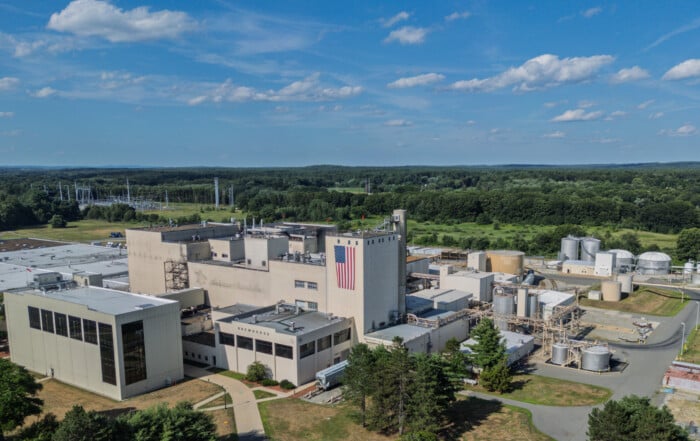
“Our needs are great and wide, I would say, which puts Lonza in a particularly interesting position because the site continues to grow,” Ouellette said. The Portsmouth location currently employs about 2,400. “We’ll be adding another 300 to 400 people by the end of 2027.”
Ouellette said the site’s workforce is roughly divided in thirds among manufacturing, quality and testing and support service functions.
Through its developing Pirouette Academy, new hires at Pirouette Pharma will rotate through different roles to understand the full product development process, Cullinane said.
Panelists also emphasized transferable skills such as adaptability, communication, problem-solving and critical thinking so that graduates have skills to adapt to changing technologies over their careers. Hands-on coursework, internships and other experiential learning give students opportunities to practice those skills.
“Too often, workforce development is interpreted as ‘We have these immediate openings. Can you help us fill them?’ To me, that’s too late,” Lane said. “We need to have these ongoing conversations. Yes, we’ll help you fill your short-term needs, but help us understand what your needs are going to be in three to five years. … Then you set up this feedback loop where we try to do a better job of anticipating.”
As an industry association, NHLS sees itself as a convener and connector.
“We told our members, ‘We want you to engage. We want you to start these conversations to build a relationship with the university,’ ” said NHLS President Andrea Hechavarria, in her opening remarks. “We have an extraordinary opportunity in front of us.”

Research and development activity is driving momentum in the New Hampshire life sciences industry, as this slide at Empower Life Sciences touts during the Sept. 9 meeting in Durham. (Photo by Sarah Pearson)
In conversation with Hechavarria, UNH President Elizabeth Chilton said UNH has identified health and life sciences as a strategic priority, and its federally supported biomedical research has tripled to more than $14 million in the last seven years.
More than 50 life sciences firms have recruited from UNH in the past five years, and the university is expanding partnerships in research, internships, commercialization and professional development.
UNH is also betting that physical proximity between companies, researchers and students can help strengthen those relationships.
Chilton highlighted a development project the university broke ground on this spring. UNH is developing The Edge, a 43-acre community of combined research space, housing and retail. The university envisions it as a better way to connect students with companies seeking talent. As construction continues, the university is planning additional research buildings designed around companies’ specific needs.
“The Edge can’t be built fast enough,” Hechavarria said. “I think it’s the secret sauce. It’s that live-work-play environment that everyone seeks and is hungry for.”