NHBR About Town: Week of October 9, 2026
Business and event happenings around the state of NH
A new report says an influx of new Granite Staters is coming primarily from neighboring Massachusetts, and most of them are younger, part of Gen Z, the cohort of people born roughly between 1997 and 2012.
But another report says the newbies, like already established residents here, face affordability challenges when it comes to housing and child care.
An analysis by StorageCafe of U.S. Census Bureau state-to-state migration data in 2024 shows Massachusetts sent 16,944 people to New Hampshire, outpacing other New England state — 10,977 to Rhode Island and 6,828 to Maine in 2024. StorageCafe is a nationwide online marketplace and search engine that helps users find and rent self-storage units.
Its June 9 report says the new Granite Staters skew young with Gen Z, making up 31% of the inflows, making it the leading cohort above millennials, Gen X, baby boomers, and the Silent Generation.
And they accept that affordability is relative. While there are certainly affordability challenges in New Hampshire, they believe it is less of a challenge than in Massachusetts, where the median priced single-family home is $668,000, compared to $580,000 in New Hampshire.
According to StorageCafe, New Hampshire converts 56.5% of newcomers into homeowners within year one. Maine converts 56%. Both rank among the highest first-year homeownership rates in the country. Rhode Island, more rent-first overall, still saw 41% of arrivals buy within the first year.
“These aren’t reluctant movers, they’re prepared buyers,” said Emilia Man, senior research analyst at StorageCafe. “Years of saving against Massachusetts prices means that when they land somewhere 25% to 44% cheaper, the math for buying works immediately. The first-year ownership rates in New Hampshire and Maine reflect that.”
The StorageCafe analysis notes that interstate migration nationally slowed sharply in 2024 to 2.1% of the U.S. population, compared to 2.3% in 2023 and 2.5% in 2022.
But, for the first time on record, Gen Z is America’s most mobile generation, accounting for nearly one in three interstate moves. In 2024, 2.2 million young adults moved to a different state overtaking millennials (born between 1981 and 1996) after years of millennial dominance and a near tie between the two generations in 2023, said the report.
According to the New Hampshire Fiscal Policy Institute (NHFPI), New Hampshire relies more on interstate movement to grow its population compared to most other states. The majority — about 60% — of the Granite State’s 1.42 million people are not native born.
About one-third (33.0%) were born elsewhere in New England, including about 25.4% who were born in Massachusetts. Approximately 19.7% were born in states outside of the New England region, while 6.8% of residents were born outside of the United States.
A May 27 brief written by Jessica Williams, a senior policy analyst at NHFPI, says New Hampshire has long relied on interstate movement to grow its population and support the workforce.
“Based on the recent data, younger working-age adults have led New Hampshire’s recent net population gains, which could help offset the state’s aging population and ongoing population decline due to more deaths than births within the state,” she said in her brief.
However, she added, “ongoing affordability challenges may hinder people’s ability to move to, and remain in, the Granite State. Housing constraints, child care access, and educational and workforce opportunities continue to influence interstate movement decisions, particularly among younger adults and families.”
Williams took a look at U.S. Internal Revenue Service (IRS) data on tax filers that move between states, counties, and other countries, along with other data from other sources, such as the University of New Hampshire survey center.
Here is some of what else she found:
What follows are recommendations from Williams to state policymakers:
Business and event happenings around the state of NH
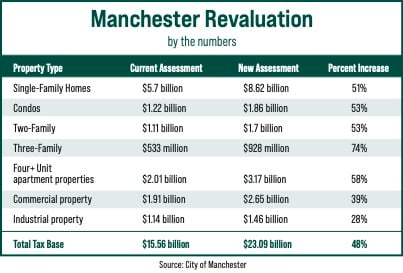
The value of all property in Manchester increased by almost half — 48% ‑ over the past five years, according to preliminary data released by city officials on Oct. 13 The valuations, compiled due to a citywide revaluation, add up to $23.09 billion. The current value of city properties is $15.56 billion, which was based on assessments made during the city's last revaluation.

The Latest is a roundup of the comings and goings of the movers and shakers in NH's business community

Anyone who has taken a transmission line or a wind farm through New Hampshire’s Site Evaluation Committee knows the process is long, expensive and can be fraught with complication.

Artificial intelligence has moved from pilot project to daily practice inside many HR departments.

When Richard “Dick” Levy’s wife, Susan, received a terminal diagnosis of a progressive brain disorder a decade ago, he became her primary caregiver. Doctors estimated Susan had between three and five years left to live.

Interest rates affect nearly every business decision — from expansion plans to asset acquisition to operational budgeting.

More than 20 years ago as a senior at Saint Anselm College, I found my way into a political advertising seminar held at the New Hampshire Institute of Politics.
New Hampshire is a remarkable place. We go first in the presidential primary. Our citizen legislature sends people to Concord who hold day jobs and show up anyway.