Concord CAP bus system gets unexpected funding boost
At one point in their budget deliberations, the Concord City Council seemed on the verge of deflating the funding it grants the free bus system in town.
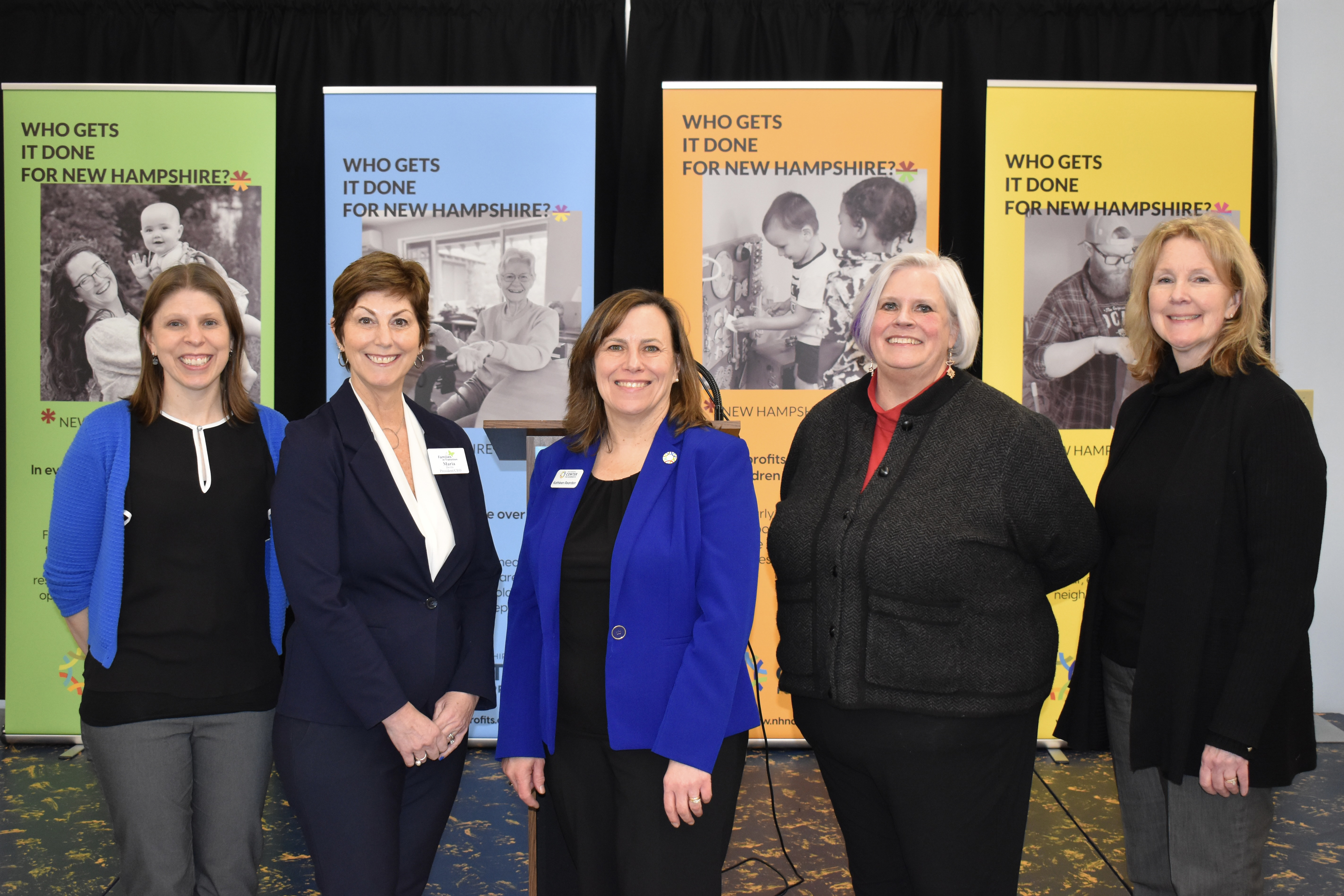
From left: Shana Hawrylchak, executive director, SEE Science Center; Maria Devlin, president/CEO of Families in Transition; Kathleen Reardon, CEO of the NH Center for Nonprofits; Betsy Burtis, chief operating officer of Amoskeag Health; and Brenda Guggisberg, executive director of the Upper Room. (Courtesy)
During a period of rising costs, heavy demand — and funding cuts — it’s a tough time to be a nonprofit in the Granite State.

The New Hampshire Center for Nonprofits is joining a nationwide campaign to promote the work of nonprofit organizations. The tax-exempt entities fill in many of the gaps that state and federal agencies do not provide, including housing, food pantries, health and social services, veterans’ needs, child care, education and support for the elderly.
Nonprofits Get It Done (NHNonprofits.org/GetItDone) comes as many state and federal funding sources have been eliminated, clawed back or come with new rules for eligibility, including the Trump Administration’s measures to ban diversity, equity and inclusion language from all federal programs and contracts.
During a Feb. 25 kickoff event at the SEE Science Center organized by the New Hampshire Center for Nonprofits, local leaders spoke about their individual missions and left the politics aside during their presentations. But the context for why the effort has been launched hardly needed to be spoken.
“National- and state-level policy decisions are being made that are threatening the work of nonprofit organizations,” said Kathleen Reardon, the center’s CEO, during an interview with NH Business Review after the formal presentation.
“We really need both the public and policymakers to really understand how much nonprofits contribute to our way of life,” she said. “They are the invisible backbones that make things work. They strengthen our communities. They foster economic growth. They step in in times of crisis.”
In New Hampshire, which does not have a sales or income tax to support programs that tax dollars might pay for in other states, nonprofits have a particularly important role.
“New Hampshire has a long tradition of government partnering effectively with nonprofits. I was just speaking with somebody just a moment ago who was at a statehouse hearing around an issue,” Reardon said. “And there were questions about working with nonprofits to get that done. Even our Legislature doesn’t fully understand how important that partnership is to families, to people, to children, to elderly.”
Brenda Guggisberg, executive director of the Upper Room, oversees a family resource center in Derry that works with children, youth and families.
“Our goal is to strengthen families so that their capacity is there so that children are thriving and ready for school,” Guggisberg said. “We are prevention based, so we’re really looking at preventing situations before they become a crisis, working across all of these domains. … This campaign for us really hits home the interconnectedness of all of the networks that we work, all of the nonprofits.”
Betsy Burtis, chief operating officer of Amoskeag Health, which operates four locations in Manchester, said her organization saw 14,700 patients come through its doors last year, including nearly 3,000 who did not have insurance. About 7,700 of the more than 47,000 patient visits were for behavioral health.
“We have a very diverse population. That’s part of the reason we do the work we do,” said Burtis, who added that she has worked in the nonprofit sector her entire career.
“It’s not just the taking care of some of these bruises or a stuffy nose, but eventually we have to have integrated services that help,” she said. “A lot of those are not reimbursed by insurance companies.”
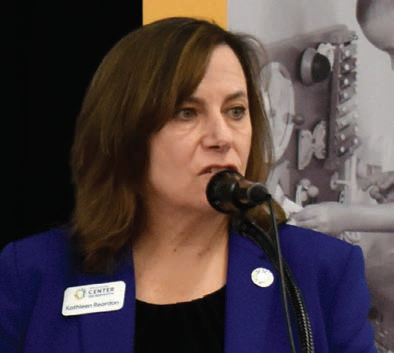
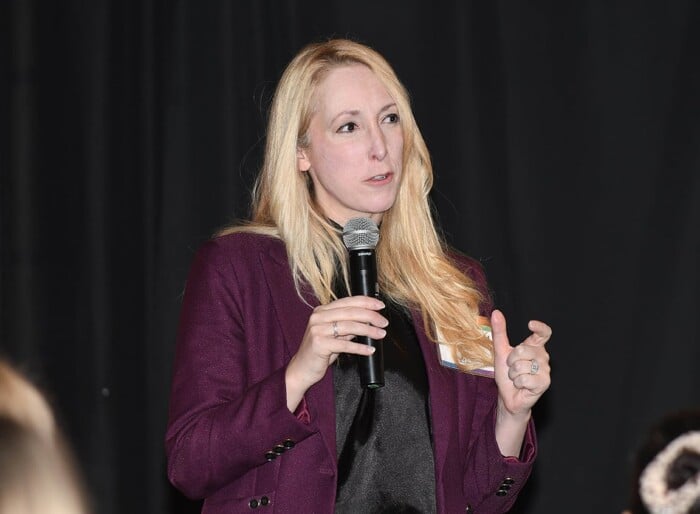
Kathleen Reardon, CEO of the New Hampshire Center for Nonprofits, kicked off the “Nonprofits Get it Done” campaign along with other local nonprofit leaders during a presentation Feb. 25 at the SEE Science Center in Manchester (Courtesy)
Shana Hawrylchak, executive director of the SEE Science Center in Manchester, said arts and cultural organizations have been hit particularly hard.
“But I truly feel like that is an essential service as well,” Hawrylchak said. “We always talk about how the Science Center’s mission to engage our community, the joyful act of exploration of science and innovation.”
The hands-on center in the Manchester Millyard hosts about 50,000 people a year, primarily school-age children and their families and teachers.
“Learning is a joyful act. It should be a joyful act. Part of the beauty of what makes us human is we have the ability to learn, dream and achieve.”
Maria Devlin, president and CEO of Families in Transition, heads a nonprofit that provides “a continuum of services from homelessness to housing.” The nonprofit works with about 15,000 people a year through its substance abuse services, food pantries, emergency shelters and housing programs.
“Our housing programs are really where we see our participants shine. We have many people who actually come into our shelters, either a family that is homeless or living in their car, go to our family shelter,” Devlin said. “They become stabilized as a family, as one unit, and then they move in with families in transition in one of our housing apartments, where they get case management services and they also receive services.”
She noted how Families in Transition works with other local nonprofits, including Amoskeag Health and the Mental Health Center of Greater Manchester to coordinate services.
“Our families remain stable in their housing because of the other supports around them,” she said.

At one point in their budget deliberations, the Concord City Council seemed on the verge of deflating the funding it grants the free bus system in town.

More than 100 “edgers” scheduled to participate Tuesday at the Brady Sullivan Plaza in Manchester, rappelling down the side of the 24-story office tower to raise money for local nonprofits.

The United Way of Greater Nashua aims to raise $175,000 this year through its biggest annual fundraiser June 22-23 at Brady Sullivan Plaza.

When a public charity is formed, the focus is often on the organization’s purpose, the application for 501(c)(3) tax-exempt status and board structure.

Stay Work Play NH, a nonprofit that works to attract and retain young people in New Hampshire, has joined with NH Business Review as a partner for Leadership Unscripted, serving as the event’s Emerging Leaders Sponsor. The June 4 event…
The Central and Northern New Hampshire nonprofit soon will be expanding to 11 centers statewide

Morrison Hospital Association, a nonprofit senior care provider in northern New Hampshire, filed for Chapter 11 bankruptcy protection April 10, citing mounting debt — including a nearly $23 million federal loan — and lingering financial effects from the COVID-19 pandemic.
The ReGen Valley Tech Hub is partnering with New Hampshire Housing and the Greater Manchester Chamber of Commerce to address the state’s housing shortage, convening a regional summit May 12 at the University of New Hampshire Manchester, organizers announced April 15.

Brookline resident Christopher Stock works as safety director for Eversource NH