Navigating New Hampshire’s new solid waste site evaluation committee
Anyone who has taken a transmission line or a wind farm through New Hampshire’s Site Evaluation Committee knows the process is long, expensive and can be fraught with complication.

Concord has a restriction when it comes to new dead-end streets: no more than 1,000 feet.
That limit is in place for resident safety, argues Deputy City Manager Matthew Walsh. If the city approves longer deadend roads, and developers build housing on those roads, residents could become trapped during severe weather events and the homes could be difficult for fire services to access, Walsh wrote in a letter to lawmakers this month.
“Specifically, there are very real and serious challenges with pumping water for more than 1,000 (feet); especially in rural areas that are not served by potable water,” he wrote to the House Housing Committee.
Across the state, municipalities big and small have similar road-length restrictions on new development. But some housing advocates say the limits are unnecessary for safety and harmful for much-needed development. And this year, they are moving to ban such restrictions.
Senate Bill 564, which passed the House Thursday, 195-147, would stop municipalities from preventing new housing on roads over a certain length, as long as that housing complies with the state fire code.
The bill is intended to ease another barrier to development amid the state’s housing crunch. Supporters say local road-length caps hinder development on what would otherwise be natural opportunities to build new housing.
But opponents countered that the bill could require towns to approve housing with limited access to emergency services. They said cities and towns should be allowed to impose their own limits beyond what the state fire code requires.
The bill comes a year after the Legislature passed a spate of laws to encourage housing by forcibly removing local zoning regulations, an effort that Gov. Kelly Ayotte has celebrated and that has engendered bipartisan support. It moves next to the Senate, which must approve minor changes added by the House and vote to send it to the governor’s office.
Beyond road length, the latest version of SB 564 stops municipalities from imposing a stricter cap on the number of housing units on a dead-end road than the cap in the state’s fire code.
It also requires cities and towns to allow septic systems, wells, electric facilities, drainage structures and other utilities along “designated perimeter buffer areas” of housing subdivisions.
If signed by the governor, the proposed law would take effect in July 2027.
The bill’s supporters called it a simple effort to standardize regulations and bring them in line with the fire code, and to prohibit arbitrary, town-specific denials of new development.
“This bill will remove barriers to the safe and reasonable development of new housing that we need,” said Rep. David Paige, a Conway Democrat.
Proponents stressed that the bill would not allow developers to skirt safety or environmental laws. In addition to the fire code, state statutes protecting wetlands, RSA 482-A, and shoreland, RSA 483-B, would still apply to any proposed new housing, the bill states.
The bill also states that municipalities could still enforce “generally applicable health, safety, environmental or building standards,” and impose “reasonable conditions” over developers in order to comply with the fire code.
But Rep. Jack Flanagan, a Mason Republican, took issue with that phrasing, calling it vague. “Reasonable to me may not be reasonable to somebody else,” he said. “So, what are we doing now, opening up our towns that we serve for lawsuits?”
Flanagan argued the new law could expose cities and towns to new legal risk. He gave a hypothetical example of a house that was too far away for firefighters to connect their hose to a water source. If that house caught fire, responding firefighters would need to rely on the water in the firetrucks’ tanks. Should that water be insufficient, and the house burns down, “whose fault is it?” Flanagan asked.
“There’s a liability issue here the bill doesn’t recognize,” he said.
Flanagan also argued the lack of water access could require the construction of cisterns — water storage tanks — near hard-to-reach properties, which could become expensive.
Rep. David Fracht, an Enfield Democrat, took issue with the requirement for municipalities to allow utilities in perimeter buffer areas provided they did not violate existing environmental laws. An earlier version of the bill had included “open spaces” in that requirement, but the House removed that provision after pushback from the NH Planners Association.
Still, Fracht said the perimeter buffer requirement was a violation of local control and could have negative effects on wildlife, green spaces and visual landscapes.
This story was originally produced by the New Hampshire Bulletin, an independent local newsroom that allows NH Business Review and other outlets to republish its reporting.

Anyone who has taken a transmission line or a wind farm through New Hampshire’s Site Evaluation Committee knows the process is long, expensive and can be fraught with complication.
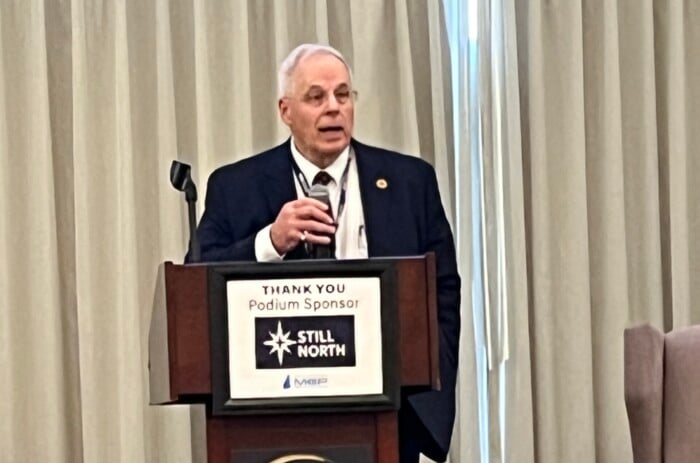
This year’s Advanced Manufacturing and High Technology Summit kicked off with a topic universal to all employers: how to build the workforce of tomorrow. The 24th annual event organized by the New Hampshire Manufacturing Extension Partnership on Oct. 9 featured a keynote panel discussion featuring representatives from the state’s university and community college systems.

Agritourism has become an important business option for many farms in New Hampshire and across the country. Exactly what is agritourism?

On a recent Friday at the Easterseals NH Military & Veterans Campus in Franklin, I found myself about 30 feet in the air. I was holding onto a pole and contemplating what suddenly seemed like a rather narrow log stretching out over a great deal of empty space toward another pole, which also seemed remarkably distant.

In recent years, New Hampshire families have faced persistent and growing challenges with affordability and accessibility as they navigate the early care and education landscape.

Published annually, “The Best Lawyers in America®” is an exhaustive search for the country’s top attorneys. Here is a compilation of the top attorneys who practice in New Hampshire in dozens of legal specialties related to the needs of businesses,…

Ramy Rahimi is the new vice president for research and development at the University of New Hampshire.

This year, NH Business Review marks the 24th anniversary of our Business Excellence Awards, which celebrate the initiative, creativity and tenacity of the Granite State’s business community.

Back in 1992, political strategist James Carvell came up with the phrase, “It’s the economy, stupid,” to help Democrat Bill Clinton defeat incumbent Republican President George H.W. Bush.