Navigating NH’s new solid waste site eval. committee
Anyone who has taken a transmission line or a wind farm through New Hampshire’s Site Evaluation Committee knows the process is long, expensive and can be fraught with complication.
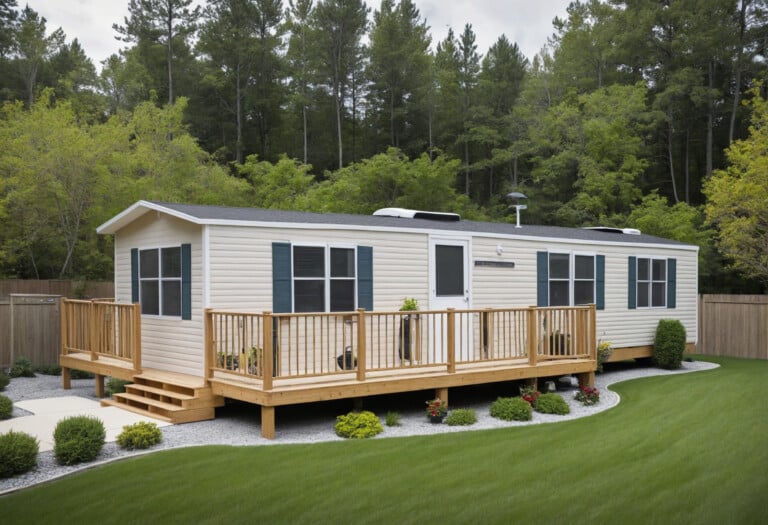
The New Hampshire Community Loan Fund is working to change some of the language biases associated with manufactured home communities, known colloquially but inaccurately — in the loan fund’s view — as trailer parks or mobile home parks.
During a presentation on manufactured homes communities on May 8, Community Loan Fund personnel noted that the words “mobile homes” and “trailer parks” no longer apply to the types of residences built today.
Unlike site-built, single-family homes constructed on a lot of land typically owned by the homeowner, manufactured single-family homes are typically built off-site. They are then towed to a site, and once there, the wheels and axles are removed and they’re placed on a permanent foundation.
They are meant to be permanent homes, according to Sarah Marchant, the Community Loan Fund’s chief operating officer, built to the same building and energy efficiency codes as site-built homes. They are not the trailer homes of the post World War II era, she noted.
“These homes are built with the same materials as site-built homes. They are wealth-building assets, and in a recent study looking back five years, manufactured homes appreciated at 62%, while site-built homes appreciated at 37% right here in New Hampshire over the same time frame,” said Marchant. “These are assets. They are real estate assets, and they are wealth-building opportunities for low- and moderate-income households.”
Most often manufactured homes are sited in a community of similarly constructed residences. The Community Loan Fund doesn’t use the word “park.”
A park denotes transience, according to Abby Bronson, director of policy and advocacy at the Community Loan Fund.
“When you hear the word ‘park,’ do you think about your neighborhood or your neighbors? I don’t. I don’t think of anything permanent. I don’t think about the people who live and work and vote in our communities,” said Bronson. “So I’d encourage you to use the term ‘community’ to give them that place where they already exist in our state.”
The big difference — and thus the challenge for manufactured home community residents — is that while they own their structure, they don’t own the land on which it sits. That site is leased by the manufactured home community owner.
Thus the issue with who, or what, owns and operates these communities of manufactured homes, and what protections its residents should have to keep their rents affordable and keep them in their homes.
“We’ve been working at the State House to change that and to make sure that manufactured homes are treated the same as site-built homes, because there’s no reason, especially as our state is dealing with this affordable housing crisis, that they should be treated any differently just because of the way that they were constructed,” said Bronson.
“It starts with changing the words that are not only outdated and inaccurate, but do not portray the experience of homeowners that we know and see every day. So when I hear words like ‘mobile home’ or ‘trailer,’ I’d encourage you to switch that out with ‘manufactured home,’ because not only have mobile homes and trailers been retired by the Department of Housing and Urban Development, those terms legally aren’t used anymore. They aren’t accurate,” she noted to the audience at the Community Loan Fund webinar.
“They also fail to account for the deep investment that people have in these homes,” she added. “They fail to account for the quality of the homes and that, at the end of the day, these are the places that so many Granite Staters call home.”
Realtor.com, a site licensed by the National Association of Realtors, offered its insights on the manufactured home/mobile market market in a March analysis.
It, too, discussed the terminology, noting, “By HUD definition, mobile homes are only those built before June 15, 1976, and everything since then is a ‘manufactured home.’” At the same time, however, the report noted that even a manufactured home, if it was towed to a site on a chassis, would still be referred to as a ‘mobile home’ regardless of when it was constructed.
Nationally, according to the Realtor.com report, the market is softer for off-site built homes than it is for site-built homes. It noted that the median listing price for mobile homes in the United States is $141,450, down 5.7% year over year. It added that mobile home prices soared during the post-pandemic buying frenzy, growing faster than the market as a whole. As the market has slowed, though, mobile home prices are falling faster.
The New Hampshire Association of Realtors (NHAR), which tracks monthly sales data for mobile homes, as well as single-families and condominiums, shows a similar trend to the national data.
Its data shows that the median price of a mobile home peaked in April. 2025 at $180,000, then declined $131,750 in January 2026. Since then, it has been up and down — to $169,500 in February, $147,000 in March, and $170,750 in the latest report in April.
The difference between April 2025’s $180,000 and April 2026’s $170,750 is 5.27%.

Anyone who has taken a transmission line or a wind farm through New Hampshire’s Site Evaluation Committee knows the process is long, expensive and can be fraught with complication.
This year’s Advanced Manufacturing and High Technology Summit kicked off with a topic universal to all employers: how to build the workforce of tomorrow. The 24th annual event organized by the New Hampshire Manufacturing Extension Partnership on Oct. 9 featured a keynote panel discussion featuring representatives from the state’s university and community college systems.

Agritourism has become an important business option for many farms in New Hampshire and across the country. Exactly what is agritourism?

On a recent Friday at the Easterseals NH Military & Veterans Campus in Franklin, I found myself about 30 feet in the air. I was holding onto a pole and contemplating what suddenly seemed like a rather narrow log stretching out over a great deal of empty space toward another pole, which also seemed remarkably distant.
In recent years, New Hampshire families have faced persistent and growing challenges with affordability and accessibility as they navigate the early care and education landscape.

Published annually, “The Best Lawyers in America®” is an exhaustive search for the country’s top attorneys. Here is a compilation of the top attorneys who practice in New Hampshire in dozens of legal specialties related to the needs of businesses,…

Ramy Rahimi is the new vice president for research and development at the University of New Hampshire.

This year, NH Business Review marks the 24th anniversary of our Business Excellence Awards, which celebrate the initiative, creativity and tenacity of the Granite State’s business community.

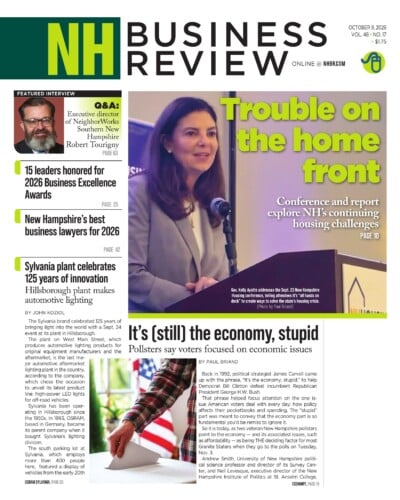
Back in 1992, political strategist James Carvell came up with the phrase, “It’s the economy, stupid,” to help Democrat Bill Clinton defeat incumbent Republican President George H.W. Bush.