Turn of the leaf
Supporters of fewer restrictions on cannabis in NH see glimpse of a possible future

Bedford resident Stephen Dunker poses at OG Cannabis, his recreational cannabis dispensary in Elliot, Maine. Dunker owns two recreational and one therapeutic cannabis dispensaries in Maine. He hopes that lawmakers will eventually approve the sale of recreational cannabis in NH, ideally under state control.
While acknowledging expansion of New Hampshire’s therapeutic-cannabis laws might not succeed in 2026 and that legalization of adult-use, recreational cannabis is still a long time coming, supporters of the measures are cautiously optimistic that they will ultimately succeed, thanks in part to both President Donald Trump and the U.S. Supreme Court.
Last December, Trump ordered that cannabis be reclassified under the Controlled Substances Act from a Schedule I drug, which is seen as having no accepted medical use and is prone to abuse, to a Schedule III drug.
The move was a nod that 40 states, including New Hampshire, have approved therapeutic cannabis and that it may indeed have medical value. In June, the Supreme Court ruled that cannabis use alone was not a prohibition to gun ownership.
The high court’s action removes what had been the main barrier to more people enrolling in the NH Department of Health and Human Services’ Therapeutic Cannabis Program, says Matt Simon, the director of public and government relations for GraniteLeaf Cannabis. The company operates therapeutic cannabis dispensaries in Chichester and Merrimack that are supplied by a growing and manufacturing facility in Peterborough.
Under the program, any New Hampshire resident of any age with a qualifying medical or mental health condition whose condition is certified by a doctor, may file an application with the DHHS (the filing fee is $50) to be in the program and obtain a registry ID that allows him or her for one year to buy therapeutic cannabis at any of the seven therapeutic cannabis dispensaries in the Granite State.
The dispensaries are also permitted to sell to persons with medical cannabis cards from other states and also from Canada.
What soon became apparent, however, is that the prices initially being charged at New Hampshire dispensaries for cannabis flower — in the $50-plus range for 3.5 grams, which is an eighth of an ounce — was significantly higher than what was being charged in Massachusetts and Maine. That resulted in NH residents eschewing dispensaries here in favor of dispensaries in neighboring states.
Prices at New Hampshire dispensaries have since come down, said Simon, and an eighth of flower now sells for about $30.
The problem, though, is that prices in Massachusetts in particular have plummeted because regulators in that state have licensed so many growers to supply both the recreational and therapeutic cannabis markets.
In comparison, there are only three growers in New Hampshire that supply the state’s therapeutic dispensaries.
Growing cannabis flower and making all the other products that flow from it, such as edibles, tinctures and vapes, for example, is not cheap, said Simon, which is why New Hampshire therapeutic dispensaries were heartened earlier this year when both the NH House and Senate adopted Senate Bill 468.
The bill would have allowed the dispensaries to grow cannabis flower on-site, something that Simon said could reduce the costs of production for the dispensaries by as much as 50%.
Gov. Kelly Ayotte vetoed SB 468, saying only that she did not support the expansion of cannabis cultivation. She is a longtime opponent of both therapeutic cannabis and recreational cannabis.

Riley Kirk, PhD, a pharmacologist and the author of “Reefer Wellness,” poses for a photo in the garden of her home in the North Country. (Photo by John Koziol)
Smart Approaches to Marijuana New Hampshire, a branch of a national coalition that says the “health, safety and economic harms of recreational marijuana legalization far outweigh the perceived social benefits,” contends the move to legalize marijuana is really more a move to commercialize it for profit, comparing it to Big Tobacco.
“We are moving way too fast to legalize in this country without taking into account the costs of such a policy. We need to slow down,” the nonpartisan group says on its website (learnaboutsam.org). “The only people who benefit from a rush to legalize are a small number of investors.”
Later this year, on a yet to be determined date, the Legislature will hold a Veto Day during which lawmakers in both chambers will be asked whether any of the bills vetoed by Ayotte, including SB 468, should become law.
A separate, would-be end run around the governor that failed in the House during the 2026 session might come back in 2027, said state Rep. Jonah Orion Wheeler, D-Peterborough.
Wheeler believes that New Hampshire residents who are at least 21 years old have a constitutional right to possess up to two ounces of cannabis. Had Wheeler’s motion passed in the NH House and Senate, it would have been placed directly on the Nov. 3 ballot for voters to have the ultimate say. If it passed, the amendment would have gone into effect without any action by Ayotte.
Another possibility, said Stephen Dunker, is that the Legislature will closely study what has worked in the five New England states that have allowed the sale of cannabis for recreational use, and more importantly what hasn’t. New Hampshire is the only New England state that hasn’t legalized recreational marijuana.
The Derry native, who lives with his family in Bedford, owns two adult-use and one therapeutic cannabis dispensaries in Maine. In what he acknowledges is not a popular position among fellow pro-recreational use advocates, he would like to see the state sell recreational cannabis as it does with liquor.
He thinks Maine issued too many licenses to companies to operate recreational-use dispensaries, some 100 by his count, in a state that, according to the 2020 Census, had only 1.4 million residents in total.
That proliferation of so many licenses has resulted in the closure of some recreational-use dispensaries in Maine, but has also served to make Maine a popular place for New Hampshire consumers to shop, both for therapeutic and recreational cannabis, said Dunker, who estimates Granite Staters represent about 30% of his customer base.
Rep. Wheeler thinks his colleagues in the Legislature are eyeing a model under which the state directly sells recreational cannabis or licenses the sale of it to third parties. The Legislature might also be waiting for further easing of cannabis regulations by the federal government, he said.
Wheeler said New Hampshire’s delay in approving recreational cannabis has “kneecapped” the state in terms of receiving taxes from the sale of it, an amount that could be in the tens of millions annually.
He said a recent, unsuccessful bill to allow recreational-use cannabis sales in New Hampshire would have generated $12 million in taxes in its first year and up to $44 million in the fourth.
Simon put the amount of tax revenues at between $40 million and $70 million per year.
Dunker thinks that, “if done right,” recreational use could bring an economic “boom” to New Hampshire, but he cautions that there is no guaranteed windfall for sellers. Before his dispensaries even opened their doors, his company was in the hole for $3 million in startup costs, he said.
Maine has a 15% sales tax on recreational cannabis, said Dunker, and he thinks New Hampshire could enact a sales tax that is competitive with that charged by neighboring states, thus making New Hampshire recreational-use dispensaries attractive to both locals and people from away.
Dunker is working hard to dispel the perceptions about cannabis users.
“Our customers are moms, dads, doctors, lawyers, teachers, judges and former law enforcement,” he said. “We provide a form of relief, which can come with maybe the best night of sleep you ever had, maybe with a little less alcohol, maybe a little more pain mitigation or maybe it’ll put a smile on your face, which is priceless.”
He supports Maine’s testing of cannabis to protect consumers, and champions its reasonable use.
Overall, Dunker hopes to one day do in his home state what he is legally able to do now in Maine: sell recreational and therapeutic cannabis to adults who want it.
“I think New Hampshire sits in a very advantageous spot by being patient and being conservative on this issue,” he said.
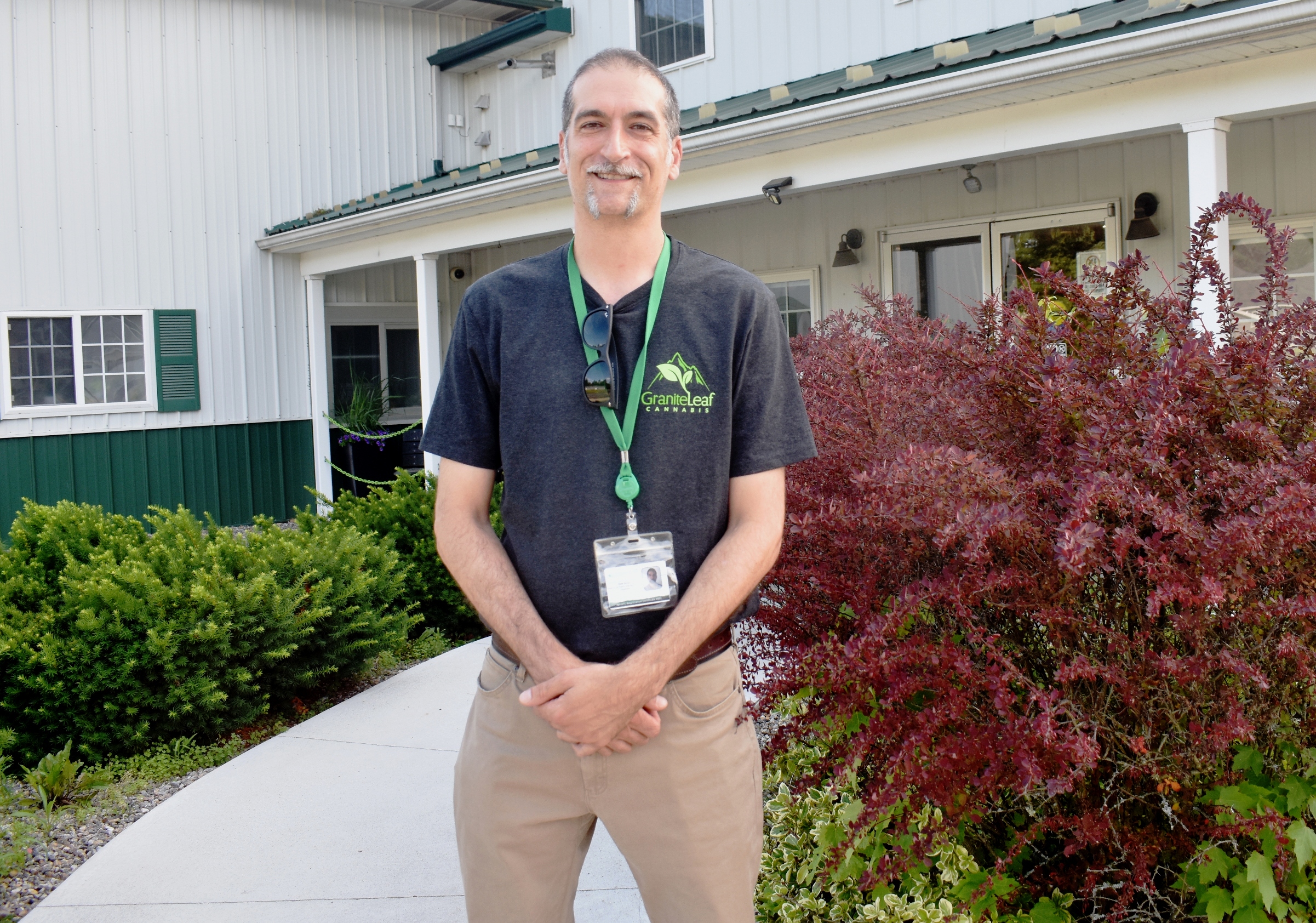
Matt Simon, the director of public and government relations for GraniteLeaf Cannabis, poses outside the company’s therapeutic cannabis dispensary in Chichester.
Dunker wants taxes from the sale of recreational cannabis in New Hampshire to be used to fund education, emergency services and infrastructure improvements.
Simon pointed out that the “let’s learn from other states” and also the “let the state do it” models of recreational-use cannabis have been tried, and failed, here.
He likes the Vermont model, which, he says, promotes mom-and-pop, small to medium-sized resellers, but explicitly excludes huge, corporate ones.
For Simon, the question of cannabis sales in New Hampshire is about the idea of personal freedom, which he notes is what the state motto espouses.
While he is under no misapprehension that Ayotte will reverse her opposition to therapeutic and recreational cannabis, Simon notes that Chris Sununu, Ayotte’s successor, moved the needle forward on both counts.
First, Sununu decriminalized the possession of up to three-quarters of an ounce of cannabis, but that cannabis is not being purchased in New Hampshire, said Simon. Second, Sununu expanded the conditions under which residents can participate in the NH Therapeutic Cannabis Program to include those who suffer from “moderate to severe chronic pain.”
That one category, he said, represents about half of the 18,000 people in the DHHS therapeutic-cannabis registry. Combined with the hoped-for increase in registrants because of the Supreme Court’s ruling on cannabis and the Second Amendment, Simon is hopeful that better days may be ahead for New Hampshire’s therapeutic-cannabis dispensaries.
He said those dispensaries in other states have largely remained in business even when recreational cannabis became legal.
That said, for therapeutic cannabis dispensaries, “It’s been a tremendous struggle” to become successful, said Simon, which is not the same as being profitable.
Startup costs were “enormous,” he recalled, and testing of the flower is also a major financial burden for them, which is why the dispensaries and the three companies that operate them — each company has one dedicated growing and manufacturing facility in the state — support SB 468.
Riley Kirk is certain, that in the long run, New Hampshire will be selling recreational cannabis to residents and visitors alike.
Hailing from the North Country, Kirk has a doctorate in pharmacology and has studied and written about cannabis extensively. She is the author of “Reefer Wellness,” which is her attempt to counteract what she and many advocates say are misconceptions about cannabis.
Foremost, cannabis “is a medicine,” she said, and, “It is extremely safe. No one in the world has died from cannabis alone.” She concedes, however, that cannabis used in conjunction with alcohol is not safe.
The federal Centers for Disease Control and Prevention says there are “health risks associated with using cannabis regardless of how it is used.”
“People who use cannabis can struggle with physical dependency and controlling their use. This is concerning, as there is evidence suggesting the use of highly concentrated THC products is associated with more severe cannabis-use disorder symptoms,” the agency says on its Cannabis and Public Health page.
Those symptoms are elevated in younger users, as other studies have noted.
“The risk of developing cannabis-use disorder is stronger in people who start using cannabis during youth or adolescence and who use cannabis more frequently,” the CDC said.
Like all medicines, Kirk acknowledged that cannabis “is not going to be good for 100% of people” who use it. “But for the vast majority of people it is safe,” she said.
SB 468 would have allowed dispensaries to grow cannabis flowers on-site, something that could reduce the costs of production by as much as 50%.