Statewide access to highspeed internet has arrived
Last month, an update of the state’s broadband dashboard shows we have reached 99% access, with less than 5,000 addresses in New Hampshire unserved.

Taylor Caswell
Without affordable housing, young people cannot afford to be here. Nowhere in the state is the need to attract younger populations more of an economic priority than in rural communities.
Despite this, the methods and tools used to address it are different and arguably insufficient in rural communities.
Traditional tools used to develop and finance housing are not well designed for rural communities. Most programs are federal and come with regulatory requirements.
They are deployed statewide and are highly competitive, which means they usually gravitate toward more populated areas of the state. And as for debt, lenders are all subject to the same rules regardless if they are financing a big project in an urban city or a small one in a rural region.
The number of units that have to be built to justify the investments of land and financing make building in rural communities far less attractive. For example, if a developer acquires 20 acres somewhere around Manchester and seeks to build housing, they will need to put a couple of hundred units there to justify the cost of acquiring that much property.
With the numbers we see related to the need for housing, that could make sense given the scale of the need. But in a rural community, all the tools that a developer might use — federal tax credits, large bank loans and guarantees, equity investors, federal or state grants, etc. — aren’t as applicable to building 10 or 15 units in a small town, which would achieve comparable scale to the Manchester development.
Developers are understandably reactive to financing available for big projects and generally don’t ever think about building in a rural community. There is little or no profit to building smaller scale in disparate locations.
In small towns, we often depend on local builders who often have their heart in the right place but can be overwhelmed by the time and cost involved in making a deal work.
Lastly, we have to talk about regulatory challenges. New Hampshire’s rural communities represent our history and legacy as a state. Protecting their character, natural resources and inherent quality of life advantages are a high priority. Their very existence is a major part of New Hampshire’s appeal.
Without upgrading, or in many instances installing, newer more modern infrastructure like water, sewer and power, so much of this will remain out of reach.
We need to take a longer view. I like to use the analogy of Farmer Brown’s field, just on the edge of town. Gorgeous property, local food is grown there, locals hike their dogs on nearby trails. Farmer Brown is getting old and his kids all live in Boston, so he sells to a big housing developer from out of town. You know what happens next: contentious planning board meetings, arguments over traffic and crime, the loss of rural character (which is true!).
The mistake isn’t that we resist bad development; it’s that we wait until we’re forced to choose between bad development and no development at all.
Alternatively, let’s consider that if Farmer Brown’s town had participated in programs like NH Housing’s Housing Opportunities Program or worked with their local planning commission, they would have already known that putting housing on Farmer Brown’s field was not something they wanted to do.
That developer would have chosen a different part of town … a place where there was infrastructure in place or planned that could accommodate new units and welcome new residents to town so they could bring new vitality and probably longer-term support and solutions for Farmer Brown and his field.
This is the trap rural communities who see the benefits of creating more housing are in. The tools that could have supported a smaller, more deliberate outcome — the ones built for 200-unit projects outside Manchester — were never built for 15 units in a town like Lancaster. The choice isn’t really a choice. It’s Farmer Brown’s field, on someone else’s terms, or nothing.
That’s the part of this conversation we keep skipping. We debate character, traffic and control as if rural towns have the same menu of options that denser communities do. Until the financing tools, the regulatory thresholds, and the state and federal programs are built to work at rural scale, towns like Lancaster will keep facing the same version of Farmer Brown’s field, over and over, with less say in how it turns out.
The housing challenge in rural New Hampshire is an options problem. A few years ago, we introduced the InvestNH and Housing Champions programs to provide some. Those programs are still around, but without much understanding or application. As a result, rural communities that want to pursue housing are stuck doing it with one hand tied behind their backs.
Taylor Caswell has led economic policy agencies on the state and federal level for decades, most recently serving as New Hampshire’s commissioner of business and economic affairs. You can reach him at linkedin.com/in/taylorcaswell.

Last month, an update of the state’s broadband dashboard shows we have reached 99% access, with less than 5,000 addresses in New Hampshire unserved.
Without affordable housing, young people cannot afford to be here. Nowhere in the state is the need to attract younger populations more of an economic priority than in rural communities.
Next month, the United States, Canada and Mexico begin the formal joint review of the USMCA trade agreement. Under the original agreement, a review is required, and while there is no likely outcome that…
Proposals gaining traction in Concord would weaken local government
New Hampshire has long acknowledged outdoor recreation as an asset. We speak of it in terms of quality of life, tourism appeal and regional character. That framing, while not inaccurate, is no longer sufficient.

Cambridge Trust President Susan Martore-Baker discusses the nuances of philanthropic giving ahead of the holiday season
Author, leadership coach and veteran of 27 years in the Army, Robert Campbell speaks on his 'Battlefield to Boardroom' book series and how companies can become veteran-ready
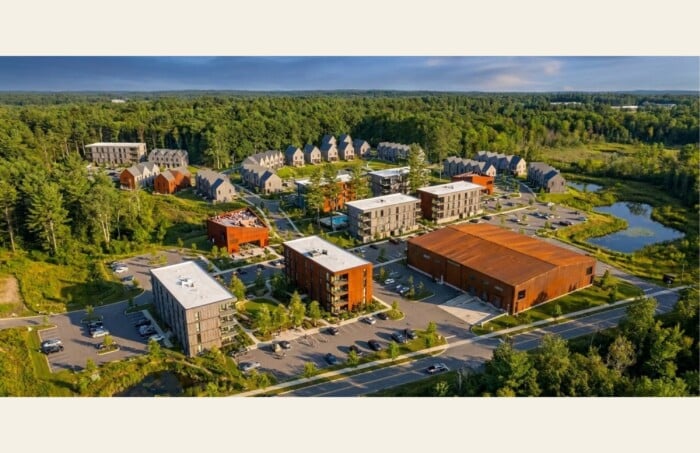
A tech-entrepreneur turned venture capitalist is eyeing one of the largest undeveloped tracts in Manchester for a community where tech- and startup-minded people would live and work. Freedom Village would be located on 250 acres of mostly wooded land at Hackett Hill, which is located in the northwestern corner of Manchester.
Business and event happenings around the state of NH