Are prediction markets revenue ripe for picking in NH?
Head of NH Lottery and Gaming Commission says state revenue from sports gambling 'is enough'
To many people, prediction markets and sports gaming are a distinction without a difference.
Which begs the question: Should New Hampshire be regulating prediction markets, especially as they apply to sports, the same way it regulates — and draws revenue from — sports betting via DraftKings?
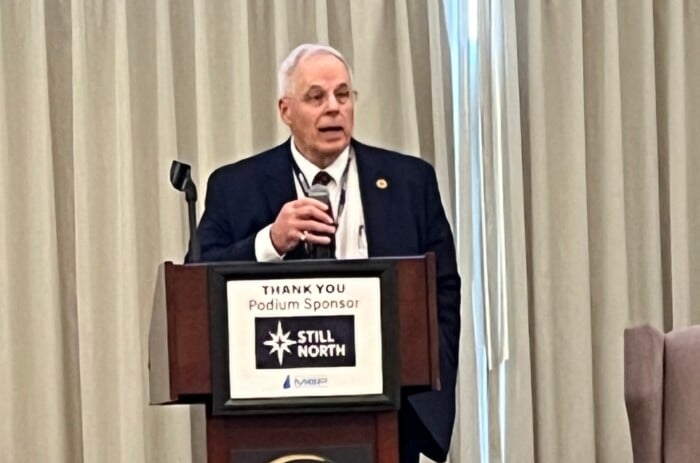
The person who heads up sports betting oversight in the Granite State says no. The deal the state has with DraftKings and the revenue it draws from sports betting through its portal is enough, according to Charlie McIntyre, executive director of the New Hampshire Lottery and Gaming Commission.
“We have an exclusive contract with DraftKings in this state. We don’t really regulate DraftKings. They’re our partner and they’re a vendor. They’re under contract with us, which is why we get such a lucrative deal,” McIntyre said. “We have one of the most lucrative contracts in the nation, and I don’t want to upset that apple cart.”
So, what is it about prediction markets that distinguish it from gambling, sports betting in particular?
“With sports betting, the house sets the odds,” said Michael McCann, director of the Sports and Entertainment Law Institute (SELI) at the University of New Hampshire Franklin Pierce School of Law.
“So DraftKings, or you go to Las Vegas, the house is setting the odds based on its own data, its own assessment,” he added. “With prediction markets, the house doesn’t set the odds. It’s based on the market. It’s based on who’s buying what. What’s going to happen with this event?”
A New England Patriots football game is an example.
Say, for example, that the odds makers have the Pats as a 3.5-point favorite to win Sunday. Someone betting on the game through DraftKings can win their wager only if the Pats win by 4 points or more (covering the spread). Or they can bet on the opposing team, wagering they’ll cover the spread (be within 2 points of winning, say) or win outright.
With prediction markets, it’s a binary speculation — yes, the Pats will win; no, the Pats will lose.
Both the DraftKings and prediction market platforms have what are considered “novelty” wagers, such as betting or trading on the color of the Gatorade that will be poured on the winning Super Bowl coach.
The prediction market players
There are two primary platforms in prediction markets — Polymarket and Kalshi. And they parlay in much more than sports.
There’s betting on pop culture — whether a certain artist (Post Malone, for example) will drop a new album by a certain date.
And, of course, there is political speculation. This particular election cycle has seen lots of activity nationally and locally in prediction markets. For instance, the Monday before the mid-term election Nov. 3, Kalshi had incumbent Republican Kelly Ayotte a 92.8% favorite over Democrat Cinde Warmington in the governor’s race.
Indeed, Ayotte got the benefit of the doubt in a blue wave (tsunami? Bluenami?) of Democratic wins that swept over the congressional delegation, N.H. House, N.H. Senate, and the Executive Council.
Kalshi reported that about $1 million traded on the Ayotte-Warmington contest. The big winner in the prediction market trading was the U.S. Senate race between Democrat Chris Pappas and Republican John E. Sununu (which Pappas won going away).
That race generated about $4.6 million in trade volume on its platform, according to Kalshi, while $1.1 million traded on Polymarket.
The prediction market purveyors argue their platforms are less like betting and more like trading. They say each outcome is treated like a share: If you believe something will happen, you buy in. If the crowd agrees with you, the prices rise. If sentiment shifts, it falls.
This creates a constantly moving market where information matters, according to prediction market advocates. News cycles, political developments, sports results and even social media trends can influence pricing within minutes.
But up to 90% of the prediction market trading is devoted to sports. Beyond the binary bets on whether a team wins or loses, there are live action bets — whether a certain influencer will be spotted on pit row during the broadcast of a motor racing event, for example.
New Hampshire’s sportsbook
Sports betting in New Hampshire became legal in 2020, and the state has an exclusive contract with DraftKings to operate both an online platform and all the retail sports betting at casinos throughout the state.
It’s been a good deal for the state, which claims 51% of the “take” — the gross gaming revenue after winnings are paid — from online sports betting, 50% from the sportsbooks at the casinos. How good? On average, according to the Lottery Commission, it collects between $2.7 million and $3.25 million per month in state tax revenue from sports betting. All that state-derived sports betting revenue is then directed into the Education Trust Fund (ETF). The ETF, in turn, finances public K-12 education and related state-level school funding programs.
The Lottery Commission reported in October that sports wagering in Fiscal Year 2026 surpassed $927 million, with players wagering more than $854 million through the DraftKings online sportsbook and nearly $72 million at New Hampshire’s retail sportsbooks. That delivered more than $43 million in revenue to public education in Fiscal Year 2026, and since its launch in December 2019, sports betting has generated more than $200 million in public education revenue.
At the start of the football season, the Lottery said it expects bettors will exceed last year’s record of more than $200 million in total wagering on the NFL and NCAA football games. Last year, New Hampshire players wagered more than $145 million on the NFL and more than $55 million on NCAA football, both record highs.
Even if he wanted to, McIntyre is not sure how the state would seek to draw a similar kind of revenue stream from prediction markets, which are not exclusive to sports.
“It’s a hard thing to do. You would obviously try and bifurcate them, but I don’t know that it’d be possible. I wouldn’t want to try candidly,” McIntyre said. “I know some states are trying. States are always looking for revenue, and right now I don’t think they’re paying anybody anything.”
State or federal regulation
The big question is whether states can regulate prediction markets at all.
McCann said their legal basis rests with federal law, overseen by the U.S. Commodity Futures Trading Commission (CFTC). Think soybean futures.
“I think it was in 1936, and the Commodities and Exchange Act was about grain and other commodities that were being speculated, and it was affecting prices for farmers, and Congress and FDR said: We need to regulate this market, and specifically in regulating and having the federal government control it, people betting on futures essentially,” McCann said.
Jump forward to 2010 and the Dodd-Frank Act expanded that oversight to financial markets with regard to swaps — wagering, trading, and speculating on a future outcome.
“So swaps would be basically placing a wager on a future outcome, and the prediction market companies argue that this makes it clear that federal law governs what they do, and there’s a federal agency, the CFTC, that oversees this market,” said McCann. “The CFTC has not prohibited sports prediction markets, and as a result, it’s lawful.”
But some states — and New Hampshire, thus far, is not one of them — are challenging the notion that sports betting is beyond their regulatory purview.
“The counterargument is that it sounds a lot like sports betting,” said McCann. “I’m making a prediction that the Bruins will win Tuesday night, right? I’m betting that the Bruins will win. This seems pretty synonymous from a functional standpoint.”
It’s a regulatory dilemma, noted McCann, not only for the 39 states — New Hampshire, among them — that allow sports betting, but for the states that don’t allow sports betting.
“The prediction markets argue they’re not subject to any of this. In fact, they can be in those 11 states that don’t have legal sports betting, which includes California and Texas, because they argue that their product is governed by federal law, which allows it,” McCann said.
New Hampshire Attorney General John Formella has not issued a formal public opinion or enforcement action targeting prediction markets.
It’s unknown at this point, however, how Democratic control of both the House and Senate might change the dynamics of any issues relating to revenue in the 2027 session, especially since it will be the year legislators and the governor will craft a new two-year state budget. A likely progressive agenda from the Democratic majority will require adjusted or new or alternative sources of revenue.
Timothy Lang Sr., the Republican state senator from Sanbornton, was content to “stay any state actions” until the U.S. Supreme Court decides the matter, though he falls on the side of state regulation.
But Lang lost his reelection bid, and the other Republicans in the majority will be replaced by a Democratic majority with a different revenue agenda.
Ultimately, it may be up to the U.S. Supreme Court to decide. It has been asked to rule on a New Jersey case (Flaherty v. KalshiEX) whether sports-event contracts on prediction markets are “swaps” regulated exclusively by the CFTC or gambling products that states have the power to ban or regulate.
Wary of prediction markets
For their part, Granite Staters, particularly those under 35, are wary of prediction markets.
A September poll from the University of New Hampshire Survey Center shows two-thirds of Granite Staters under 35 expect prediction markets to have a negative effect on the country over the next 10 years, while older state residents are unsure what effect they will have.
The Survey Center said Granite Staters believe it should be legal to bet on sports using prediction markets but think it should be illegal to bet on elections, the economy, or political events like war. A plurality are unsure about the federal government regulating prediction markets, with those on the political left in favor of more regulation.
New research from UNH says that online betting in New Hampshire has a human cost.
A study led by Gorkem Turgut (G.T.) Ozer, assistant professor of decision sciences at UNH Peter T. Paul College of Business and Economics, found that state legalization of online sports betting was associated with a 22.8% increase in calls to the National Problem Gambling Hotline, and a 3.1% increase in suicide rates.
“Our key finding highlights a divide: the negative consequences manifest primarily when the activity shifts online,” Ozer says. “The widespread accessibility of mobile gambling coincided with a measurable uptick in problem gambling hotline calls and elevated suicide rates.”
Since it wasn’t a part of his study, Ozer declined to speculate on whether the same human price is associated with prediction markets.