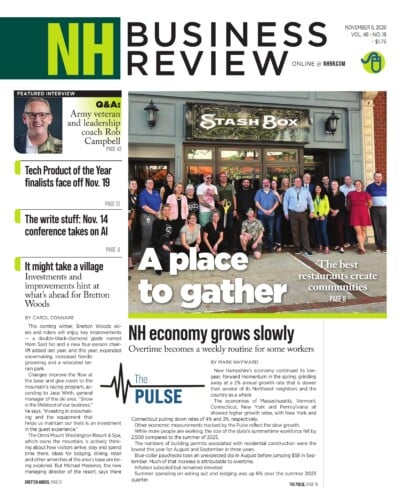
NH economy grows slowly
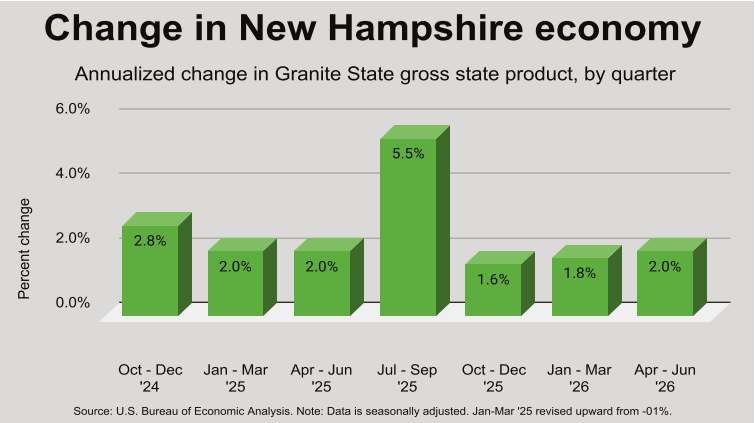
New Hampshire’s economy continued its lowgear, forward momentum in the spring, grinding away at a 2% annual growth rate that is slower than several of its Northeast neighbors and the country as a whole.
New Hampshire’s economy continued its lowgear, forward momentum in the spring, grinding away at a 2% annual growth rate that is slower than several of its Northeast neighbors and the country as a whole.
The economies of Massachusetts, Vermont, Connecticut, New York and Pennsylvania all showed higher growth rates, with New York and Connecticut pulling down rates of 4% and 3%, respectively.
Other economic measurements tracked by the Pulse reflect the slow growth. While more people are working, the size of the state’s summertime workforce fell by 2,500 compared to the summer of 2025.
The numbers of building permits associated with residential construction were the lowest this year for August and September in three years.
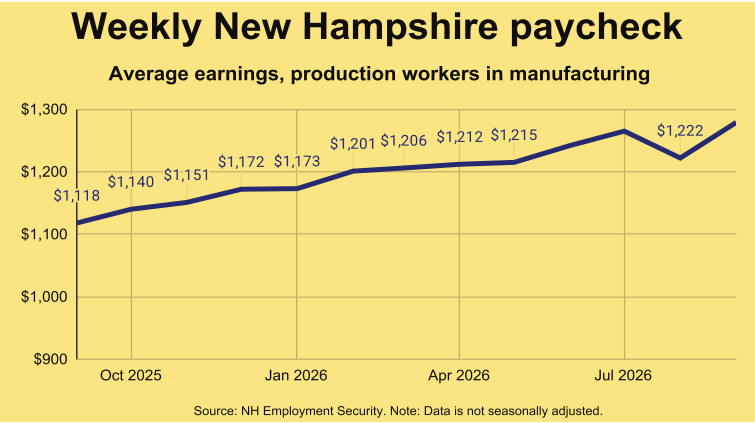
Blue-collar paychecks took an unexpected dip in August before jumping $58 in September. Much of that increase is attributable to overtime.
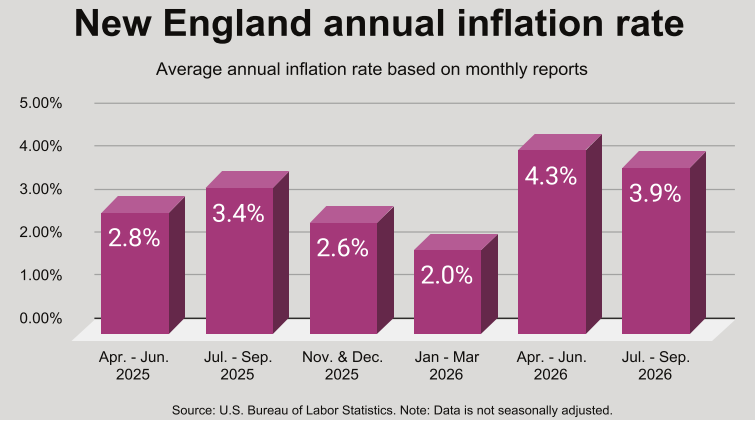
Inflation subsided but remained elevated. Summer spending on eating out and lodging was up 6% over the summer 2025 quarter.
The U.S. Bureau of Economic Analysis reports gross state product for each of the 50 states but on a slower basis than other economic indicators. For example, it released GSP for the second quarter on Sept. 30.
The national economy expanded at a slightly higher rate, 2.2%, between April and June.
“The last couple of years, our growth has been slightly lower than the national average,” said Gregory David, assistant director of the state Labor Market Information Bureau.
The Bureau of Economic Analysis recorded some of the strongest growth in durable goods manufacturing, wholesale trade, information, finance/insurance and real estate fields.
Slow and negative growth was seen in mining, nondurable goods manufacturing, retail, transportation, management, and arts and entertainment.
As a category, the restaurants and lodging operations did well this past summer.
Third quarter sales in New Hampshire tallied $1.85 billion, based on meals and rooms tax receipts.
That’s up 6% over 2025 numbers. “Most people thought July and August were quite good,” said Mike Somers, president and chief executive of the NH Lodging and Restaurant Association.
In an interview, Somers frequently used the word “mixed.” While some establishments experienced highs, others saw lows.
Food prices were up for beef, but dropped for other foods such as dairy.
It was easier to find servers, bartenders and managers, but harder to find housekeepers and experienced culinary staff.
“I think the economy has good fundamentals. It’s a little bit soft right now because of the price of gas,” Somers said.
What will improve the state’s economic performance? David sees population size, especially the size of the workforce, as a key factor to growth. With more people retiring than entering the workforce, one of the biggest drivers in the state’s growth is migration into New Hampshire from states such as Massachusetts and New York.
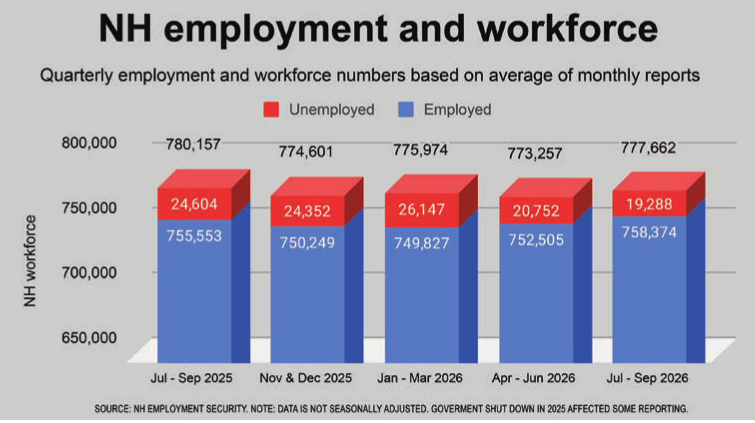
The size of the workforce fell between summers 2025 and 2026.
Nearly 3,000 more New Hampshire people worked this summer, meaning the seasonally adjusted unemployment rate dropped from 3.2% in September 2025 to 2.6% this September. The seasonably unadjusted rate was even lower at 1.9%.
Shifting is taking place in the workforce. State data shows a healthy increase in the number of manufacturing employees working on the factory floor, a category known as production workers.
Between September 2025 and September 2026, the number of production workers in the manufacturing sector grew by 1,600. It appears that the number of managers at those factories fell by roughly the same number.
Unemployment claims are low, but David said it can be hard for some people to secure jobs. Businesses are hesitant to hire; they opt to bring on temps or pay overtime.
“Businesses need workers, but they’re concerned about the long-term environment,” he said.
Inflation, of course, is on many people’s minds. The average New England inflation readings worked out to an annual rate of 3.9% in the third quarter. Much of that inflation involves oil.
About 40% of the state relies on home heating oil to stay warm, and fuel oil increases could easily translate into an increase of $1,000 for a New Hampshire family this winter, David said.
“If you’re buying fuel oil, you’re not buying something else,” he said.
Or you could be working overtime to pay that heating bill.
Production workers in manufacturing are working more hours — three more hours a week in September 2026 compared to September 2025.
In every month of this year, the number of average weekly hours exceeded 40.
“A lot of people are working overtime,” David said. “People are putting in a lot of hours.”
“The Pulse” is an exclusive feature of NH Business Review that examines local and national data to track New Hampshire’s economy.
Each month, the series examines an economic trend based on the latest data. On a quarterly basis, “The Pulse” will report key economic indicators such as employment, inflation and economic growth for the New Hampshire economy for a more expansive review that includes several informational graphics.
“The Pulse” focuses on three key indicators: prices, output and labor. It will also feature a wild card category. One of the six will change every quarter in an effort to capture data that gives additional insight.
New Hampshire’s economy continued its lowgear, forward momentum in the spring, grinding away at a 2% annual growth rate that is slower than several of its Northeast neighbors and the country as a whole.
Interest rate hike? What interest rate hike? The move by the Federal Reserve to hike a key interest rate by a quarter of a percentage point (0.25%) has provoked a big yawn in the New Hampshire economy.
As the price tag of power grows in New Hampshire, so does the expectation that demand will grow in the state as well as the region.
Inflation is back. Driven by higher fuel prices, inflation in New England shot up to a 4.3% annual rate in the spring quarter. That is more than double the rate of 2%, the target rate for the Federal Reserve nationwide,…
New Hampshire businesses seem to be hitting the summertime blues. Over a two-week period ending June 28, the percentage of businesses describing their performance as above average or better tumbled 5 points, and only 47% of businesses said they were…
NH residents are curbing the urge to ‘scratch’
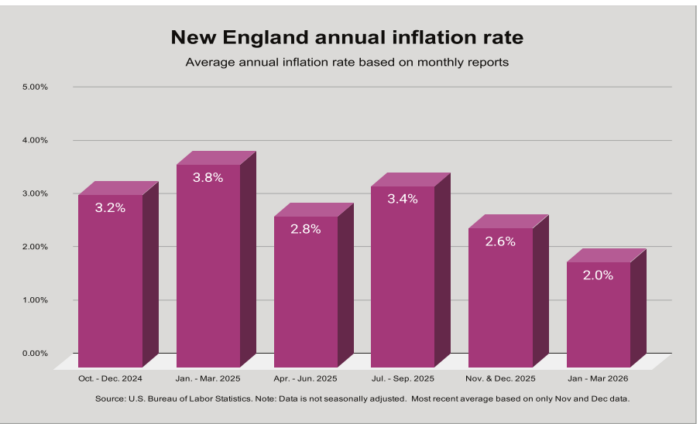
It was brief, even fleeting, but for the first three months of 2026, the average, annualized rate of inflation in New England was 2%.
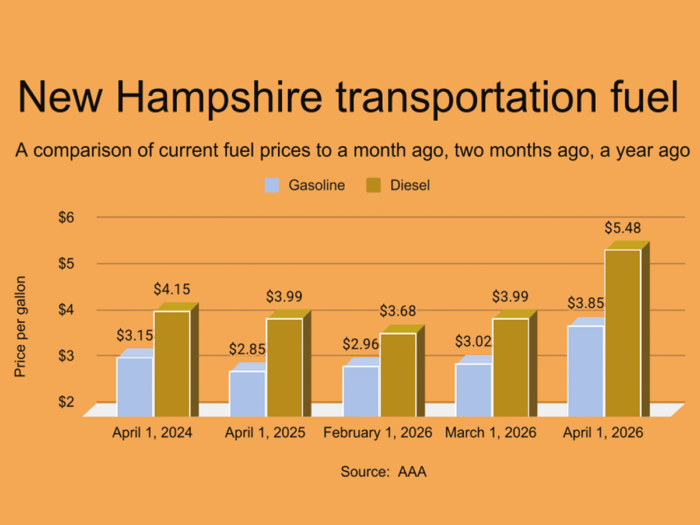
A gallon of gas has jumped about 25%