Fed rate hike not likely to impact NH economy
Interest rate hike? What interest rate hike? The move by the Federal Reserve to hike a key interest rate by a quarter of a percentage point (0.25%) has provoked a big yawn in the New Hampshire economy.
Interest rate hike? What interest rate hike? The move by the Federal Reserve to hike a key interest rate by a quarter of a percentage point (0.25%) has provoked a big yawn in the New Hampshire economy.
A bank president said his customers are more concerned about increases in the prices of energy and employee healthcare. And a local Realtor said he hasn’t seen buyers withdrawing from the market or making lower offers because of the rate hike.
That isn’t good news for the Fed, which raised the rate in an effort to slow the economy. Its goal: to tamp down persistent inflation.
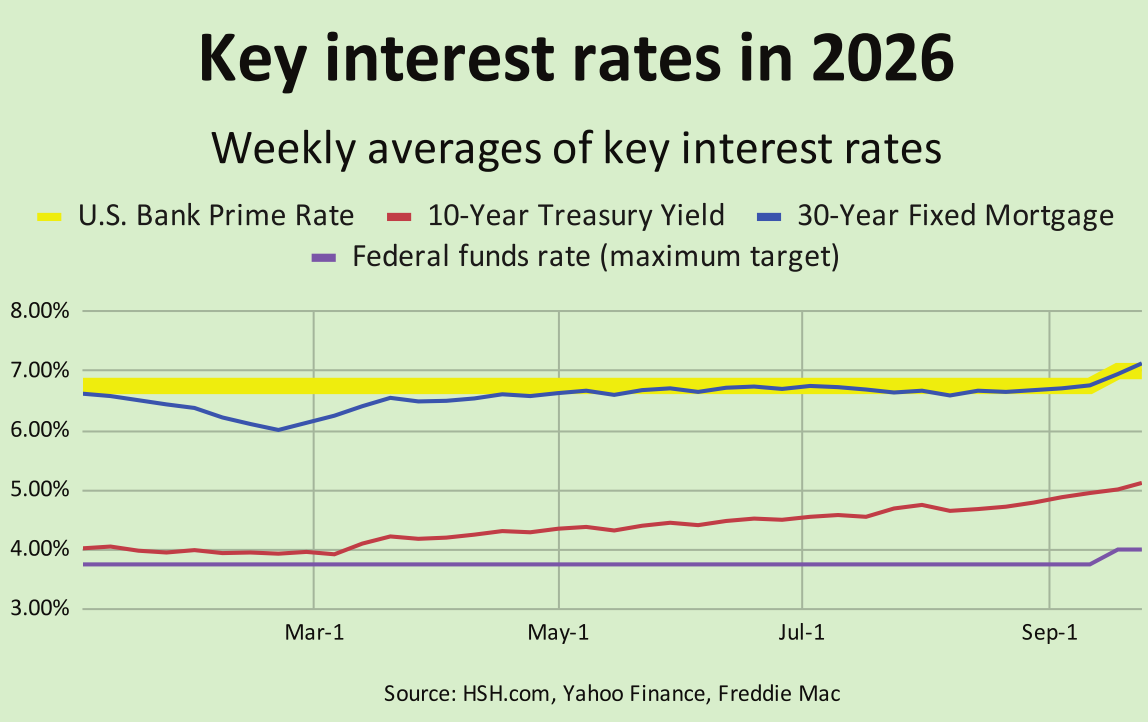
On Sept. 16, the Fed’s Open Market Committee voted unanimously to raise the target range for the federal funds rate between 3.75% and 4%.
The federal funds rate is the interest rate that commercial banks charge one another for overnight lending of excess reserves.
Will it slow economic activity?
“It’s not really a meaningful move for (our bank customers),” said Marc Lubelczyk, state president for Citizens Bank in New Hampshire and Vermont. “It will take time to ripple through the economy, but a 25-point increase in their borrowing rate is not significant to them.”
The Fed hiked the rate in the face of continuing reports of inflation.
For example, the annual New England inflation rate for August was 3.4%, which is significantly above the Fed’s target rate of 2% for the country as a whole.
Inflation did drop in New England over the summer, however. The U.S. Bureau of Labor Statistics shows annual inflation rates of 4.2% in June, 3.9% in July and 3.4% in August.
In a statement, the Fed said domestic spending has remained resilient despite unspecified geopolitical uncertainty. The Fed said productivity is strong, capital investment is robust and job gains have kept pace with the workforce.
“Inflation remains elevated,” the Fed stressed. The interest rate connected to 30-year mortgages has seen a steady climb through most of 2026.
The average 30-year, fixed-rate mortgage bottomed out at 6% on Feb. 20, just days before the start of the Iran war. The rate has climbed since then.
On Sept. 24, it hit a rate of 7.13%.
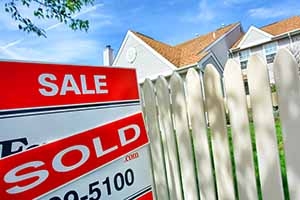
The real estate market has seen some slowing. Houses have been on the market longer, and the number of price reductions has risen, said Greg Powers, a Realtor at Keller Williams Realty Metropolitan in Bedford.
But those are likely the result of a steadily rising inventory of properties for sale, Powers said. Fellow real estate agents talk about the Fed increase, but few buyers do.
“None of them have mentioned a specific example of a buyer stopping their house hunting or making a lower offer because of (the rate increase),” he said.
Most commercial loans are based on the prime rate, which tracks the federal funds rate. The prime hit a rate of 7% on Sept. 24, its highest of the year.
Lubelczyk said the interest rate is not the main focus of commercial customers.
“Across the spectrum, our customers are cautious and resilient but still focused on investing and growth,” he said.
And banks are lending more. Data from the Federal Deposit Insurance Corporation shows that total assets of insured New Hampshire banking institutions increased by $46 million to $16.76 billion between June 2025 and June 2026.
Lubelczyk wouldn’t venture an estimate on how high interest rates would have to move to slow economic activity, but he said interest rates are not at a historic high.
“We’ve seen them higher,” he said.
“The Pulse” is an exclusive feature of NH Business Review that examines local and national data to track New Hampshire’s economy.
Each month, the series examines an economic trend based on the latest data. On a quarterly basis, “The Pulse” will report key economic indicators such as employment, inflation and economic growth for the New Hampshire economy for a more expansive review that includes several informational graphics.
“The Pulse” focuses on three key indicators: prices, output and labor. It will also feature a wild card category. One of the six will change every quarter in an effort to capture data that gives additional insight.
Interest rate hike? What interest rate hike? The move by the Federal Reserve to hike a key interest rate by a quarter of a percentage point (0.25%) has provoked a big yawn in the New Hampshire economy.
As the price tag of power grows in New Hampshire, so does the expectation that demand will grow in the state as well as the region.
Inflation is back. Driven by higher fuel prices, inflation in New England shot up to a 4.3% annual rate in the spring quarter. That is more than double the rate of 2%, the target rate for the Federal Reserve nationwide,…
New Hampshire businesses seem to be hitting the summertime blues. Over a two-week period ending June 28, the percentage of businesses describing their performance as above average or better tumbled 5 points, and only 47% of businesses said they were…
NH residents are curbing the urge to ‘scratch’
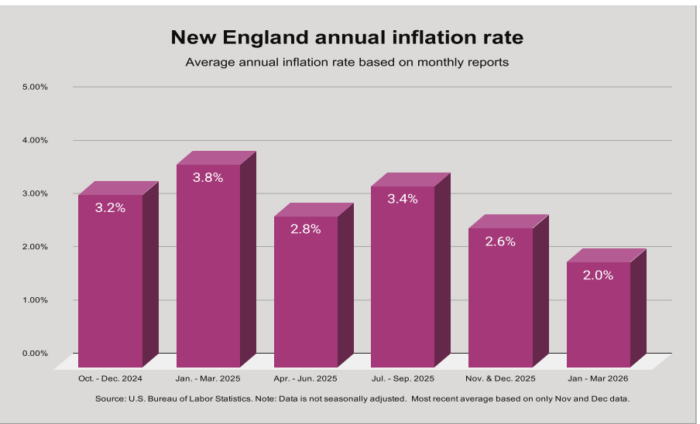
It was brief, even fleeting, but for the first three months of 2026, the average, annualized rate of inflation in New England was 2%.
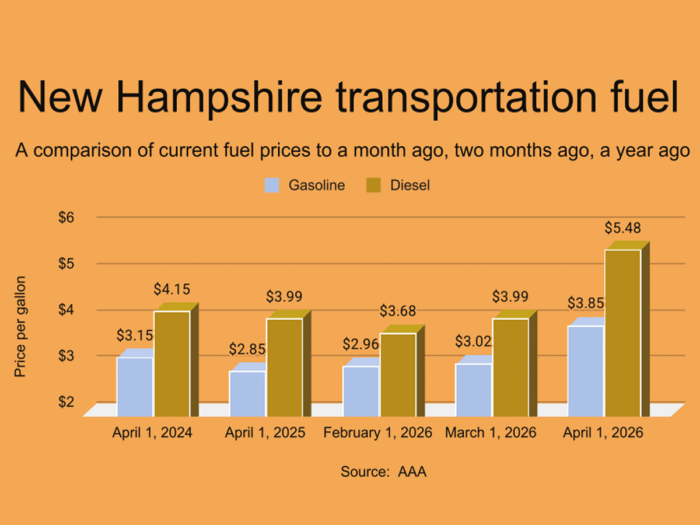
A gallon of gas has jumped about 25%