While other economic indicators have had their ups and downs over the years, the one steady increase has been the payroll of the civilians working there.
An analysis of economic impact reports produced by the Seacoast Shipyard Association from calendar year 2020 to 2025 shows that payroll value increased by 15.3% — from $671.4 million to $774 million. The money paid to these civilian workers — as machinists, welders, shipfitters, painters, fabricators and more — helped bring the shipyard’s total economic impact to $1.48 billion in 2025.

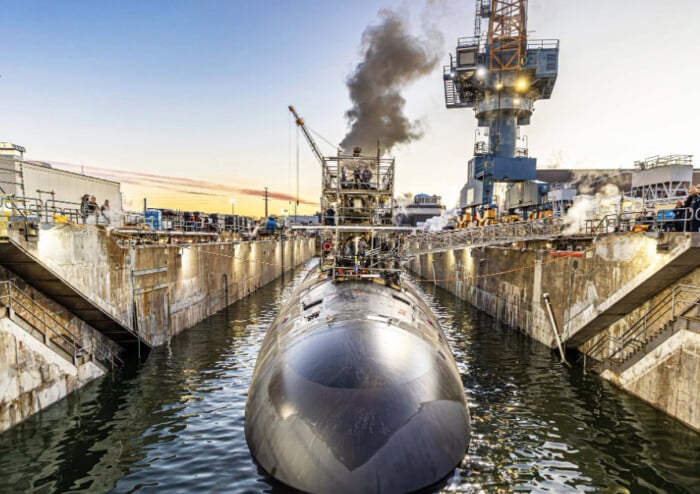
This is the fast-attack submarine USS Washington settled into the dock at the Portsmouth Naval Shipyard for repairs and updates. It successfully undocked on Oct. 27, concluding a 712-day dry-docking period that began when the submarine first arrived at the shipyard in September 2024. (Courtesy photo)
That’s an 8.64% decrease from 2024’s $1.62 billion (a highwater mark over the years), but a 56.13% increase over the $947.9 million overall impact in 2020.
The Seacoast Shipyard Association releases an economic impact report annually for the preceding calendar year. The data that sums up the total financial impact includes payroll of both civilian and military personnel there, supply purchases, and the various contracts associated with the work there.
In presenting its 2025 report last month in Portsmouth, Alana Schaeffer, who chairs the association, said the shipyard’s impact reaches well beyond the numbers.
“It’s about the businesses and communities in Maine and New Hampshire that are strengthened, a workforce that keeps serving our community even when paychecks stop and a community surrounding us that refuses to let those workers struggle alone,” she said.
As the payroll has grown over the years, so has the number of employees post COVID.
The number of civilian employees stood at 7,639 in 2020 (the first full year of the pandemic), then drooped to 7,257 the following year, then grew steadily each year to the 7,970 recorded in 2025.
Most of the employees who reside in New Hampshire are concentrated in Rochester, Dover, Portsmouth, Somersworth, Barrington, Farmington, and Newmarket.
In Maine, home to most of the civilian employees, they’re concentrated in Sanford, Kittery, Berwick, South Berwick and Lebanon.
The shipyard is responsible for the overhaul, repair, and modernization of the U.S. Navy Virginia-class nuclear powered, fast-attack submarines.

These graphs summarize the economic indicators at the Portsmouth Naval Shipyard over the five-year period from 2020 to 2025.
The shipyard has faced a number of challenges over the years, with shifting priorities from changing policies in the White House.
It faced a very serious threat of closure from the Base Realignment and Closure (BRAC) round in 2005 during the George W. Bush administration.
The current administration of President Donald Trump has been targeting unions and staffing levels.
At Trump’s behest in April 2026, the Department of Defense voided collective bargaining agreements for two major unions at the shipyard — the United Brotherhood of Carpenters and Joiners Local 3073 and the American Federation of Government Employees. His Sharpie-inscribed executive order targeted federal workers in roles deemed essential to national security with the administration arguing that military-related workforce operations must be tightly integrated under direct federal command without the kind of outside interference that unions represent.
The order is facing current legal challenges.
Also, the administration’s new federal personnel restrictions have complicated the facility’s ability to maintain what its unions say are the proper labor volumes.
While congressional delegations in both Maine and New Hampshire have sought collectively to keep the shipyard functioning, it has become a cause celebre over the years for departing U.S. Sen. Jeanne Shaheen, D-NH.
She has had a unique perspective as a senior member of the Senate Armed Services Committee, ranking member of the Senate Foreign Relations Committee, co-chair of the U.S. Senate Navy Caucus, and senior member of the U.S. Senate Defense Appropriations Subcommittee and Armed Services Committee.
“Portsmouth Naval Shipyard plays a key role in the Navy’s readiness while fueling our local economy. This year’s economic impact report is the latest example of how the Shipyard creates thousands of jobs, strengthens our Seacoast communities and promotes investments that power economies across New England,” said Shaheen, who is stepping aside after 17 years, having taken office on January 3, 2009.
“I have been proud to offer my unwavering support to the Shipyard and its workforce throughout my time in the Senate, and I look forward to the continued impact PNSY will make in the years to come,” she said.
Below is a summary of the economic indicators from impact reports 2020 through 2025:
CY 2025
- Employment: 7,970
- Civilian Payroll: $774,128,898
- Military Payroll: $39,225,349
- Purchases (Supply): $177,379,209
- Contracts: $493,854,917
CY 2024
- Employment: 7,721
- Civilian Payroll: $762,242,290
- Military Payroll: $35,986,559
- Purchases (Supply): $158,232,835
- Contracts: $658,778,097
CY 2023
- Employment: 7,469
- Civilian Payroll: $716,176,891
- Military Payroll: $34,207,756
- Purchases (Supply): $160,034,544
- Contracts: $626,148,319
CY 2022
- Employment: 7,356
- Civilian Payroll: $663,523,786
- Military Payroll: $38,517,178
- Purchases (Supply): $196,168,301
- Contracts: $559,743,052
CY 2021
- Employment: 7,257
- Civilian Payroll: $670,722,530
- Military Payroll: $48,741,064
- Purchases (Supply): $133,774,294
- Contracts: $469,374,010
CY 2020
- Employment: 7,639
- Civilian Payroll: $671,364,132
- Military Payroll: $46,912,700
- Purchases (Supply): $123,201,766
- Contracts: $306,382,201