'From the Battlefield to the Boardroom' with Robert Campbell
Author, leadership coach and veteran of 27 years in the Army, Robert Campbell speaks on his 'Battlefield to Boardroom' book series and how companies can become veteran-ready
With gasoline near $4 a gallon and healing oil prices expected to jump this winter, U.S. Energy Secretary Chris Wright on Thursday said clean energy initiatives are partly to blame for high energy prices.
Wright, the founder and former chief executive of a Denver-based oil-services and fracking company, spoke within eyesight of a small solar array at the Raymond district office of the New Hampshire Electric Co-op.

U.S. Energy Secretary Chris Wright, left, shakes hands with Jeremy Claar, a New Hampshire Electric Co-op lineman, during a visit on Thursday to the Co-op’s Raymond facility. (Photo by Mark Hayward)
“Energy should be about humans and math,” said Wright during a one-day visit to New Hampshire. President Trump’s energy secretary said $10 trillion has been spent worldwide on wind, solar, batteries and associated transmission lines. That provides about 3% of energy worldwide.
“The main impact has not been to grow our energy production. It’s been to make our energy more expensive,” he said. He said Democrats make energy more expensive and stand in the way of expansion projects.
But after he spoke, Co-op officials said the organization’s 3-megawatt solar array in Moultonborough and other clean energy efforts, including the New Hampshire renewable energy standard, has helped to moderate prices for its customers.
U.S. Sen. Jeanne Shaheen, D-N.H., said Wright’s visit comes as New Hampshire struggles with an energy affordability crisis that he played a direct role in creating.
“This Administration’s reckless war in Iran and continued attacks on energy efficiency have led to skyrocketing prices at the pump and soaring electricity costs, squeezing families across the state,” Shaheen said in a statement emailed to NH Business Review.
Last month, national media reported that New Hampshire was among 16 states that saw 284 clean energy grants rescinded because those states voted for Democrat Kamala Harris in the 2024 election.
That included elimination of a $5 million grant to the New Hampshire company Brayton Energy, which was working on a thermal energy storage project.
“It is a vindictive decision that proves yet again this is an Administration (that) is prioritizing politics over giving families financial breathing room,” Shaheen said in the statement.
Wright said he canceled projects in all 50 states, and he focused on the cost reduction, viability and new energy associated with each project.
“The politics of who ran the state had absolutely nothing to do with any, any decision,” he said.
The New York Times initially reported the story, and quotes a court filing that said the October notice of rescinded grants was “based solely on the political identity of the grant recipient’s state, ie, whether the recipient’s location and/or place of performance is in a Blue State or a non-Blue state.”
The term Blue State is short-hand for a state that either votes Democratic or is led by Democrats.
Wright said the legal filing addressed the timing of announcements, and he had nothing to do with the announcements
Wright said New England’s biggest energy challenge is its inability to get otherwise abundant natural gas into the state via pipeline in the winter.
With pipelines at capacity, the region must have its natural gas shipped in by tanker, which greatly increases the cost. New York State and environmental groups are holding up the project in the regulatory sphere.
“This is a lifelong passion of mine. I want to see that pipeline under construction early next year,” Wright said.
He also said the nuclear industry should grow in New Hampshire.
As for heating oil, the Energy Department forecasts the national retail price of heating oil at $5.10 a gallon by the end of this year. That’s up 17% since the start of the year and 36% since Trump took office.
“The challenge there is refining. Oil prices are up a little bit, but more it’s tight refining capacity,” he said. The Constitution Pipeline would lower natural gas prices in the winter, giving a better incentive for people to switch fuels, he said.
In their conversations with reporters, Co-op leaders agreed that electricity prices rise in the winter because of pipeline issues.
But they said the Co-op benefits from the solar array in Moultonborough and an associated battery storage facility, both of which they said are the largest of their kind in the state.
That includes tapping the power sources during peak demand, when prices are the highest.
“We’re doing well with that,” said Vice Chairman Bill Darcy.
Wright spoke privately with the Co-op officials for about 15 minutes and then chatted with a line crew. He urged the crew members to get friends and family interested in electricity transmission, and he asked about their work during a winter storm.
“You get numb early on; the rest of the day is good to go,” said Raymond resident Jeremy Claar.

Author, leadership coach and veteran of 27 years in the Army, Robert Campbell speaks on his 'Battlefield to Boardroom' book series and how companies can become veteran-ready

A tech-entrepreneur turned venture capitalist is eyeing one of the largest undeveloped tracts in Manchester for a community where tech- and startup-minded people would live and work. Freedom Village would be located on 250 acres of mostly wooded land at Hackett Hill, which is located in the northwestern corner of Manchester.

Business and event happenings around the state of NH
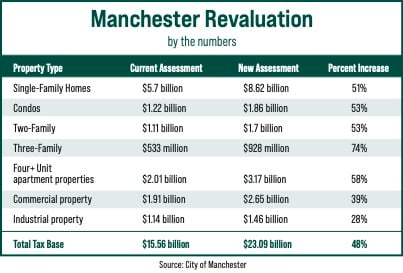
The value of all property in Manchester increased by almost half — 48% ‑ over the past five years, according to preliminary data released by city officials on Oct. 13 The valuations, compiled due to a citywide revaluation, add up to $23.09 billion. The current value of city properties is $15.56 billion, which was based on assessments made during the city's last revaluation.

The Latest is a roundup of the comings and goings of the movers and shakers in NH's business community

Anyone who has taken a transmission line or a wind farm through New Hampshire’s Site Evaluation Committee knows the process is long, expensive and can be fraught with complication.

Artificial intelligence has moved from pilot project to daily practice inside many HR departments.

When Richard “Dick” Levy’s wife, Susan, received a terminal diagnosis of a progressive brain disorder a decade ago, he became her primary caregiver. Doctors estimated Susan had between three and five years left to live.

Interest rates affect nearly every business decision — from expansion plans to asset acquisition to operational budgeting.