Statewide access to highspeed internet has arrived
Last month, an update of the state’s broadband dashboard shows we have reached 99% access, with less than 5,000 addresses in New Hampshire unserved.

Taylor Caswell
If you drive through communities in other states and pay attention to how they are organized, you will often notice stark differences from New Hampshire.
You’ll see large “town centers” designed around national retail chains and surrounded by acres of parking lots; long straight roads with four or five lanes on each side peppered by stoplights set to change at what seem like 15-minute intervals; sharp distinctions between residential and commercial districts; and generally, a lack of much visible human activity. And it all starts to look very, very similar from one town to the next.
Here in New Hampshire, we certainly have some of these features scattered around, but they are the exception, not the rule. How have we managed to avoid this national trend? The answer is largely one thing: our legacy of local control, and the unique community character and economic benefits that follow from it.
Maintaining these benefits demands constant vigilance against government’s gravitational pull toward uniformity. It is what keeps our communities vibrant and people choosing New Hampshire over other states. The demographic gains we’ve seen in younger age groups in recent years reflect this as much as anything else.
State governments — really most governments — default to what’s easier to administer. Uniformity reduces regulatory complexity and sharply reduces the need to find creative solutions to unique circumstances. Being creative takes longer, draws in more stakeholders and requires working through real challenges. But it’s usually worth it. Most people I know who choose public service do so precisely because they want to do that kind of work; they are invested in the challenge of good government. When New Hampshire businesses point to how accessible state government is, that accessibility is usually this type of creativity showing through.
But given that gravitational pull, local decision-making and innovation in solutions can start to yank away from the traditional anchor of local control. Calls for fiscal austerity and “government efficiency” are often interpreted by executive agencies as mandates to reduce complexity. That sacrifices the creativity and, in a zeal for uniformity, becomes a serious threat to the anchor of local control.
As another branch of government, legislatures face the same trap. Confronted with funding shortfalls, they take the easier route: across-the-board percentage cuts rather than real reform, without pausing to review which programs consume revenue and which generate it.
We have traditionally resisted this outcome through our built-in Live Free or Die reflex — a longstanding commitment to individual rights, free markets and self-determination. Any proposal that came near the line of threatening local control was dismissed faster than almost anything except an income tax proposal.
But that reflex is being tested right now. In the current legislative session, proposals receiving broad support would, if enacted, set a negative precedent. One removes any local say in the siting of large garbage landfills, handing that authority to state government outright. Others second-guess local budgeting authority, substituting the Live Free or Die ethos for a new Concord-knows-best approach. Taken individually, each can be framed as a government efficiency measure. Taken together, they are a pattern — one that, consciously or not, threatens local control at meaningful scale.
Think about how different life is for residents in Keene, Manchester, Dover, Plymouth, North Conway and Colebrook. All that variety packed into one small state is a genuine competitive differentiator, and it cannot be engineered from the top down. It can genuinely only come from within each community.
States that take the easy path hand their economic development strategy to strip malls and build communities that look like everywhere else. We have resisted that, but resistance requires work, and governments under fiscal pressure will always feel the pull.
We talk about the “New Hampshire Advantage” as if it’s a single thing. It isn’t. It is the aggregate result of thousands of local decisions that cannot be replicated. Protecting it means protecting the conditions that make those decisions possible.
Government is hard when you’re doing it right.
Taylor Caswell has led economic policy agencies on the state and federal level for decades, most recently serving as New Hampshire’s commissioner of business and economic affairs. You can reach him at linkedin.com/in/taylorcaswell.

Last month, an update of the state’s broadband dashboard shows we have reached 99% access, with less than 5,000 addresses in New Hampshire unserved.
Without affordable housing, young people cannot afford to be here. Nowhere in the state is the need to attract younger populations more of an economic priority than in rural communities.
Next month, the United States, Canada and Mexico begin the formal joint review of the USMCA trade agreement. Under the original agreement, a review is required, and while there is no likely outcome that…
Proposals gaining traction in Concord would weaken local government
New Hampshire has long acknowledged outdoor recreation as an asset. We speak of it in terms of quality of life, tourism appeal and regional character. That framing, while not inaccurate, is no longer sufficient.

Author, leadership coach and veteran of 27 years in the Army, Robert Campbell speaks on his 'Battlefield to Boardroom' book series and how companies can become veteran-ready
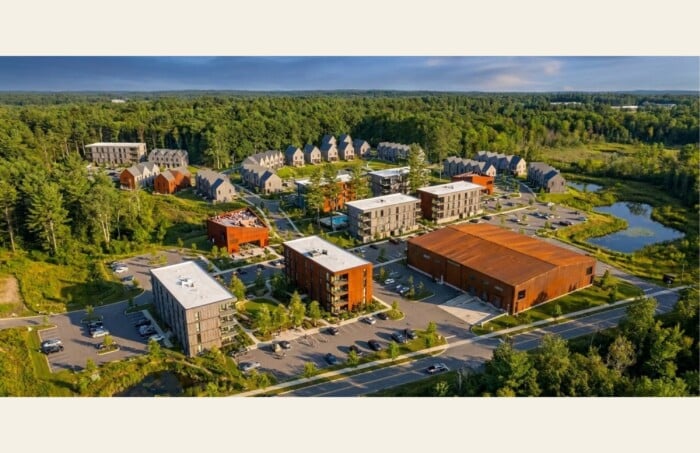
A tech-entrepreneur turned venture capitalist is eyeing one of the largest undeveloped tracts in Manchester for a community where tech- and startup-minded people would live and work. Freedom Village would be located on 250 acres of mostly wooded land at Hackett Hill, which is located in the northwestern corner of Manchester.
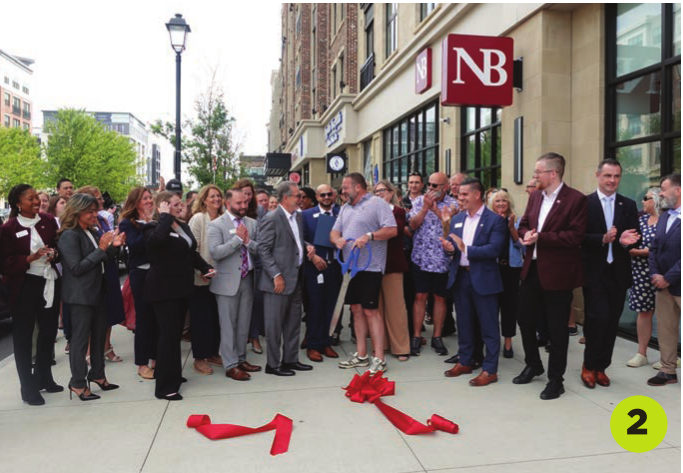
Business and event happenings around the state of NH
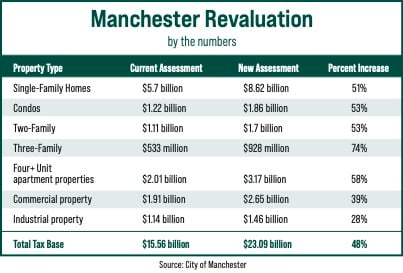
The value of all property in Manchester increased by almost half — 48% ‑ over the past five years, according to preliminary data released by city officials on Oct. 13 The valuations, compiled due to a citywide revaluation, add up to $23.09 billion. The current value of city properties is $15.56 billion, which was based on assessments made during the city's last revaluation.