Sustainability Spotlight: The competitive edge
Small businesses drive New Hampshire’s economy, accounting for roughly 97% of all state enterprises and generating the majority of its jobs, according to the U.S. Small Business Administration.

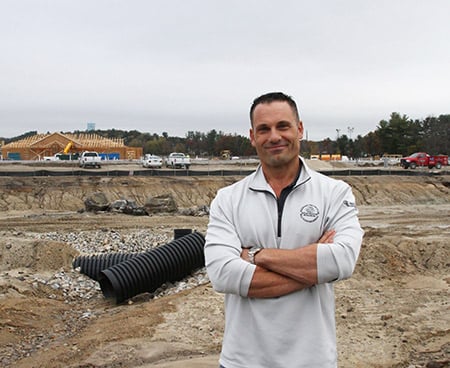
John Hyde
In construction, sustainability is still too often defined by project type, certification or client mandate. If a job is labeled “green,” we assume the contractor is sustainable by default. But that framing misses the point.
Sustainable projects do not make a sustainable contractor. A contractor is sustainable because of how they choose to build across all projects. It shows up in the decisions we make, the conditions we create on our job sites and the way we treat the people doing the work.
Sustainability also plays a significant role in a company’s commitment to corporate social responsibility (CSR), a business model that encourages companies to operate in ways that enhance society and the environment while being accountable to stakeholders and the public. Taken together, it’s clear the term “sustainability” carries more weight than ever before.
The impact of the Contractor’s Commitment
That belief is what led Chapman Construction to become a signatory of the Contractor’s Commitment, a performance standard created by contractors who understand how jobs actually run. It focuses on five key areas where builders have real control: materials, waste, carbon, water and wellness. The program is intentionally flexible. It can be applied to any project, at any scale, and it is designed to encourage progress, for continuous improvement.
For us, this work is about extending our values beyond the office. Many of our clients are implementing CSR policies, and we see the Contractor’s Commitment as a triple win: It’s great for our employees, great for our clients and leads to a better finished building product that helps meet evolving standards in corporate wellness.
On recent projects, we began measuring indoor air quality and job-site electricity use. Not because a client asked us to, but because these impacts are largely within our control. The data was eye-opening. We saw spikes in fine particulates that reinforced what many superintendents already know from experience. OSHA compliance is the floor, not the goal.
Teams focused on embodied carbon in high-impact scopes like steel framing.
In one case, sourcing lower-embodied carbon studs reduced emissions by more than 30%. These were not experimental projects with unlimited budgets. They were real jobs, with real constraints, and they proved that better outcomes are achievable with thoughtful planning and decision-making.
Abiding by the Contractor’s Commitment not only gives our clients a better product, but it shows respect for the people building the work and the future occupants of those spaces.
Taking the long game, not shortcuts, to healthier projects
Changing how we work takes time.
It requires figuring out what matters, adjusting processes, training teams and then repeating it enough that it becomes normal. There have been challenges along the way, and that is expected. If we are not running into some friction, we are probably not pushing hard enough.
Looking ahead, our goals as a company are practical and focused. We are increasing participation across projects, capturing lessons learned, completing case studies, expanding carbon assessments, and improving how we track and use data.
Chapman has always been a leader and an innovator. Maintaining that reputation means continuing to evolve. Sustainability is not about checking a box; it is about responsibility, consistency and making deliberate choices, on every project, to build better than we did yesterday.
John Hyde, director of sustainability at Chapman Construction/Design, has over 20 years of experience in the construction industry. New Hampshire Businesses for Social Responsibility produces “Sustainability Spotlight” monthly for NH Business Review.
Small businesses drive New Hampshire’s economy, accounting for roughly 97% of all state enterprises and generating the majority of its jobs, according to the U.S. Small Business Administration.
At Northeast Delta Dental, our mission guides us to prioritize social impact, essentially the good we can do in our community with the resources we have available.
Sustainable investing has undergone a reset. The excitement and lofty promises that accompanied the rise of ESG have given way to skepticism, political debate and a healthy demand for accountability.

Small and medium-sized enterprises (SMEs) make up the majority of businesses in NH and play a vital role in driving economic growth, innovation and job creation.
Mental health literacy as a workplace sustainability strategy
New Hampshire should be a place where businesses have every structural advantage to compete and grow — built on the workforce, infrastructure and policies that make it the best state in the nation to…

In construction, sustainability is still too often defined by project type, certification or client mandate. If a job is labeled “green,” we assume the contractor is sustainable by default. But that framing misses the point.

When the path forward isn’t clear and feelings of overwhelm or despair are near, finding anchors in gratitude, horizon and context can steady our leadership through almost anything.
Sanborn Head’s ‘Go Green Team’ practices sustainability at the engineering firm