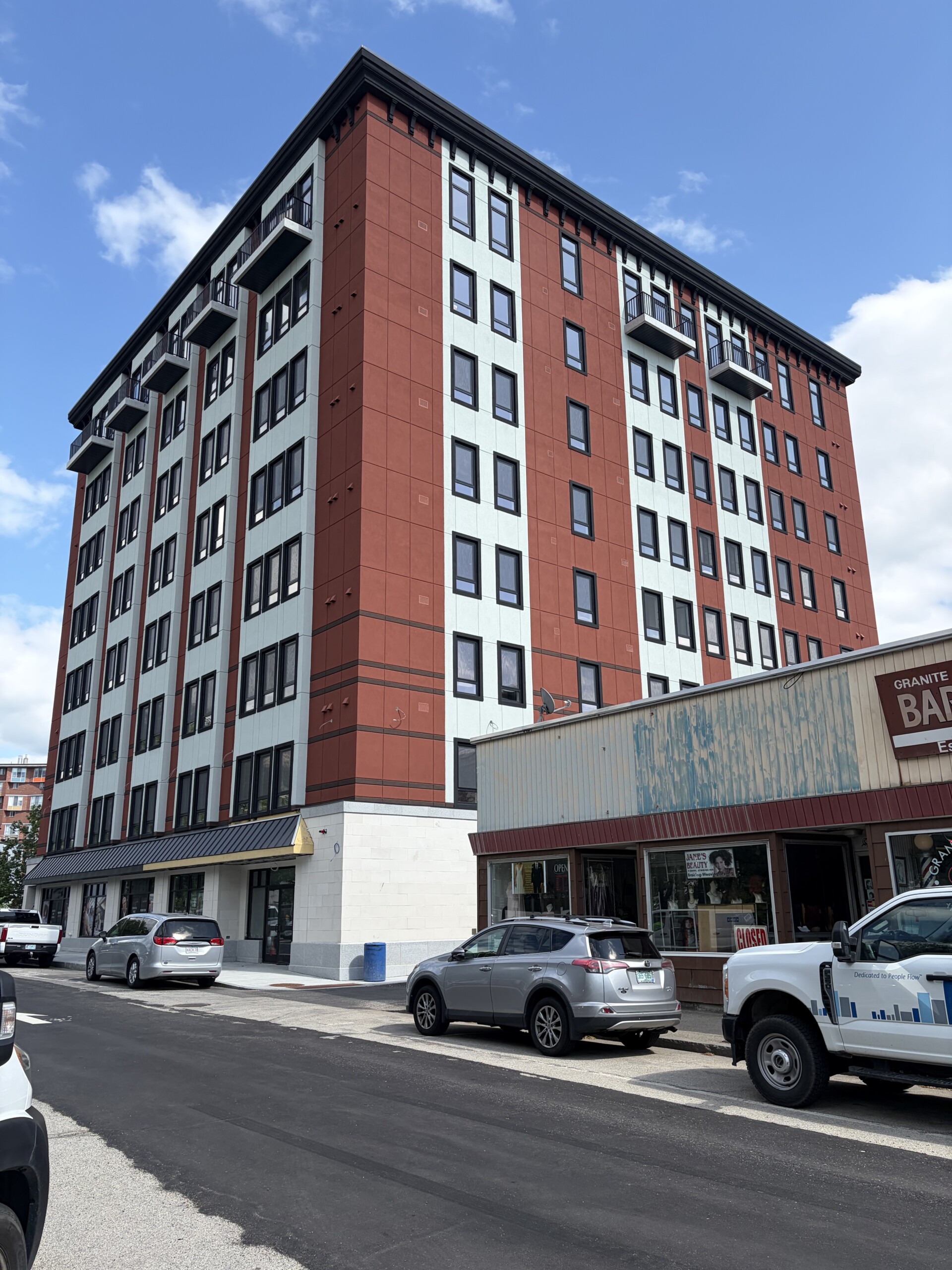
Luxury apartments connected to the eight-story Grand Central Suites apartment building in downtown Manchester should be available for July move-ins, with a top unit fetching $2,800 a month.
Owners of the building, located across Central Street from Veterans Memorial Park and just a few feet from Elm Street, held a ceremonial ribbon cutting Tuesday with Mayor Jay Ruais and other city officials.

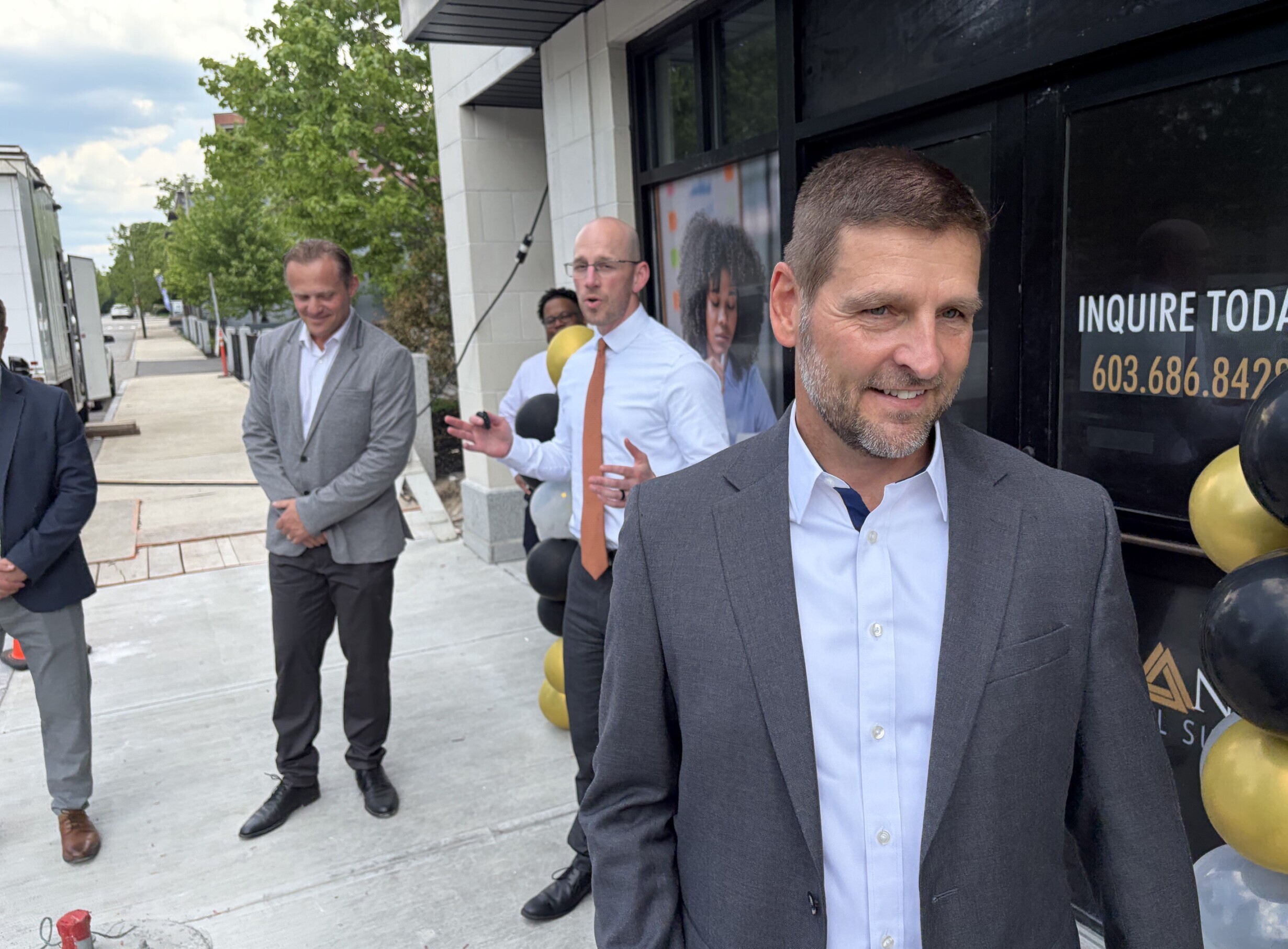
The new, majority owner of Grand Central Suites, Steeve Breton, walks by the initial developer, Nazar Vincent, now a minority owner, on Tuesday in front of the eight-story luxury apartment building. (Photo by Mark Hayward)
The top rental pays for a two-bedroom, penthouse apartment on the eighth floor. It comes with on-site parking, 13-foot ceilings and a balcony with sweeping city views.
Lower-priced, lower-level one-bedroom apartments start at $1,800.
The ribbon cutting represents the culmination of a controversial project that surfaced in 2023:
- Grand Central Suites benefits from local and federal tax breaks even though it lacks affordability.
- The project repeatedly missed completion dates.
- It drew the ire of unions, contractors and some city officials.
Last year, Massachusetts real-estate developer Steeve Breton formed a limited liability company and acquired the incomplete project for $3 million, according to property records. The city has estimated the project at $23.8 million when completed.
Breton, who grew up in Manchester, owns or controls 2,000 apartment units in several states.
“It was definitely stalled,” Breton said about the project. “I saw this bite-sized piece in Manchester. I had to have it.”
Breton said he has majority ownership of the project. Other investors include friends.
The project was about half complete when Breton acquired it, he said. The original developer, Nazar Vincent, remains an owner-investor with a single-digit percentage share, he said.
Most of the sales price went to pay contractors, who had not been paid in months, Breton said.
“There was a lot of money, plumbers, electricians, everybody had to be paid,” he said.
Two years ago, at Vincent’s request, Manchester aldermen approved the project for a New Hampshire Community Revitalization Tax Credit, or 79-E. For three years, the project pays property based only on its pre-construction value.
Currently, the property is valued at $766,000 for tax purposes, which translates into a tax bill of $7,750. Had it been taxed at the full estimated value, owners would pay $481,700 in taxes, based on the 2025 city tax rate.
The project has been controversial. In 2023, unions protested outside of it. Last June, city aldermen voted narrowly, 8 to 6, on an insurance subordination that was necessary for the project to proceed under Breton.
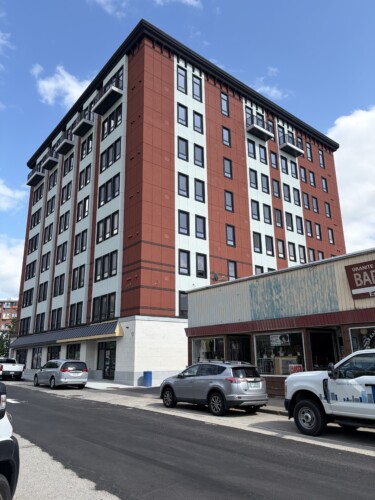
Grand Central Suites has 36 one-bedroom units and 39 two-bedroom that are marketed as luxury. They come with LED fireplaces, granite countertops and pendant kitchen lights. (Photo by Mark Hayward)
And there is the affordability issue. Breton stressed that when Vincent won the tax break, there was no requirement that the project be affordable.
“I inherited that, which was part of why I was able to invest in it and attract investors. The property works. It’s gonna cash flow well because we’re not paying taxes the first three years,” he said.
He said it should help keep other apartments affordable. With the 77 units on the market, there will be fewer high-income tenants settling for B-grade apartments, which will allow those rents to stabilize, he said.
Jodie Nazaka, director of economic development for the city, said Breton could apply for another two years of 79-E tax breaks, but he would have “to demonstrate something different” with the property, such as affordability.
Breton said he’s not sure whether that would make sense economically. For one, he would have to guarantee affordable units for nine or 10 years. And the Trump administration has cut funding for federal housing subsidy programs.
The property is also eligible for federal Opportunity Zone tax credits. In fact, the name of the holding company, QOZB LLC, is short-hand for Qualified Opportunity Zone Business LLC.
The biggest tax advantage is avoidance of capital gains taxes if the partnership holds the property for 10 years, Breton said.
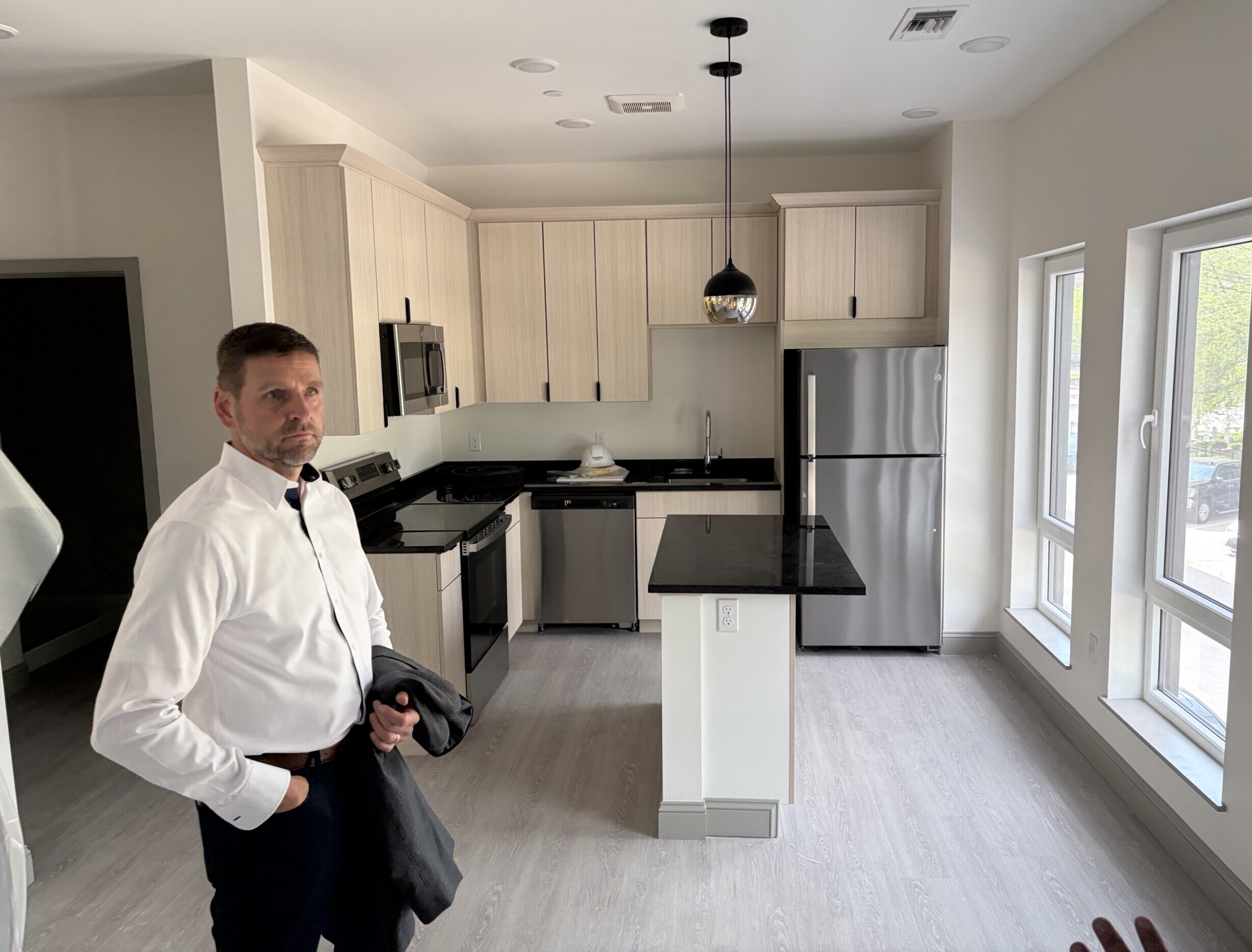
The property has 36 one-bedroom units and 39 two-bedroom that are marketed as luxury. They come with LED fireplaces, granite countertops and pendant kitchen lights. Some units are small – the smallest one-bedroom is 514 square feet – floors are faux-wood vinyl and parking is not free.
Breton said he has reserved a bank of about 30 spaces in the nearby Center of New Hampshire parking garage, which tenants can lease. Also, parking spaces are available on Central Street in front of the building.
He is talking to the city about a resident-only parking zone but isn’t sure that will happen. Thirteen spots are available inside the building.
He has two letters of intent from businesses eyeing the ground-level commercial space; one is a salon.
Breton said he was born in Quebec and his family “snuck across the border” to Manchester when he was a child. They didn’t speak English and lived in the United States illegally for a short period. They eventually gained citizenship.
He graduated from West High School and met his wife, a New Yorker, at Keene State College.
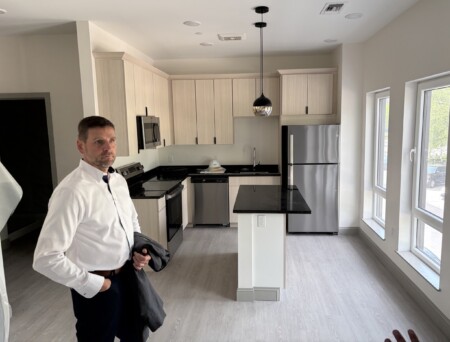
Grand Central Suites owner Steeve Breton inside a nearly finished second-story, one-bedroom apartment. (Photo by Mark Hayward)
They live in Natick, Mass.
In his remarks, Mayor Jay Ruais said the rust-colored facade of the building fits in with the brick and mill city feel of Manchester. He said it will bring more shoppers, pedestrians and residents to the downtown.
“There’s not a conversation I have in the city … all of it goes back to housing in some way, shape or form,” Ruais said. “This is so important to the long-term health and vitality of the city.”