What you need to know about business values
I am often asked by private business owners and their advisors: “What multiples of revenue and earnings are businesses in my industry selling for now?”

Louis Pereira
I am often asked by private business owners and their advisors: “What multiples of revenue and earnings are businesses in my industry selling for now?”
While these industry rules of thumb are generally inaccurate in determining the value a specific business, they were historically used by business brokers for pricing businesses for sale before accurate transaction data was available.
In 1978, Ray Miles, founder of the Institute of Business Appraisers, developed a database of sales data of small private businesses, now called ValuSource Market Comps, containing about 56,000 sales transactions.
Another database of sales transactions of privately owned companies started in 1997 by Shannon Pratt, now called DealStats, has about 55,000 transactions. These are the two most widely used sources of private company valuation multiples used by business appraisers and brokers/M&A advisors.
Ray Miles published extensive studies regarding the transactions and discovered the two things with the greatest impact on valuation multiples are the industry and size of the business, and for most industries, time and geographical location had the least impact.
A DealStats study of median earnings multiples based on EBITDA (earnings before depreciation, amortization, interest and taxes) over the life of the data set indicated a multiple of 4.0 times EBITDA for all industries, ranging from 2.6 times for the accommodations and food industry to 10.7 times for the information industry. The construction industry was 3.7 times.
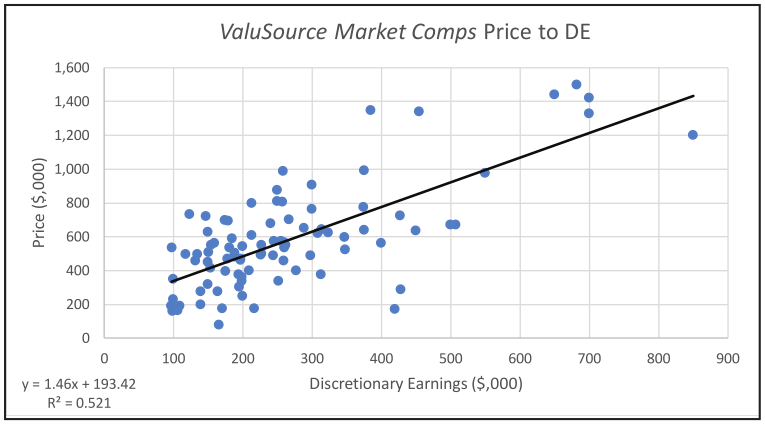
Another study that sorted the data into quintiles by revenue found the smallest 20% of companies (median revenue $100,000) had a median EBITDA multiple of 2.2 times and the largest 20% (median revenue $2,500,000) of 5.1 times. When looking at the actual data, it is not consistent even within specific industry segments and size groups. The above graph is for 114 sales transactions of electrical and other wiring contractors with revenue ranging from $700,000 to $3 million and earnings ranging from $100,000 to $850,000 from ValuSource Market Comps.
For this industry and size-specific data set, the earnings multiples (based on discretionary earnings) range from 1 to 4.9 times, with a median of 2.2 times. The industry rules of thumb are generally based on the average or median multiples. Nevertheless, the graph shows companies often sell for multiples very different than the average.
“What causes this variation?” Value is defined as the present worth of the future economic benefits the company is expected to generate for the owners, including the magnitude of those benefits and the timing of those benefits, as well as the uncertainty that they may not occur when expected. In business valuation, economic benefits are usually defined as the cash flows the company will generate while owned and capital gains (or losses) received when the company is sold.
The uncertainty is measured as risk. All value is forward-looking and speculative, based on assumptions about the future performance and circumstances of the business and is a function of buyers’ and sellers’ expectations of risk and potential future returns. Value is not calculated; it is opinioned based on consideration of the relevant facts, informed judgement, reasonableness and common sense.
The value of any business can be summarized as: Value = Economic Benefits / Risk.
Value increases by increasing the economic benefits and/or reducing the risk and declines by decreasing economic benefits and/or increasing risk. Beyond the industry and magnitude of revenue and earnings, other factors that affect the perceptions of future earnings and risk include growth, debt, profit margins, asset utilization and available working capital. In addition, value is impacted by depth and quality of management and staff; customer, product and supplier diversity and concentration; quality of financial statements; competition and barriers to entry; operating systems, equipment and other assets; quality and location of facilities; licensing and legal compliance; sustainability of revenue and earnings; written business plans and operations and compliance manuals; and transferability.
All these factors contribute to determining the right value multiple for a specific company.
Louis Pereira, MBA, Lifetime MCBI, CBA, ASA, CVA, is a certified business appraiser and accredited senior appraiser with Merrimack Business Appraisers LLC.
I am often asked by private business owners and their advisors: “What multiples of revenue and earnings are businesses in my industry selling for now?”

When operating in a higher expense environment, a variety of practices can help businesses protect profitability.

Retirement raises many questions for business owners, but one of the biggest may be: What happens to everything I’ve built when I’m ready to leave?

New Hampshire small businesses saw fewer 7(a) and 504 loan approvals and a total lower approval amount in fiscal year 2026 compared to the previous fiscal year, while the average loan size grew, according to loan approval data provided by the Small Business Administration (SBA).

Citizens Bank picked a most opportune time for a session on how people can cope in today’s challenging economy. It occurred Nov. 3, the day after the mid-term elections where the issue of affordability played a major role in Democratic…

Cyber and payment fraud losses are board-level risks for every organization, escalating the need for strong, modern security systems

How to begin building a wealth transfer plan around the outcomes you want to achieve

Interest rates affect nearly every business decision — from expansion plans to asset acquisition to operational budgeting.

It's still a fact in 2026 that New Hampshire has the second oldest population in the United States — 43.4 median age — tied with Vermont and topped only by Maine. Most senior citizens in New Hampshire say it's a great place to retire. But it depends on life's circumstances.