There’s lithium in them hills
Whether the NH stash should be mined is undetermined
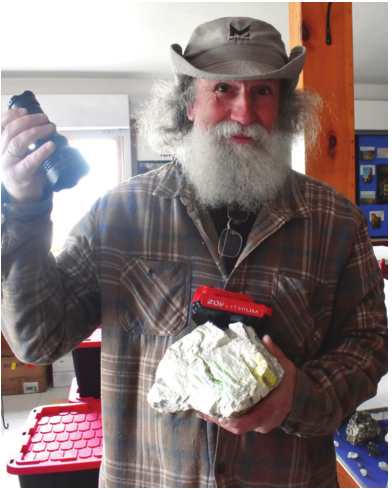
Holding a piece of autunite on top of which is a lithium battery for powering hand tools, “Prospector Joe” Bodge says the battery is likely the only lithium visitors will see at Ruggles Mine in Grafton, which at one point was the oldest and largest mica mine in the U.S.
There’s lithium in the hills of New Hampshire, the U.S. Geological Survey (USGS) says, but the precise location of the lithium has not been made public. And there doesn’t seem to be clarity about whether the lithium should be mined, even as significantly larger deposits are being discovered throughout the U.S.
The USGS said the Appalachian region of the eastern United States, including New Hampshire and western Maine, “contains an estimated 2.3 million metric tons of undiscovered, economically recoverable lithium, enough to replace 328 years of U.S. imports at last year’s level,” the USGS said April 28.
The USGS said 1.4 million metric tons of lithium oxide is “concentrated in the Carolinas, and the northern Appalachians hold an estimated 900,000 metric tons, concentrated in Maine and New Hampshire.”
The above quantity of lithium, the USGS said, would be enough lithium, based on 2025 usage, for 1.6 million grid-scale batteries; 130 million electric vehicles; 180 billion laptops, or “a 1,000 year-supply of laptops for the world; “and 500 billion cellphones, or “60 cellphones for each person on earth.”
The USGS said the supply of lithium has become “a priority for technology companies” and also a security concern for the U.S., because while “Australia is the world’s largest producer of lithium, China is second, and accounts for the majority of world lithium refining and consumption.”
There is lithium in pegmatites in the north Appalachian region, including in the Grafton Pegmatite District, where the famous Ruggles Mine is located; at the Palermo Mine in North Groton, which is also in that district; and in the Keene District in Cheshire County, which is concentrated in the Gilsum–Alstead area. The USGS added that there are also pegmatites in the Raymond District.
Despite the presence of pegmatite-bearing lithium in New Hampshire, Matt Davis, an associate professor and undergraduate coordinator of Earth Sciences at the University of New Hampshire, said the deposits cited by the USGS in its April 25 announcement were located mostly in Maine, mainly in Newry and that the lithium was occurring in spodumene.
He said the USGS announcement “sets the stage for discussion of mining lithium in New Hampshire,” but the matter is not entirely resolved. The lithium in New Hampshire that the USGS references is “a resource yet to be discovered,” said Davis, although it is guided by accumulated data.
Overall, “We should take it (the USGS announcement on lithium deposits in New Hampshire) with a grain of salt,” he said.
Asked to quantify the 900,000 metric tons of lithium identified by the USGS in Maine and New Hampshire, Davis said the quantity “is a lot” but cautioned that it has yet “to be discovered.”
Davis believes that a geological assessment should be done and that the state of New Hampshire should bring in experts to identify and quantify the amount of lithium here.
He was adamant that there are no petroleum deposits in New Hampshire, and when asked about rare earth elements, replied that the conversation about them was “similar” to that about lithium.
Phoenix Tailings, which operates a facility in Exeter, said on its website that it is “restoring U.S. industrial independence by building the domestic refining capacity needed to make metals for every major technology. Our mission is to redefine the metals industry by creating the first fully clean mining and metals production company.”
Following a visit to Phoenix Tailings recently by Gov. Kelly Ayotte, the company said on its social media that, “As geopolitical tensions continue to rise, rebuilding domestic rare earth supply chains has become one of the defining industrial challenges of our generation. The United States cannot afford to rely on foreign adversaries for the materials powering defense systems, energy infrastructure, robotics, aerospace and advanced manufacturing.”
Davis said policymakers should do their jobs before any mining of lithium in New Hampshire takes place.
Asked whether investors should start looking to buy potentially lithium-laden land in western Maine or New Hampshire, Davis said “‘not yet.”
Jack Savage, who is president of the Society for the Protection of New Hampshire Forests, said it was “premature” to weigh in on lithium mining in the Granite State. Nonetheless, the Forest Society is concerned “about the potential impacts on conserved land and effects on conservation values.”
The Forest Society cares about water quality, he said, and “about forests, about wildlife, we care about recreation so we think about how any activity might impact those conservation values.”
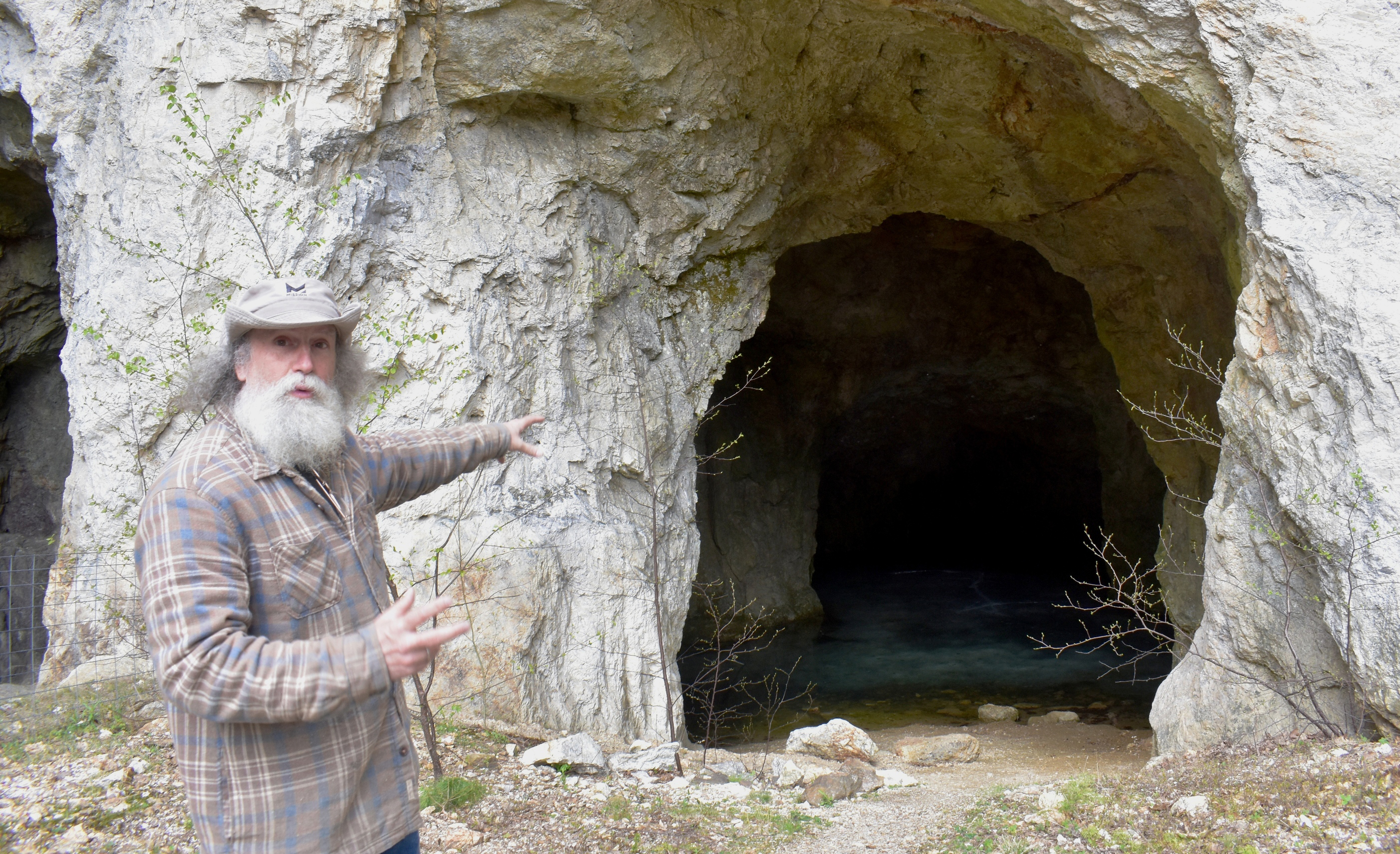
“Prospector Joe” Bodge at the Ruggles Mine in Grafton on May 11. He said Ruggles will never mine nor look for lithium. (Photo by John Koziol)
“Prospector Joe” Bodge of Ruggles Mine in Grafton suspects there’s lithium on his property but doesn’t want to know for sure. He’s a little suspicious of government and how, when the government learns of something that it might want, the government will sometimes find a way to obtain it.
Bodge, who wants to preserve Ruggles Mine to be enjoyed by his children and grandchildren, as well as the public, said mining is an inherently destructive process.
“It destroys the land and it (the land) can never be recovered,” Bodge said. Mining is “not environmentally friendly,” he added and “places like this (Ruggles Mine), once they’re gone, they’re gone.”
Ruggles will “never” explore its lithium potential, he said, and should the USGS come to the mine to do test pits, he would deny them the opportunity.
“There’s plenty of lithium already being mined and to destroy a rural area doesn’t make sense, in my opinion,” he said.
Inside the Ruggles gift shop, which is being rehabilitated, Bodge held a chuck of autunite on top of which he positioned a lithium battery that powers hand tools.
“This is as close as people are going to get to seeing lithium as far as we believe,” Bodge said. “We’re not digging for lithium, and we’re not testing for lithium.”