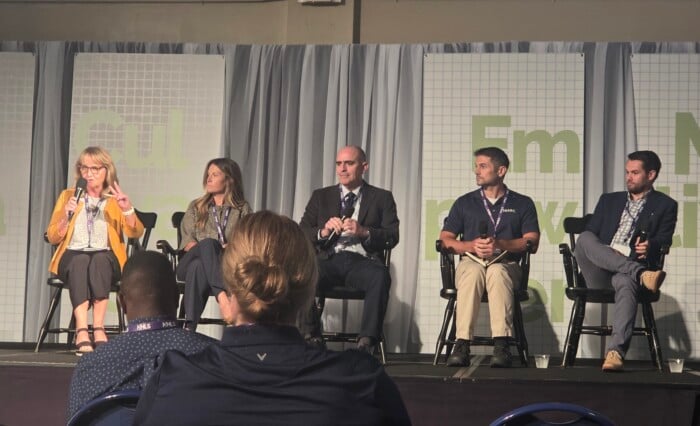
Childcare solutions in action: How businesses are addressing workforce needs
Strengthening New Hampshire’s childcare ecosystem isn’t solely the responsibility of parents, providers or government.
Sections
Extras
Connect With Us
Gov. Chris Sununu signed off earlier this month on a two-year, $250,000 pilot program that will incentivize selected New Hampshire schools to buy local.
The program, established by House Bill 1678, will reimburse chosen schools for certain foods that “originate in New Hampshire.” Approved items include meats, fruits, vegetables — and, in New Hampshire fashion, cider and maple syrup.
The Department of Agriculture, Markets, and Food will administer the request for applications. The program aims to choose one school from each of the state’s 10 counties, but if not all counties apply, a second school from the same area may be chosen.
A selection committee with members including a farming representative and a child nutrition expert, among others, will make the picks.
Only schools that participate in the National School Lunch Program, which provides free or low-cost lunches to children, are eligible for the program. The schools chosen should “represent a variety of school sizes, geographic locations, and socioeconomic backgrounds,” the bill reads.

Strengthening New Hampshire’s childcare ecosystem isn’t solely the responsibility of parents, providers or government.
There are any number of reports, surveys, and rankings that show how well — or how poorly — New Hampshire is doing on a range of issues. Everything from education funding to safety to having a baby to business opportunities to student loan delinquency — it seems everything can be measured in one form or another, often as a yardstick against other states.
The two educational institutions launched a new pilot partnership this summer, bringing 16 high school students from towns across New Hampshire together to learn the math behind AI and how to use it to tackle real problems.
Gather’s new culinary education program, Fresh Start, is a way to teach people with employment challenges the kitchen skills and life skills they need to have a career in the food service industry
New Hampshire businesses are facing a workforce challenge that goes beyond wages and hiring.
When people talk about New Hampshire’s economy, they often picture tourism, small to mid-sized businesses, and manufacturing. Increasingly, there’s another category that belongs on that list: the blue economy.
Southern New Hampshire University (SNHU) will relocate all offices and administrative operations from its longtime Millyard headquarters to its main Manchester campus, a university spokesperson confirmed Thursday, July 16.
At Blueline Advisors in Exeter, chief investment officer Frank Sabin is embracing AI, with the help of the students, to better serve his clients, who have entrusted about $250 million in assets in his care.
Two New Hampshire cities are among the 10 best-run cities in the country, according to a WalletHub analysis of U.S. communities where residents get the most bang for their taxes. Manchester was rated No. 3, while Nashua was close behind at No. 5., based on a “Quality of Services” score that WalletHub developed using 36 metrics across six key service areas — financial stability, education, health, safety, economy and infrastructure/pollution.