Navigating New Hampshire’s new solid waste site evaluation committee
Anyone who has taken a transmission line or a wind farm through New Hampshire’s Site Evaluation Committee knows the process is long, expensive and can be fraught with complication.
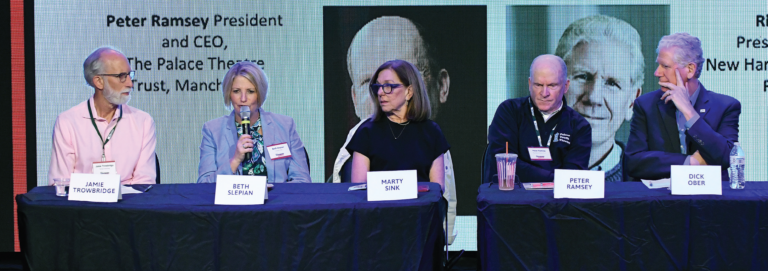
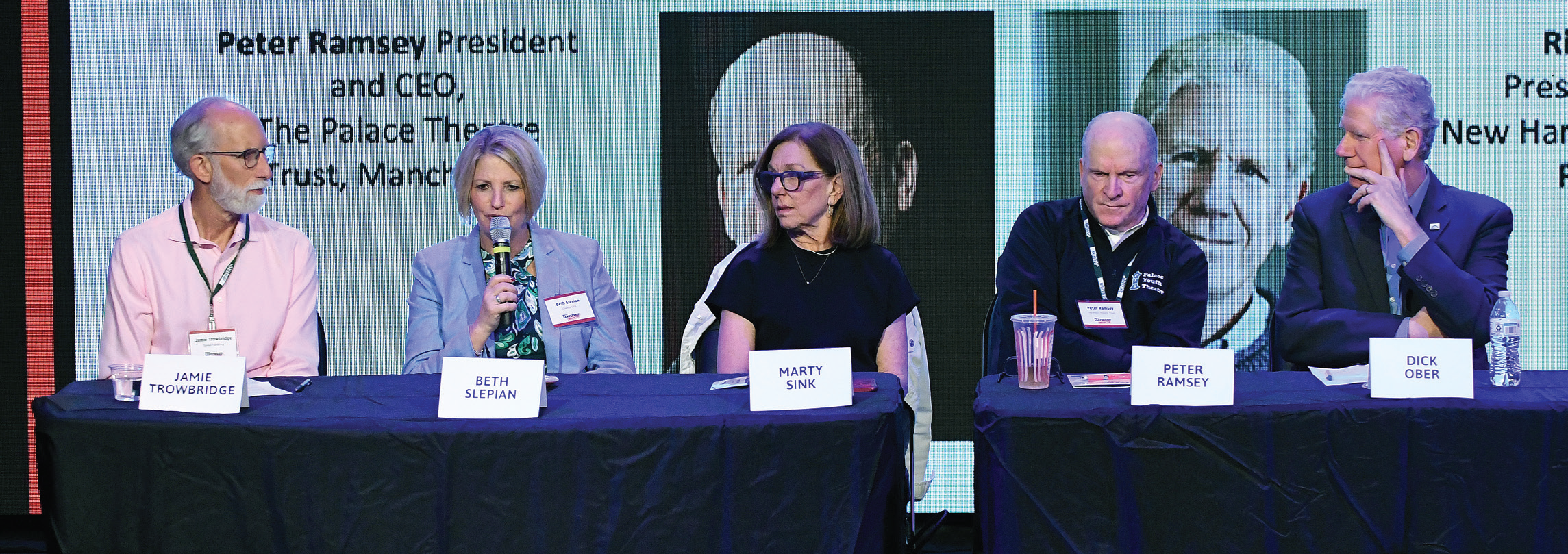
From left, former Yankee Publishing CEO Jamie Trowbridge; Granite VNA President and CEO Beth Slepian; CASA New Hampshire President and CEO Marty Sink; President and CEO of the Palace Theatre Trust Peter Ramsey; and President and CEO of the New Hampshire Charitable Foundation Dick Ober swap stories of success during NH Business Review’s “Leadership Unscripted” event on June 4 at the Rex Theatre. (Photo by Jodie Andruskevich)
Is leadership thrust on you, or do you have to seek it out? Community engagement and helping others were themes at NH Business Review’s annual event, “Leadership Unscripted: New Hampshire’s Senior Executives on Success, Setbacks and the Climb to the Top” on June 4 at The Rex Theatre in Manchester.
The event was moderated by NH Business Review and New Hampshire Magazine Editor Mike Cote. Yankee Publishing President and CEO Ernesto Burden gave an introduction and offered remarks.
Panelists were Beth Slepian, president and CEO of Granite VNA; Marty Sink, president and CEO of Court Appointed Special Advocates (CASA) of New Hampshire; Peter Ramsey, president and CEO of The Palace Theatre Trust; Jamie Trowbridge, former Yankee Publishing CEO; and Richard Ober, president and CEO of the New Hampshire Charitable Foundation.
Cote kicked off the event by asking each panelist to describe their journey to the top. Early family experiences were revealed as catalysts that helped shaped their leadership careers.
Ramsey told the crowd he has felt connected to the performing arts since he was a child. But his mother’s service on a nonprofit board also made an impression on him.
“She ran for selectmen way before women were involved in politics, and the one message she gave all of us was, ‘Get involved in the community, try to be a nice person and make a difference,’” Ramsey said.
The pandemic reinforced in him the importance of arts in the community. He recalled a Palace run of “Mamma Mia” early in 2020, when then-Gov. Chris Sununu asked Ramsey to close, saying it would only be “two weeks.”
Ramsey remembers pushing back, knowing that the arts was sorely needed during isolation. “You can’t watch a symphony online,” Ramsey told the crowd, recalling that the Palace Theatre wrote about 50 grants to raise nearly $7 million in about 18 months to keep afloat, noting that hundreds more venues still haven’t reopened.
Beth Slepian, president and CEO of Granite VNA, also reflected on her family’s legacy of giving back.
For the first 25 years of her career, Slepian says she was a “boots on the ground” physical therapist, helping patients with spinal cord injuries and strokes in various hospital- and skill-based health organizations. Those experiences, along with her work in nursing homes, eventually led to her second life calling as a leader in the nonprofit sector.
Slepian, who will retire after 39 years, says she loves compliance, education and training, and advocacy (“I’m a wicked rule follower”), but emphasized that rules aren’t everything.
Slepian remembers being knocked out of the running for a job because she didn’t have “chief” in her title. Possessing “passion, people and purpose” means giving more than what your job title entails, Slepian said.
“Titles do not make a person a leader. I will hire somebody now with life experience over a title or a degree any day,” Slepian said.
President and CEO of the New Hampshire Charitable Foundation Richard Ober outlined his lengthy leadership record in the state. Ober said, apart from a college internship, his entire 43-year career has been within the nonprofit sector here.
“I stayed long enough in my first two nonprofits to actually get promoted to leadership positions, and that position was, by far, the biggest job of my career: running the NH Charitable Foundation for the last 16 years,” Ober said.
He says New Hampshire’s close-knit community feel led him to these roles.
“New Hampshire is a small neighborhood; we’re built on networks and relationships. I’ve essentially had three big nonprofit jobs in the state. Every single one of them led from the previous one. Nonprofits are staffed and structured by deeply purposedriven people,” Ober said.
He also felt a sense of duty to serve others in New Hampshire.
“Place really matters to me — it’s all about the power of place. How does place affect us, and how do we give back and shape that place? That’s essentially been my career,” Ober remarked.
Jamie Trowbridge’s path toward becoming president and CEO of Yankee Publishing in 1999 began as a kid spending time at the company’s Dublin office. (Up until 2019, Yankee Publishing was a family-run organization; Trowbridge was the publishing company’s third-generation owner.)
Like Ober, Trowbridge acknowledged he had an edge over other qualified candidates, “but hopefully we bring something to the party that is more than the family name,” Trowbridge told attendees.
Initially, Trowbridge doubted he could take on such a monumental task, saying he stepped into the role before he really knew it was time.
“I was 40, and I had four little kids, and I was not ready (for the role),” Trowbridge said.
But he also knew it was something he had to do. Despite some investment setbacks, the rise of new media and amid print magazine closures, Trowbridge knew diversifying would be the key to survival.
“The 2000s were rough as the impact of the internet and digital media really started to hit the magazine,” Trowbridge recalls.
But buying the Old Farmer’s Almanac was a pivotal moment in the company’s long history, he says. Launching almanac.com made the organization a daily publication rather than an annual one — a “transformation” that landed Yankee Publishing on a national and world stage.
“To this day, more than 5 million people visit almanac.com,” he said.
Trowbridge said change within an organization can be “uncomfortable” for everyone involved, including the customer, who appreciates consistency in a longstanding product like Yankee Magazine.
But as the CEO within a rapidly changing media industry, he knew his role was to push the company further.
Transitioning the company toward an employee stock ownership plan (ESOP) required the company to incur more debt, but it also gave more financial power to its employees, and in turn would keep the company safely intact.
“The switch to employee ownership means that employee owners are more invested, literally and figuratively, in the future of the company,” Trowbridge said. Marty Sink, who founded CASA of NH in 1989, says her family was also rooted in community service.
“What I grew up with was a family that was about giving back to others. That was instilled with myself and my four siblings from a very early age,” Sink says. “That was what is fundamentally, I think, at the core of what I do, is trying to do things for others and give back as unselfishly as possible.”
Sink was also spurred to lead others through her own experience as a foster parent.
“We probably had about a half a dozen foster children in and out of our home, but I became very quickly, very aware of gaps in this system of child protection within the state of New Hampshire,” Sink says.
After obtaining $5,000 in seed money from the National CASA/GAL Association for Children, the New Hampshire chapter began with 10 volunteers advocating in two district courts. Now, about 600 NH volunteers give up their time to advocate for a better life for children within the state’s welfare and judicial system.
Ober used an analogy from his early writing career to share a nugget of advice for those seeking business roles that have a higher calling.
“I do know something about New Hampshire, and I know something about nonprofits. Write what you know about and don’t pretend that you know about something you don’t know about,” he said.
Sink called her career “an incredible journey,” saying, “I didn’t come with leadership skills, but you kind of learn as you go.”
Trowbridge reminded the group of the company’s vision statement, which carries themes of growth, sustainability and a duty to local communities.
“Leadership is, as Dick (Ober) said correctly, in your heart. A good leader is a good person; a bad leader is just kind of really not a good person,” Ramsey said.
Slepian said she loves being a leader. “For me, it’s just a privilege.”

Anyone who has taken a transmission line or a wind farm through New Hampshire’s Site Evaluation Committee knows the process is long, expensive and can be fraught with complication.
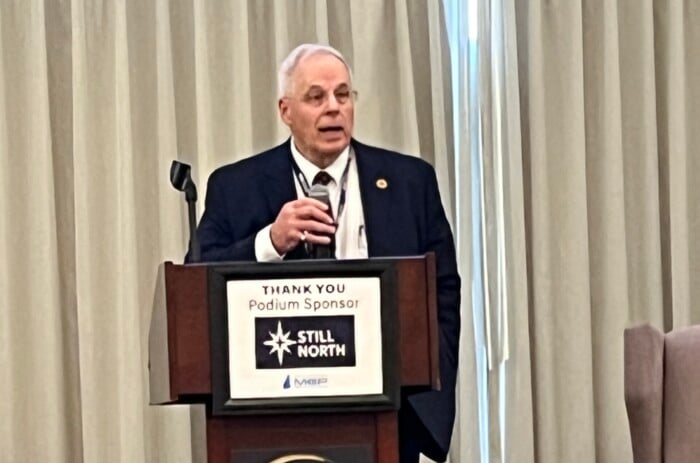
This year’s Advanced Manufacturing and High Technology Summit kicked off with a topic universal to all employers: how to build the workforce of tomorrow. The 24th annual event organized by the New Hampshire Manufacturing Extension Partnership on Oct. 9 featured a keynote panel discussion featuring representatives from the state’s university and community college systems.

Agritourism has become an important business option for many farms in New Hampshire and across the country. Exactly what is agritourism?
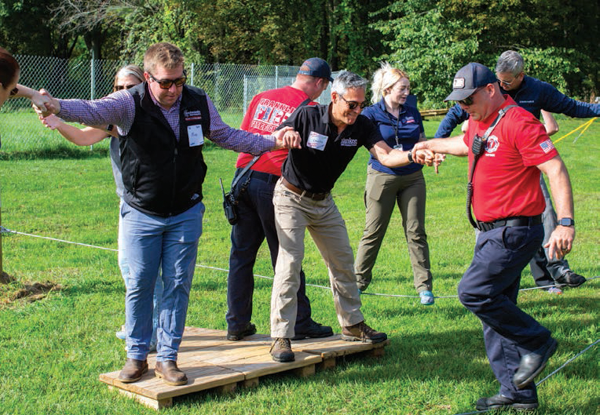
On a recent Friday at the Easterseals NH Military & Veterans Campus in Franklin, I found myself about 30 feet in the air. I was holding onto a pole and contemplating what suddenly seemed like a rather narrow log stretching out over a great deal of empty space toward another pole, which also seemed remarkably distant.
In recent years, New Hampshire families have faced persistent and growing challenges with affordability and accessibility as they navigate the early care and education landscape.

Published annually, “The Best Lawyers in America®” is an exhaustive search for the country’s top attorneys. Here is a compilation of the top attorneys who practice in New Hampshire in dozens of legal specialties related to the needs of businesses,…
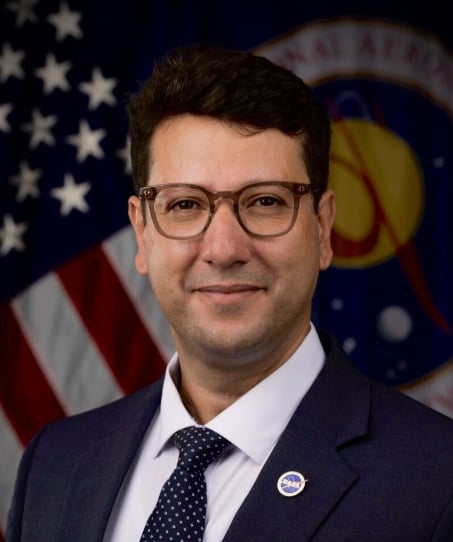
Ramy Rahimi is the new vice president for research and development at the University of New Hampshire.

This year, NH Business Review marks the 24th anniversary of our Business Excellence Awards, which celebrate the initiative, creativity and tenacity of the Granite State’s business community.

Back in 1992, political strategist James Carvell came up with the phrase, “It’s the economy, stupid,” to help Democrat Bill Clinton defeat incumbent Republican President George H.W. Bush.