Permitting and construction of new homes is up, but it’s still at historic lows and not enough to keep up with demand.
The recent housing production is mostly single-family, with a smattering of multi-family developments but relatively few duplexes, triplexes and fourplexes.
In the state’s largest job centers — namely Portsmouth, Lebanon, Bedford, Concord, Hooksett, Londonderry and Salem — there isn’t enough housing for the people who work there. That forces them to live elsewhere and forces them to pay what’s called “the commute tax” that costs them more than just time and money.

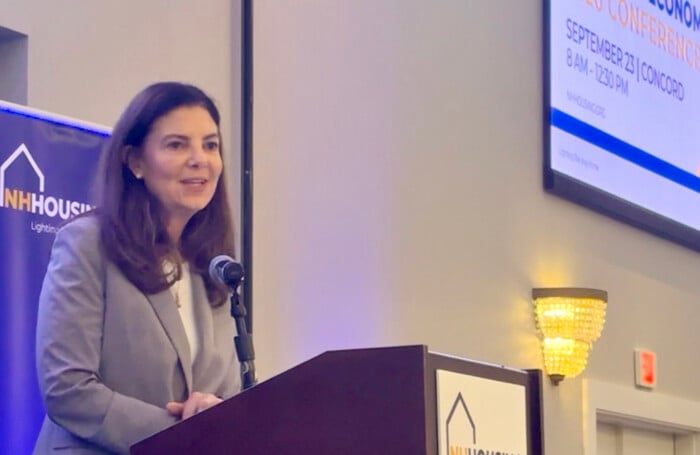
Gov. Kelly Ayotte addresses the Sept. 23 New Hampshire Housing conference, telling attendees it’s “all hands on deck” to create ways to solve the state’s housing crisis. (Paul Briand photo)
Those are some of the findings of the 2026 Housing Report as outlined by Rob Dapice, executive director and CEO of New Hampshire Housing, during its annual conference held Sept. 23 at the Grappone Center in Concord.
“New Hampshire voters made it clear just last month in another UNH Granite State poll that housing is far and away the most important problem facing the state of New Hampshire,” said Dapice, referencing the August survey that showed, among the many issues that Granite Staters are coping with, housing is at the top.
And by a wide margin. The poll shows 26% of respondents feel housing is the number one problem facing the state, followed by taxes (18%), cost of living (15%), education (6%) and jobs/economy (6%).
The conference, which attracted about 300 registrants, included opening remarks from Gov. Kelly Ayotte, who noted “it’s going to take all hands on deck working together on this housing issue.”
She cited past legislative progress to make the creation of more housing easier, but noted, “we’ve got to keep the momentum going and make sure that we’re heading in the right direction with continuous and more production housing of all forms, so that people can enjoy working, living the quality of life of this awesome state.”
“We’re growing in population, and this is an issue that will allow us to remain vibrant, allow us to grow, allow us to remain strong as a state,” Ayotte added, “because if they want to come here, they want to stay here. Our young people, my children, your children, we need them to have a place to stay.”
NH Housing (formally known as the New Hampshire Housing Finance Authority) released two reports in advance of the conference.
One report debunked the notion that building affordable housing deflates the value of nearby residential properties. (See a related NHBR story.)
The September 2026 housing report highlighted some well-established trends in the state — the wide gap between home prices and incomes, the difficulty that renters face in making the transition to home ownership, and the affordability of rents.
It also described “the commute tax” and the effect it has on workers who can’t afford or can’t find housing in the communities in which they drive to their jobs each day.
“Commuting is a normal part of life,” said Dapice in his executive summary, “but when jobs and homes are too far apart, the cost imposed on workers (particularly lower-wage workers) can be severe. In a state ranked #41 for transportation, it’s an issue that deserves our attention.”

Preston Hunter of PROCON talks about a project to convert the former Hillsdale Elementary School in Manchester into housing as part of a panel discussion Sept. 23 at New Hampshire Housing’s annual conference. (Paul Briand photo)
The report describes “the commute tax” that affects both workers and their employers: “The cost includes more travel time, transportation expenses, stress, and less flexibility for work and family responsibilities,” it said. “Employers face a smaller practical work pool and greater exposure to delays, absences, and turnover.”
The report charted a jobs housing index, saying an index of 1.3 to 1.7 jobs per housing unit is considered balanced. Communities showing above that target, according to the report, have more jobs than housing and thus depend heavily on workers living elsewhere.
Portsmouth topped that ranking with an index of 3.37 followed by Lebanon (2.82), Bedford (2.45), Concord (2.21), Hooksett (1.93), and Londonderry (1.93) and Salem (1.75).
Communities falling in the suggested range include Merrimack (1.69), Exeter (1.69), Keene (1.60), Manchester (1.45), Nashua (1.39), and Hudson (1.34).
Those under the suggested range include Dover (1.12) and Rochester (0.84).
The housing conference included keynote remarks from Christopher Thornberg, founding partner of Beacon Economics, whose comments were sometimes at odds with the NH Housing’s findings about such issues as housing affordability.
Thornberg, whose economic research firm is based in California, spoke of conflicting narratives, arguing that current economic conditions are stronger than common narratives suggest, with high consumer spending, incomes and household financial stability.
“I will say over and over again that what New Hampshire has is a supply crisis, not an affordability crisis, and that is a critical distinction because policies that are supposed to help affordability typically hurt supply, whereas policies that help supply help affordability. There is a right side of that equation to operate on and wrong side,” he said.
In speaking of rentals in the state, he cited Manchester and said that renters there now spend 30% of their income on their units, the same percentage they spent in 2024. “Yes, rents are up, but that’s because renter incomes are up. It’s not an affordability crisis, but we think it is,” he said.
NH Housing’s own data shows that Manchester ranks fourth in the state in terms of hourly income ($39.40) needed to afford the median rent there. Lebanon at $46.52 is first, followed by Portsmouth ($45.52), and Nashua ($39.40).
“Even with full-time employment, workers in many of the most in-demand fields such as home health and personal care aides, childcare workers, retail salespersons, and restaurant cooks do not earn enough to afford the median effective rent in the state,” said the October 2025 report.
Dapice diplomatically acknowledged Thornberg’s comments that, in many ways, threw shade on NH Housing’s own data and work. “There’s a lot in there that I think should provoke us and challenge us, and I think there’s been a lot of talk in the last couple of years about free speech and challenging each other. And there’s been efforts on the left and the right to quiet critics. And you know, I think it’s important that when we pretend that there’s only one narrative of what’s going on in the housing crisis, we prevent ourselves from understanding it better and from engaging with people who disagree with us,” he said.
The housing conference included two panel discussions: one on repurposing historic structures for housing and one on building the workforce as a way to build communities.
The state’s housing issue “can certainly create opportunities for rebuilding our communities in a more sustainable way using our resources that we already have,” said Nadine Miller, deputy state historic preservation officer, in introducing the panel on repurposing older buildings.
The panelists included Preston Hunter, PROCON’s vice president of business development, John Knight, executive director of Historic Harrisville Inc., and Stuart Anderson of Alba Architects.
Each had examples of their work to repurpose buildings that were otherwise languishing in disrepair, including: the Notre Dame School in Berlin, the Hallsville Elementary School in Manchester, and former milltown residences in Harrisville.
The panelists noted the challenges that can range from structural to zoning to grant funding from a variety of federal and state agencies.
But Hunter noted that available land for housing development is scarce. “I think there’ll be more and more value placed on existing buildings as a great asset and opportunity to fill our housing needs going forward,” he said.
On the workforce front, moderator Richard Lavers, commissioner of NH Employment Security, drew a parallel between building the workforce and housing. “We need to get young people, middle-aged people, older people to play their part in helping to build that workforce that we so desperately need to continue to build our housing supply in New Hampshire is critical,” he said.
Material related to the housing conference, including slides used during presentations, can be found here.