Dartmouth professor honored for developing ‘camera-on-a-chip’ that powers smartphones
Eric Fossum co-invented technology that grew out of research at NASA

Eric Fossum received the Bayh-Dole Coalition’s American Innovator Award in Washington, D.C., on June 3. (Bayh-Dole Coalition)
Whenever you pick up your phone to capture video, use your car camera to back out of your driveway or review your doorbell footage to watch deer in your backyard, you can thank Eric Fossum.
The camera-on-a-chip technology that drives smartphones, web cameras, medical devices and other electronics was co-invented by an engineer who now serves as a senior professor at Dartmouth College.
More than 30 years later, the accolades keep coming. On June 3, Fossum received the Bayh-Dole Coalition’s American Innovator Award, along with co-inventor Sabrina Kemeny, co-founder of tech startup TAP Systems Inc.
“It’s kind of amazing to watch your “technology” grandchildren grow up and multiply and be fruitful,” Fossum said during a recent interview with NH Business Review.
The solid-state image sensor technology grew out of research Fossum was working on for NASA’s Jet Propulsion Laboratory in California. Fossum and Kemeny, his wife at the time, started Photobit Corporation in 1995 to further develop and commercialize it. The company was acquired by Micron Technology in 2001.
Even Fossum — who Forbes named one of the top 250 living American innovators this year — is surprised by the image technology’s impact, which is widely used in biomedical devices and surgical instruments.
“There are so many applications, and it’s so ubiquitous that everybody takes it for granted now that they have a camera in their pocket or that it’s used for their automotive applications, parking their car, whether it’s a backup camera or it’s 360-degree view cameras,” said Fossum, who joined Dartmouth in 2010.
The American Innovator Award, which included a trip to Washington, D.C., celebrates the importance of innovation and technology transfer that was made possible by the Bayh-Dole Act, the 1980 federal law that allows universities, small businesses and nonprofits to own, patent and commercialize inventions developed with federal funding.
“It used to be that when a federal contract led to an invention, the government would own the invention, which seems reasonable at the surface,” Fossum said. “But the reality is that the government didn’t know how to commercialize those investments.”
Before Bayh-Dole, promising technologies were more likely to get stalled by bureaucracy. And no one is going to champion an idea more than the people who came up with it, Fossum noted. Under the act, whoever secures the federal contract has first dibs on commercializing the invention.
“Then you are looking for indirect payback to taxpayers by growing a company which pays taxes or employees’ wages or strengthens the economy by allowing other types of new companies to flourish like Facebook or something that’s based on picture-taking … Otherwise, that invention could have languished inside some virtual warehouse of intellectual property that never got commercialized.”
Fossum is getting used to traveling to Washington to be honored for his work. In January, the National Academy of Engineering named him the recipient of the 2026 Charles Stark Draper Prize for Engineering, an honor that included a $500,000 cash award (most of which he donated to STEM charities). Last year, he was awarded the National Medal of Technology and Innovation, the nation’s highest honor for technological achievement.
“It is very overwhelming in some ways to get some of these big recognitions,” Fossum said.
At Dartmouth, Fossum directs the PhD Innovation Program and served as vice provost for entrepreneurship and technology transfer, and now heads Dartmouth’s new office for industry partnerships for innovation and education.
“We teach PhD students not only how to do research, but also how to think about commercializing whatever technology they’re working on during the research phase so that they could actually start their own company,” Fossum said. “When they get out, they have the tools and knowledge they need to do a startup and perhaps be successful.”
The program currently has about 55 students. In addition to conducting research, they take courses on business law, accounting, financing and entrepreneurship.
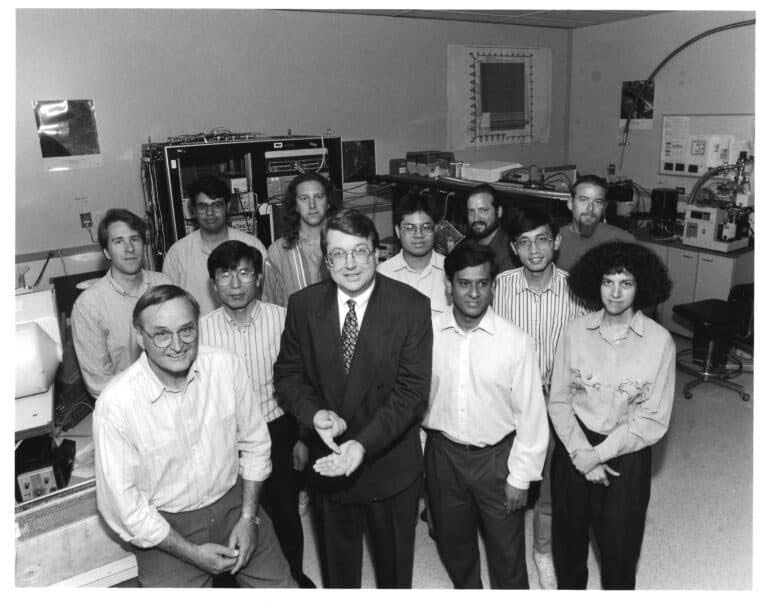
Eric Fossum, with his team, shows the complementary metal oxide semiconductor (CMOS) chip he invented at the NASA Jet Propulsion Laboratory at the California Institute of Technology in 1995. (NASA Jet Propulsion Laboratory)
What happened to Gigajot?
Fossum was named Entrepreneur of the Year by the New Hampshire Tech Alliance in 2019. At the time, he was working on a Dartmouth spinoff developed with graduate students called Gigajot Technology that moved to Pasadena, Calif.
The privately held company announced four years ago that it had developed the world’s highest resolution photon counting sensor. Gigajot’s 41 megapixel GJ04122 sensor was funded in part by the National Science Foundation SBIR Program.
The sensor “utilizes a 2.2-micron pixel and has a read noise of only 0.35 electrons, which is significantly lower than state-of-the-art pixels of similar size,” the company said in an April 2022 press release. “The sensor is capable of photon counting and photon number resolving up to its top speed of 30 frames per second at full resolution.”
Gigajot CEO Dr. Saleh Masoodian said the company’s quanta image sensor will enable discoveries in the life sciences community.
“Additionally, this QIS device further validates that Gigajot has the world’s leading small pixel performance, which will eventually be deployed to high-volume consumer products that value high resolution, low light imaging performance and HDR,” Masoodian said in the release.
For now, that’s where the story ends. Shortly after the announcement, Gigajot’s website went dark, and links in the press release no longer work.
“That company did nicely,” Fossum said, but he was mum on details about Gigajot’s business status, saying he can’t talk about it for legal reasons. Industry observers speculate Gigajot was acquired by another company.
It’s a sure bet Gigajot’s inventions didn’t get sucked into the blackhole of bureaucracy. For now, Fossum can still talk about the technology’s potential.
“Gigajot has been quite successful at further developing the photon-counting image sensor technology that was developed at Dartmouth and has demonstrated some very large pixel count photon counting in the sensors, like 160 megapixels, each one sensitive to a single photon,” Fossum said, “which is quite good for seeing the dark for security applications or perhaps automotive applications or astronomical applications or biotech, manufacturing applications, all those things.”
Considering how much time has passed, you might already be using it.