Philanthropic Giving with Susan Martore-Baker
Cambridge Trust President Susan Martore-Baker discusses the nuances of philanthropic giving ahead of the holiday season

Jason Alexander
I’m a firm believer in starting with clear problems before jumping to solutions. But I also know that many New Hampshire business owners are sitting on the fence, wondering if AI is relevant to their operation at all. The good news? You don’t need a massive budget or a technical team to start seeing value from AI. You just need to know where to look.
Let me walk you through some practical, low-risk AI applications that small and medium businesses can implement relatively quickly.
Most small businesses hit the same wall: As you grow, customer inquiries multiply faster than you can hire people to handle them. You want to be responsive, but you also can’t have someone monitoring email and chat around the clock.
AI-powered chatbots and email assistants can handle a significant portion of routine customer questions. When will my order ship? What are your hours? Do you offer this service? These questions don’t require human judgment, but they do require timely responses.
The key is setting these tools up with clear boundaries. A well-configured AI assistant should handle the routine stuff and smoothly hand off complex issues to a real person. Customers actually appreciate faster responses to simple questions, as long as they can reach a human when they need one.
Implementation is usually straightforward. Most modern customer service platforms have AI features built in or available as add-ons. You’re not building something from scratch. You’re activating a feature and training it on your most common questions and answers.
Here’s a pain point I hear about constantly: time spent on repetitive data entry. AI tools can now extract information from documents with impressive accuracy. Invoice details, contact information from business cards, data from forms. The AI reads the document, pulls out the relevant fields, and populates your system automatically. Your role shifts from data entry to verification, which takes a fraction of the time.
This isn’t science fiction technology. It’s readily available through various software platforms, and the accuracy keeps improving. The time savings add up quickly, and you’re redirecting your team’s energy to work that requires human thinking.
AI email assistants can now categorize incoming messages, draft responses to routine emails, summarize long threads and flag urgent items that need immediate attention. Some can even schedule meetings by understanding conversational requests and checking your calendar.
This isn’t about removing the human element from communication. It’s about clearing away the clutter so you can focus on the emails that actually matter. When AI drafts a response to a routine request, you review it, adjust if needed, and send. You’re still in control, but you’ve cut the time investment significantly.
AI transcription and summarization tools can now attend your meetings, create accurate transcripts, identify action items and generate summaries. Several platforms integrate directly with Zoom, Teams or Google Meet. You focus on the conversation. The AI handles the documentation.
You might spend five minutes reviewing and cleaning up a summary instead of 30 minutes creating it from scratch.
Finding a time that works for three or four busy professionals can take a dozen emails back and forth. AI scheduling assistants can eliminate most of that friction.
These tools can read your calendar, understand availability preferences and coordinate with other people’s schedules automatically. Someone emails asking to set up a meeting. The AI responds with available options or even books directly if you’ve given it permission. You’re not involved unless there’s a conflict or special consideration.
This might seem like a small thing, but the cumulative time saved across a year is substantial.
All these quick wins address repetitive tasks that consume time without requiring significant human judgment. They’re not replacing your expertise or decision-making. They’re clearing away the routine work so you can focus on what actually needs your attention.
If you’re ready to dip your toe into AI, start by identifying your biggest time drains. Where does your team spend hours on work that feels mechanical? Where do routine tasks create bottlenecks? Those are your candidates for AI assistance.
Pick one. Implement it thoughtfully. Measure the time savings. Learn what works and what doesn’t. Then move to the next opportunity.
The businesses that succeed with AI aren’t the ones trying to do everything at once. They’re the ones taking deliberate steps, learning as they go and building capability over time. That approach has always worked in business, and it works for AI adoption, too.
Jason Alexander is the CEO and founder of ChiefAI, an AI advisory and consulting firm helping small and medium-sized businesses implement AI solutions strategically.
Cambridge Trust President Susan Martore-Baker discusses the nuances of philanthropic giving ahead of the holiday season
Author, leadership coach and veteran of 27 years in the Army, Robert Campbell speaks on his 'Battlefield to Boardroom' book series and how companies can become veteran-ready

A tech-entrepreneur turned venture capitalist is eyeing one of the largest undeveloped tracts in Manchester for a community where tech- and startup-minded people would live and work. Freedom Village would be located on 250 acres of mostly wooded land at Hackett Hill, which is located in the northwestern corner of Manchester.

Business and event happenings around the state of NH
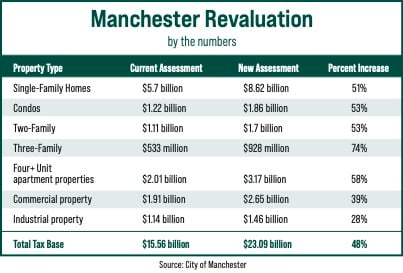
The value of all property in Manchester increased by almost half — 48% ‑ over the past five years, according to preliminary data released by city officials on Oct. 13 The valuations, compiled due to a citywide revaluation, add up to $23.09 billion. The current value of city properties is $15.56 billion, which was based on assessments made during the city's last revaluation.

The Latest is a roundup of the comings and goings of the movers and shakers in NH's business community

Anyone who has taken a transmission line or a wind farm through New Hampshire’s Site Evaluation Committee knows the process is long, expensive and can be fraught with complication.

Artificial intelligence has moved from pilot project to daily practice inside many HR departments.

When Richard “Dick” Levy’s wife, Susan, received a terminal diagnosis of a progressive brain disorder a decade ago, he became her primary caregiver. Doctors estimated Susan had between three and five years left to live.