NHBR About Town: Week of October 9, 2026
Business and event happenings around the state of NH
Sections
Extras
Connect With Us
In mid-May, the U.S. House of Representatives passed its version of the National Defense Authorization Act (NDAA) for fiscal year 2017, and recently the U.S. Senate followed suit. The NDAA is the federal law that lays out the annual budget and expenditures for the U.S. Department of Defense (DOD), including all branches of the military.
Both the House and Senate versions of the NDAA included language instructing the U.S. Department of Defense to adhere to a long-established law known as the Berry Amendment. First passed in 1941, the Berry Amendment requires DOD to purchase — to the greatest extent possible – American-made clothing and textiles for U.S. soldiers.
Unfortunately, for more than a decade, DOD has not abided by this rule with respect to training shoes for new recruits. Since FY 2002, DOD has instead provided new recruits with cash allowances to purchase training shoes, which are not required to be American-made. The explanation: DOD asserted that it was difficult to find suitable athletic footwear that was made entirely in the United States.
However in recent years, American companies, such as New England’s own New Balance and Saucony, have made significant financial investments in equipment in order to produce footwear that is 100 percent American-made, and therefore fully compliant with the Berry Amendment.
In adding this Berry Amendment language to the NDAA, Congress has sent a clear message that DOD needs to drop their reasoning for circumventing the law, buy American with regard to training shoes, and support U.S. manufacturing jobs.
Here in New England, New Balance employs some 1,400 people at five manufacturing facilities throughout the region. When and if DOD follows the Berry Amendment and purchases American-made recruit training shoes, American companies like New Balance could compete for work to produce some 150,000 pairs of shoes for the military, potentially adding even more valuable New England jobs.
Inclusion of this important provision in the NDAA is the result of a strong bipartisan effort on the part of several New England lawmakers.
The law on this matter is clear, and it has been on the books for 75 years. The time has come for DOD to listen to Congress and follow the Berry Amendment — to ensure that our troops are wearing “Made in the USA” shoes as they train to defend our country and in doing so support American jobs.
James T. Brett is CEO of The New England Council.
Business and event happenings around the state of NH
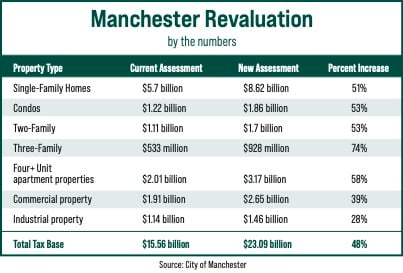
The value of all property in Manchester increased by almost half — 48% ‑ over the past five years, according to preliminary data released by city officials on Oct. 13 The valuations, compiled due to a citywide revaluation, add up to $23.09 billion. The current value of city properties is $15.56 billion, which was based on assessments made during the city's last revaluation.

The Latest is a roundup of the comings and goings of the movers and shakers in NH's business community

Anyone who has taken a transmission line or a wind farm through New Hampshire’s Site Evaluation Committee knows the process is long, expensive and can be fraught with complication.

Artificial intelligence has moved from pilot project to daily practice inside many HR departments.

When Richard “Dick” Levy’s wife, Susan, received a terminal diagnosis of a progressive brain disorder a decade ago, he became her primary caregiver. Doctors estimated Susan had between three and five years left to live.

Interest rates affect nearly every business decision — from expansion plans to asset acquisition to operational budgeting.

More than 20 years ago as a senior at Saint Anselm College, I found my way into a political advertising seminar held at the New Hampshire Institute of Politics.
New Hampshire is a remarkable place. We go first in the presidential primary. Our citizen legislature sends people to Concord who hold day jobs and show up anyway.