The Pulse: Gas, diesel prices jump as war in Iran continues
A gallon of gas has jumped about 25%
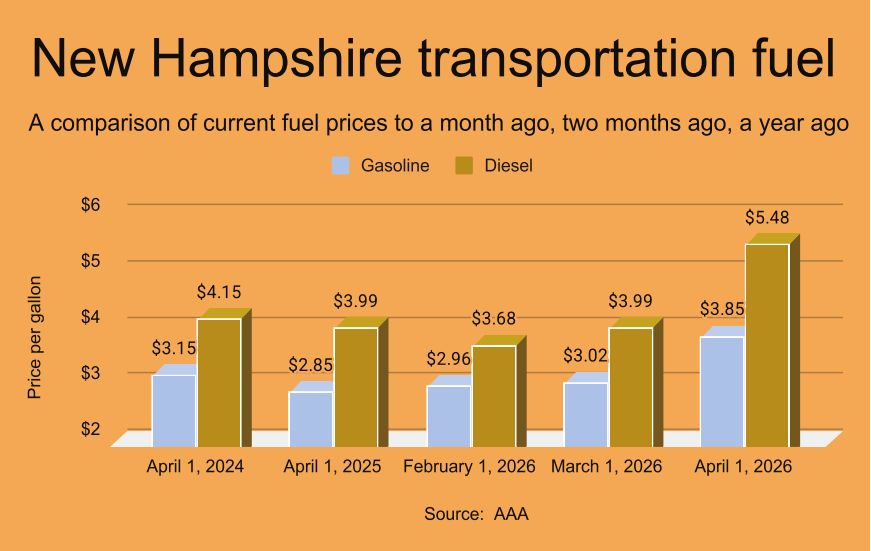
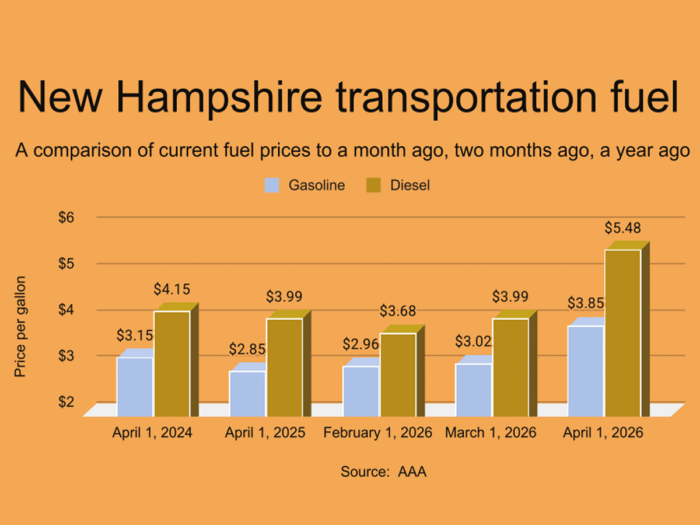
While the average New Hampshire price for a gallon of gasoline rose about 25% in the first 32 days of the Iran war, diesel fuel faced a steeper, 37% increase, according to data compiled by The Pulse.
The increase pushed diesel fuel, which usually costs more than gasoline, to nearly $5.50 a gallon in the Granite State on April 1.
The jolt is likely to ripple across the New Hampshire economy. Transportation is a key component in everything from manufacturing, to tourism to delivery of retail products from companies such as Amazon.
“Everything we need (in New Hampshire) comes by truck,” said Carmine Sarno, vice president of the Candia-based freight terminal M&S Logistics. “Therefore, just about everything that needs to be transported, whether on store shelves or delivered via e-commerce, will cost more.”
April 1 marked the 32nd day of the war against Iran, which started on Feb. 28 when President Trump ordered U.S. armed forces to begin bombing Iran.
The Islamic republic quickly closed the Strait of Hormuz, stranding oil tankers and effectively shutting off the supply of about 20% of the world’s oil.
In the weeks before the action, the price of gasoline in New Hampshire was just shy of $3 a gallon. In all likelihood, it will top $4 a gallon later this month. The national average topped $4 on April 2, according to the American Automobile Association (AAA).
AAA places New Hampshire in the middle range when it comes to gas prices among the 50 states. California gasoline was almost $5.90 a gallon in early April; Oklahoma was the lowest at $3.27.
Last month, New Hampshire economist Brian Gottlob said gasoline would likely exceed $4 a gallon, crossing an important psychological barrier. It would be impossible for such a price not to have an impact on spending, he said.
As a fuel user and vice president of M&S, Sarno struggles with pricing decisions. The company is raising trucking rates when it can, mostly through a fuel surcharge that makes up a portion of the bill that shippers pay.
But in reality, companies can’t pass along 100% of the increases in diesel.
“Margins are already thin, so spikes like this get absorbed in part by the carrier,” he said. He estimates that trucking companies recover only a half to two-thirds of any rapid increases in fuel prices, especially in the short term.
Several factors come to play. Some shippers withhold loads, hoping prices will stabilize. Truckers outbid one another in the backhaul market, which represents return loads after an outbound delivery. Also, customers are pushing back when confronted with rate increases.
“When costs rise faster than the ability to raise the rates, most fleets will opt to park their trucks rather than operate at a loss, especially without a relief in sight,” said Sarno, who is chairman of New Hampshire Motor Transport Association, which advocates for the trucking industry.
He cited several factors for the steeper increase in diesel prices, including the inability of truckers to cut back on nonessential travel, as opposed to car owners.
Also, the need for diesel is strong; diesel powers the cargo ships and other military equipment now engaged in the Middle East.
Meanwhile, some preliminary indications show the economy is holding its own.
Nationally, the United States added 178,000 jobs in March, far more than had been projected. And in February, inflation in New England amounted to 1.2% over the previous 12 months.
Those readings will likely change the longer the Middle East conflict goes on. But New Hampshire is not as vulnerable to oil price shocks as it was in the 20th century.
Most of New Hampshire electricity is generated by natural gas, which is produced in the United States, and nuclear energy, which is produced at Seabrook.
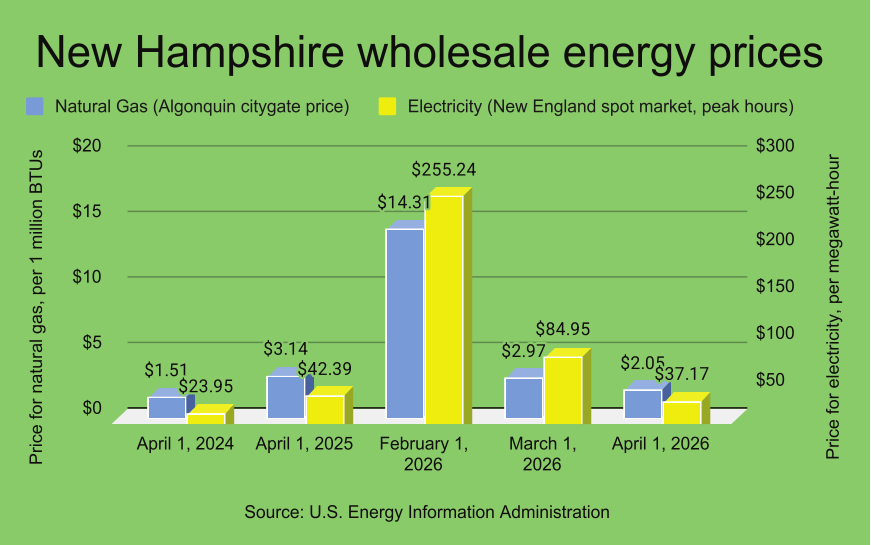
In fact, wholesale prices for natural gas and electricity fell over the last two months, the opposite of oil-based fuels.
“As we transition to spring, natural gas demand for home heating decreases, allowing more to be used for electricity,” said New Hampshire Energy Commissioner Jared Chicoine.
New England also uses less electricity in the shoulder months between the winter and summer.
“Compared to this winter, the region’s coldest in 20 years, gas demand is lower and access to domestic supply is higher. This has stabilized electricity prices, despite challenges in the oil markets,” Chicoine said in an email.

“The Pulse” is an exclusive feature of NH Business Review that examines local and national data to track New Hampshire’s economy.
Each month, the series examines an economic trend based on the latest data. On a quarterly basis, “The Pulse” will report key economic indicators such as employment, inflation and economic growth for the New Hampshire economy for a more expansive review that includes several informational graphics.
“The Pulse” focuses on three key indicators: prices, output and labor.
It will also feature a wild card category. One of the six will change every quarter in an effort to capture data that gives additional insight.
A gallon of gas has jumped about 25%
Federal Reserve report shows cautious optimism about the future
The New England region was one of only four in the United States to experience economic expansion during October and early November, according to the latest "Beige Book" report of the Federal Reserve. The report said the outlook for future economic growth was "cautiously optimistic" for the six-state region. But it expressed ongoing downside concerns about the labor market.
Inflation up, car registrations level, job numbers more a guess for the third quarter 2025
The following data shows the extent that New Hampshire employers rely on the H-1B program to fill positions for highly skilled workers. Recently, President Trump instituted stiff, $100,000 fees for future H-1B workers. Media reports say some 700,000 people work…
The unstoppable New Hampshire economy of the post-COVID years is running into economic headwinds of higher unemployment and inflation, a nonpartisan economic research firm said in late August. No definitive evidence points to a recession, the New Hampshire Fiscal Policy Institute said in an economic issues brief.

SNHU professor says data shows no cause for concern right now