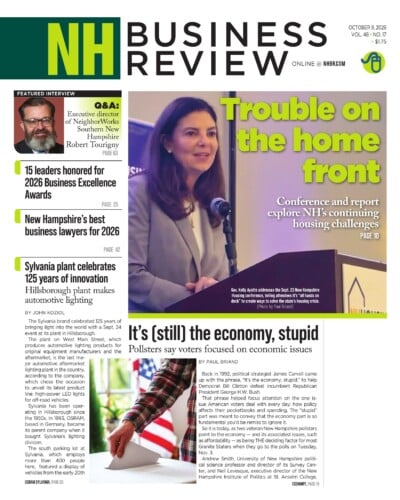
Ask a developer about the best way to bring down the cost of new housing in New Hampshire, and he’ll tell you it’s allowing more density.
That was the case Sept. 17 when New Hampshire Business Review (NHBR) hosted a webinar on housing that included Eric Jackson from the Stabile Companies, a housing developer/builder based in Nashua.

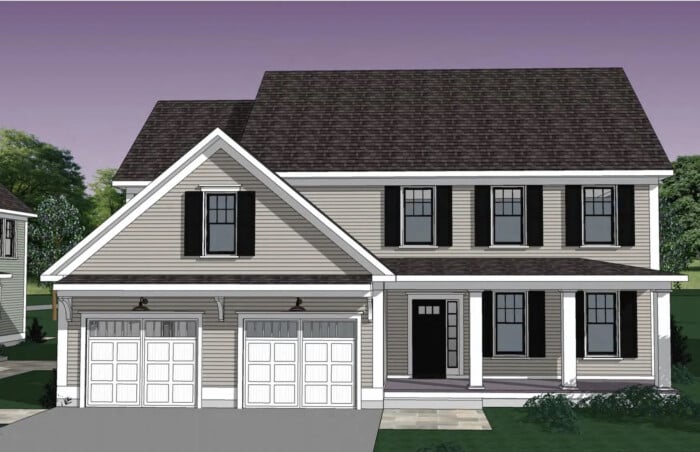
This rendering shows a “twin home,” the term the Stabile Companies use to describe the duplexes they are building in a development called Deer Cove in Dover as an example of how greater density can be used for housing construction.
The webinar — Housing Trends 2026: From the Ground Up — also included Nicholas Harris from the Sheehan Phinney law firm and Chase Hagman from New Hampshire Housing.
“We simply can’t get enough density to make projects financially feasible, and density is by far the best way to bring housing costs down,” said Jackson, Stabile’s director of acquisitions and development.
His median price for a newly constructed home in Hillsborough and Rockingham counties, where his company does most of its work, is $980,000.
Because of the higher cost of land acquisition (up 65%, he said), the cost of road and infrastructure installation (up 70%), and the actual cost to build the house (up 104%), his road cost per house drops if he can put more homes in a development site with higher allowed density.
“If you build a 1,000-foot road on a piece of land for about $1,200 a foot, which is about what it costs to build a road these days, that’s $1.2 million,” he said. “If you put 10 houses on that road, your road cost per house is $120,000. If you put 20 houses on that road, your road cost per house is $60,000. So, by doubling the density, you’ve cut your road cost per house in half, which in this example saves $60,000 on the price of a house, and that’s a really big deal.”
Land use and zoning remain issues — both locally and at the state legislative level — as New Hampshire continues to discuss ways to get itself out of a residential housing market cycle of high demand and high prices.
The webinar sought to look at the issues, with a focus on the challenges and opportunities faced by developers, as represented by Jackson as a builder and by Harris, who represents a number of landowners and developers.
Hagman, managing director of NH Housing’s home ownership division, said a number of factors make the current market challenging, including mortgage rates that are climbing beyond 7% with no forecast of them coming down any time soon.
Supply, as measured in months, remains at about two; with a balanced market the months supply should be between five and six, he said.
“But you could also make a really strong argument that our biggest need in terms of inventory remains around starter homes, with a reasonable price point to get younger individuals and families into a home and into communities, as well as homes for those that are entering retirement or trying to downsize,” Hagman said. “That’s really a rather big gap in the market at the moment.”
And there is an affordability gap, according to Hagman. The median price for a home in New Hampshire was about $570,000, according to data from the New Hampshire Association of Realtors. To afford that home, a household would need to earn $182,000 annually, and only 15% of households in the state earn that much, he said.
Harris noted the improvements to the process for building residential developments, including legislative action that allows accessory dwelling units (ADUs), allows greater density, expands allowed uses to include adaptive reuse of buildings and manufactured housing, and eases construction restrictions on unimproved roads.
He also cited the creation in 2024 of the Land Use Review Docket, which replaces a superior court process to hear local housing decision appeals.
But the municipal review process by zoning officials can still “get pretty complicated pretty quick,” said Harris, who advises clients that it could take up to 12 months to get a residential subdivision approved.
He credits state policymakers with trying to address the housing crisis by trying to remove building barriers, particularly with regard to zoning regulations. “They’re taking that question seriously and they’re pushing different trends around the state to increase the efficiency where there was historically friction,” he said.
Among the housing-related action taken by the 2026 Legislature and signed into law by Gov. Kelly Ayotte were measures that allow by right multifamily projects in commercial districts, prohibiting municipalities using local regulations in a way that undermines or unreasonably restricts that objective.
“There is a lot of good happening on the topic of housing, from supportive programs for communities to, frankly, creative thinking on delivering more affordable housing, and a lot of resources for home buyers to help reduce barriers to home ownership,” Hagman said.
Some pushback remains, however.
“Nothing in the cost structure of a home is as powerful as density when it comes to trying to build affordable housing,” Jackson said. “And unfortunately, as most of us know, there are 234 independent municipalities in the state of New Hampshire that govern density. And candidly, many of them just don’t want it.”
He cited a Dover project where city officials worked with the Stabile team to create a higher density development of duplexes, called Deer Cove, that has 20 units in 10 buildings. Each structure resembles single-family homes with two-car garages — what Stabile calls a “twinhome.”
(The full recording of the webinar is available from NHBR here.)
A new survey of New Hampshire voters show support for greater density and smaller building lots as a way to spur more starter home development.
Saint Anselm College’s Initiative for Housing Policy and Practice on Sept. 16 released its annual statewide survey of voter attitudes toward affordable housing in New Hampshire. The 2026 results reveal growing voter support for expanding opportunities to build starter homes, alongside continued broad support for policies that increase housing supply.
Nearly three quarters of New Hampshire voters, 74%, support having parts of every town where single family homes can be built on smaller lots, up from 59% in 2025. The 15 point increase was the largest year over year shift among the housing policy questions repeated in this year’s survey from similar polling last year.
“Support for starter homes jumped off the pages of this year’s survey,” Elissa Margolin, initiative director, said in a statement. “One of the benefits of conducting this survey annually is the ability to track shifts in voter attitudes as Granite Staters navigate the tight housing market.”
It listed the following key findings:
- 74% support having parts of every town where single family homes can be built on smaller lots, up 15 percentage points from 2025.
- 73% say their community needs more affordable housing.
- 63% say towns and cities should change local planning and zoning regulations to allow more housing.
- 62% say the state should do more to encourage municipalities to remove barriers to housing development.
- 78% support state investment in municipal water and sewer infrastructure to enable more housing development.
- 79% support using eligible surplus state owned land for housing.
- 66% support allowing large single family homes with water and sewer service to be converted into as many as four apartments.
- 66% support allowing nonprofits and churches to build affordable housing on their property as part of their nonprofit mission.