Military & Veterans Campus has new way to build teamwork
Taking the Werner Mazda Challenge Course with Easterseals
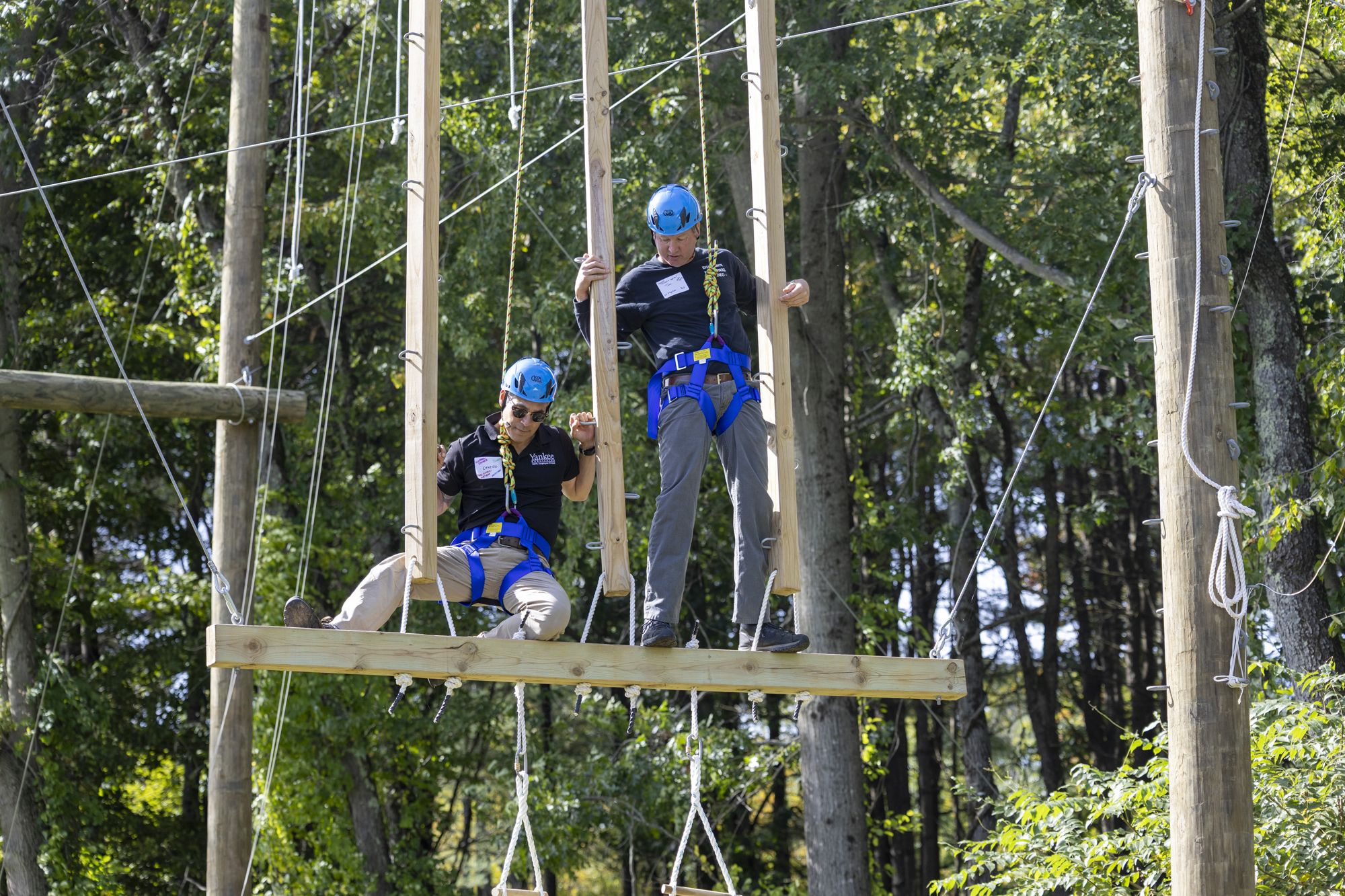
On a recent Friday at the Easterseals NH Military & Veterans Campus in Franklin, I found myself about 30 feet in the air. I was holding onto a pole and contemplating what suddenly seemed like a rather narrow log stretching out over a great deal of empty space toward another pole, which also seemed remarkably distant.
All of this had appeared much lower, wider and simpler from the ground.
I don’t consider myself to be particularly afraid of heights, but at that moment, I’d be lying if I said my heartbeat hadn’t sped up considerably. On the other hand, I was wearing a harness, and a team member from UNH’s Browne Center was on belay below me. More importantly, I’d spent the morning with a group of guests, Easterseals staff and Browne Center leaders exploring facets of teamwork, interpersonal relationships and my own perceptions.
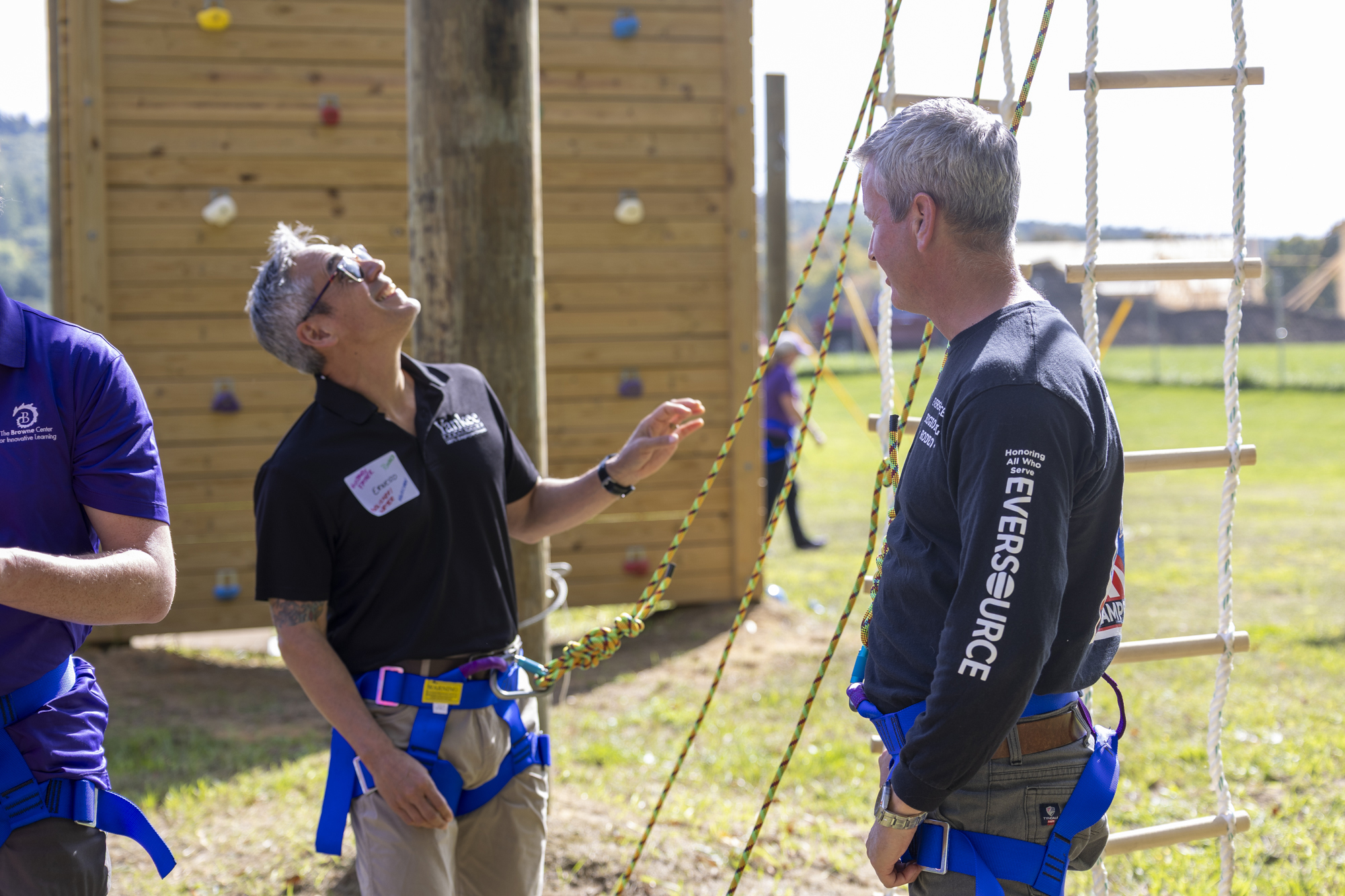
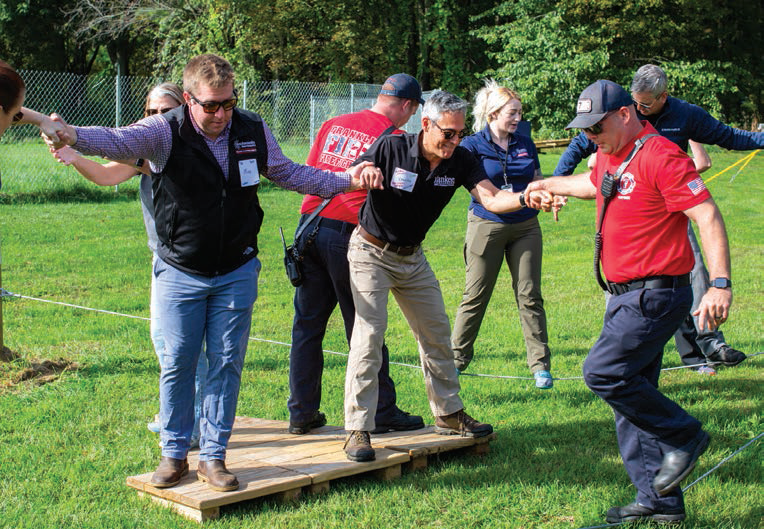
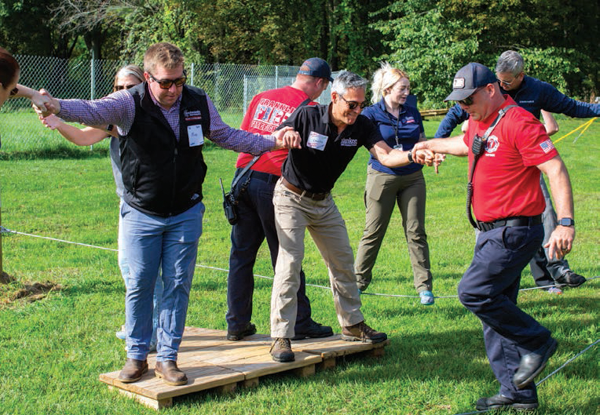
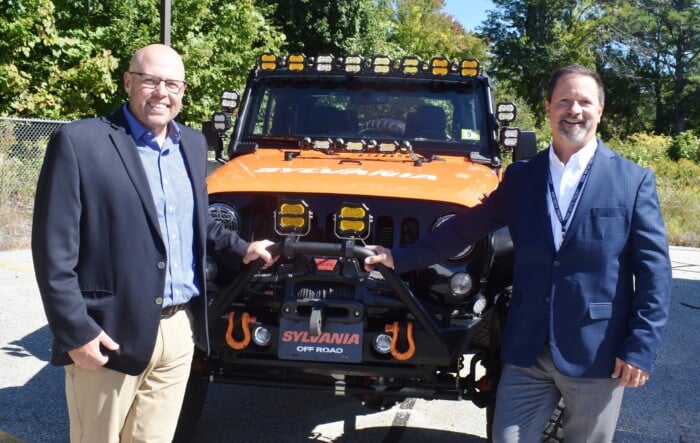
Center photo from left: Ernesto Burden, president and CEO of Yankee Publishing, checks out the action with Tom Davis, director of electric transmission field operations for Eversource Energy, at the Easterseals NH Military & Veterans Campus in Franklin during a demonstration of the newly opened Werner Mazda Challenge Course.
I was there as one of a group of community and business leaders invited to experience the newly opened Werner Mazda Challenge Course at the Military & Veterans Campus. We’d spent the morning getting a sample of what the course and programming provided by the Browne Center could offer both to the military members, veterans and first responders the campus is designed to serve, and to businesses that can simultaneously support the campus and build their own teams by booking retreats and programming there.
I had the opportunity to chat with Easterseals NH CEO Maureen Beauregard as we strolled through the campus fields on that crisp, sunny September morning. We walked past new construction that will eventually include an indoor climbing wall, allowing challenge-course programming to continue year-round, as she laid out a vision for the campus that has been roughly five years in the making.
“When I look at that challenge course, I’m like, this one person is going to try this challenge course, and they’re going to say, ‘I can trust another person,’” Beauregard said. “‘Look what I can do. I can have faith and trust in myself again, and I can be with all these people and not feel alone.’” Beauregard sees the course as part of a broader therapeutic ecosystem that also includes equine activities, therapeutic dogs, art, future woodworking opportunities and other forms of engagement, with the understanding that it takes different approaches to reach different people.
Corporate team–building is a core part of the model she envisions.
“I always say we have to sell half so that we can pay for the mission half,” Beauregard said as we arrived at the course. “I would love for all these veteran service organizations to come here and not face any financial barriers, but we got to get that business plan down of selling half to pay for the mission half.”
From a distance, the high elements of the course catch the eye: the climbing wall, the cargo net, the firecracker rope ladder. But the morning begins for our group with less dramatic, and somehow deeply revealing, elements.
We carry a ball balanced on a ring at the center of an array of strings, each of us holding one, moving as a single organism, almost like a flock of birds, out of the tent and toward the course’s low elements. There isn’t a lot of talking, but everyone knows what to do, how much tension to exert, when to stop walking and let the circle stabilize.
We flow through a series of similar exercises, examining our experiences afterward through verbal prompts and discussion. We learn to ask for help, to trust each other for balance and support. It’s a powerful experience that makes strangers and acquaintances feel, at least in a way, like old friends.
At one point Beauregard comments during a group discussion, “I’ve known Ernesto for years, but I feel like I really know him after this morning.”
I felt the same. Josina Garnham, executive director of the Browne Center, underscored that experience: “We believe human connection is the catalyst for change. Whether you think about healing or whether you think about organizational change, team change, that’s what we do, and the way we do our work is through experiential learning.”
By the time we harnessed up and got ready to climb, that connection work had been done.
Which brings me back to the log.
From 30 feet up, I could see across the fields and the new construction and the whole Military & Veterans Campus. I thought about the people that facility was built to serve. I thought about the people I’d spent the morning with and gotten to know so well. I thought about the people in my own life: my team of fellow employee-owners at Yankee Publishing, my friends, my family.
I thought about how high 30 feet is and how narrow the log becomes when the wind suddenly comes up off the September fields.
And I thought about how good it was to have someone on belay.
I stepped out onto the log and began to walk.