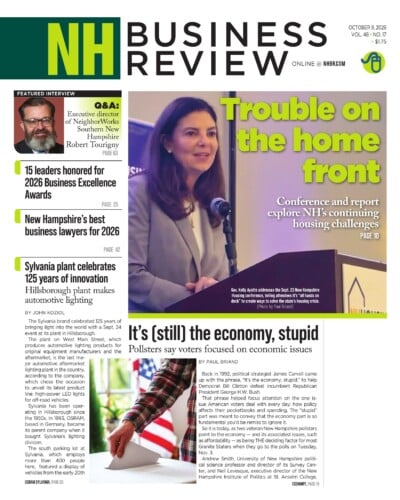
It’s (still) the economy, stupid
Back in 1992, political strategist James Carvell came up with the phrase, “It’s the economy, stupid,” to help Democrat Bill Clinton defeat incumbent Republican President George H.W. Bush.
Back in 1992, political strategist James Carvell came up with the phrase, “It’s the economy, stupid,” to help Democrat Bill Clinton defeat incumbent Republican President George H.W. Bush.
That phrase helped focus attention on the one issue American voters deal with every day: how policy affects their pocketbooks and spending. The “stupid” part was meant to convey that the economy part is so fundamental you’d be remiss to ignore it.
So it is today, as two veteran New Hampshire pollsters point to the economy — and its associated issues, such as affordability — as being THE deciding factor for most Granite Staters when they go to the polls on Tuesday, Nov. 3.
Andrew Smith, University of New Hampshire political science professor and director of its Survey Center, and Neil Levesque, executive director of the New Hampshire Institute of Politics at St. Anselm College, agree that economic issues could have a profound effect on politics both nationally and locally come Nov. 3.
“I do think that you’re seeing a blue wave coming,” said Smith, referencing the likelihood that Democrats could overturn Republican majorities, not only in the U.S. House of Representatives but in the New Hampshire House as well.
Levesque sees the same indicators. “The fact that voters are saying that Democrats are better at solving economic problems, affordability problems, all of those factors, and you could definitely say that the Democrats are going to be very, very strong,” he said.
Smith and Levesque have a combined 44 years — and a host of election cycles — at their respective posts — 27 for Smith at UNH, 17 for Levesque at St. Anselm.
Their polling through this mid-term election cycle has shown economic issues as leading the concerns shared by Granite State voters.
A Survey Center poll from August shows 26% of respondents feel housing is the No. 1 problem facing the state, followed by taxes (18%), cost of living (15%), education (6%) and jobs/economy (6%).
Another UNH poll earlier this month showed that voter assessment of President Donald Trump’s handling of the economy has fallen to record lows.
An August NHIOP survey showed that voters here no longer trust the Republican Party on economic issues. The Democratic Party now enjoys a 48% to 36% advantage on affordability issues.
“The Republicans are getting blamed for the bad economy now, and people can’t vote against Trump; they’re going to vote against the Republicans,” Smith said. “When people are unhappy about how much money is in their pocket, they’re sour about everything, and the goal is to throw the bums out and bring the new bums in.”
It often happens in midterm elections, as voter dissatisfaction with a sitting president (who’s not on the ballot) is heaped upon his party’s candidates. In the 2000s it’s happened five times already:
• 2006, with George W. Bush as president, the House and Senate shifted from Republican to Democrat.
• 2010, with Barack Obama as president, the House shifted from Democrat to Republican.
• 2014, during Obama’s second term, the Senate shifted from Democrat to Republican.
• 2018, during Trump’s first term, the House shifted from Republican to Democrat.
• 2022, with Joe Biden in the White House, the House shifted back to Republican.
“If the president is not popular, is not seen as popular, and this is largely driven by economics. If you look at the job approval rating, there’s a very strong correlation between how many seats you’re going to lose in the House of Representatives and the job approval rating of the President,” said Smith.
Nationwide, Trump’s job approval hovers at about 37%. In New Hampshire, according to the Survey Center’s latest polling, it sits at 32%.
A lot of current issues play into pocketbook concerns. The conflict with Iran has driven up oil prices. Gas is more expensive, so is diesel, which increases trucking prices and has a direct effect on the cost of groceries. The emerging artificial intelligence technology has people concerned about their jobs. Tariffs, particularly in the Granite State, are having the residual effect of Canadians not visiting here, affecting those in the hospitality industry.
“It can rear its head in different forms, but basically it goes back to your wallet,” Levesque said.
New Hampshire’s director of the New Hampshire Economic and Labor Information Bureau, Brian Gottlob, spoke of the Granite State’s economic jitters in an interview broadcast by WMUR-TV on Sept. 27.
“The thing that I think stands out the most among businesses and individuals is the impact that prices are having, prices on individual households, but also businesses and their ability to accommodate price increases, not pass them on in terms of higher prices for their goods and services,” Gottlob said in answer to a question from NH Business segment host Fred Kocher about public concerns with the economy.
The numbers already indicate a heavy turnout among Democrat-leaning voters on Nov. 3.
It hasn’t gone unnoticed that, among undeclared voters in the state, who can choose a Democrat or Republican ballot during primary elections, a vast majority took Democrat ballots on primary day Sept. 8. According to Secretary of State data, 81,242 undeclared voters went to the polls and 66.8% of them took a Democrat primary ballot while 33.2% took a Republican ballot.
“I got a lot of those numbers at four in the morning the day after the election, and I think it’s the most interesting data that we have. That is, it’s not just a poll; it’s real data,” Levesque said. “Voters picking Democrats’ ballots in that number was the most important data point from the Tuesday election.”
While it may not be a Democratic sweep up and down the ballot on Election Day, both Smith and Levesque predict significantly blue inroads nationally and locally.
“I think that this is going to go all the way down the ballot. I think there’s a very strong chance that Democrats win control of the New Hampshire House,” Smith said. “The Senate’s going to be a little bit tougher, because it’s gerrymandered, but they could win control of the Senate as well.”
One candidate who’s likely to ride over the blue wave is the incumbent Republican Gov. Kelly Ayotte, who is opposed by Democrat and former Executive Council member Cinde Warmington.
“It can be an all boats rising,” Levesque said of the blue wave, “but traditionally the governor of New Hampshire’s had a little bit of insulation from that. And Gov. Ayotte has localized her race, and she’s done everything to be omnipresent and focused on issues that she sees are important to New Hampshire voters.”
The magic number for Smith is 54%. If 54% of voters turn out for the November general election, it will indicate that enough voters are upset enough with current conditions to vote for Democrats.
“Democrats, not only are they revved up because they want to vote against Trump because he won the last elections, they’re also angry about the economy, which is going to get them out to vote,” Smith said. “Republicans, they’re not happy with the economy. They’re not necessarily happy with Trump. They’re not going to vote for Democrats. They’re going to stay home.”
If the turnout gets above 60%, according to Smith, it signifies that Republicans are revved up enough to go to the polls to protect their party majorities.
“That’s really what you see in the midterm elections, over cycle on cycle on cycle, is that the President’s party’s turnout goes down, and the turnout of the out-of-office presidential party goes up, and that’s what I think you’re going to see in this election,” Smith said. “But, again, that’s exacerbated because of the state of the economy.”
The numbers already indicate a heavy turnout among Democrat-leaning voters on Nov. 3.
Back in 1992, political strategist James Carvell came up with the phrase, “It’s the economy, stupid,” to help Democrat Bill Clinton defeat incumbent Republican President George H.W. Bush.
Permitting and construction of new homes is up, but it’s still at historic lows and not enough to keep up with demand. The recent housing production is mostly single-family, with a smattering of multi-family developments but relatively few duplexes, triplexes and fourplexes.

New Hampshire in general, and its legal profession in particular, suffered a huge loss when Jack B. Middleton died on Sept. 8. The president of McLane Middleton, he recently marked 70 years of active law practice with that firm.
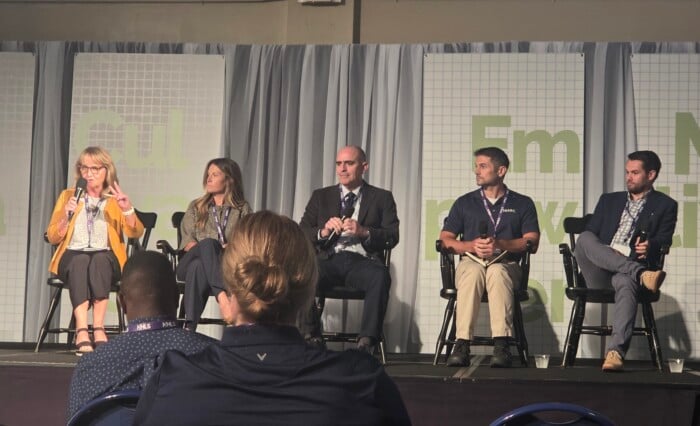
New Hampshire’s life sciences industry is expanding quickly, but the workers employers need range far beyond biomedical scientists — from manufacturing technicians and engineers to project managers, supply-chain specialists and finance professionals. At the Empower Life Sciences event hosted by…
It's still a fact in 2026 that New Hampshire has the second oldest population in the United States — 43.4 median age — tied with Vermont and topped only by Maine. Most senior citizens in New Hampshire say it's a great place to retire. But it depends on life's circumstances.

SB 482, which goes into effect in December, sets a daily conversion limit of $2,000 per digital transaction kiosks.

New report cites Tradeport’s ‘uniquely important role in New Hampshire’s economic architecture’ as executive director looks toward ‘retooling’ for life science users
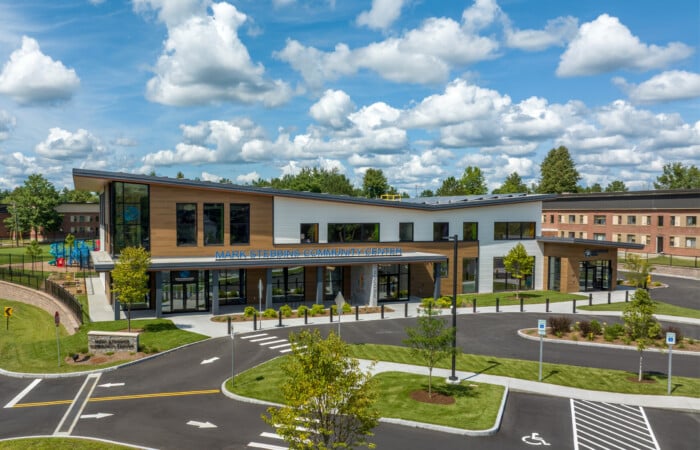
After a 14-month construction mission, the “Apollo” landed at the Kelly Falls apartment complex this week with the completion of the Mark Stebbins Community Center, the culmination of a vision by the late Mark Stebbins, a long-time business leader and philanthropist.
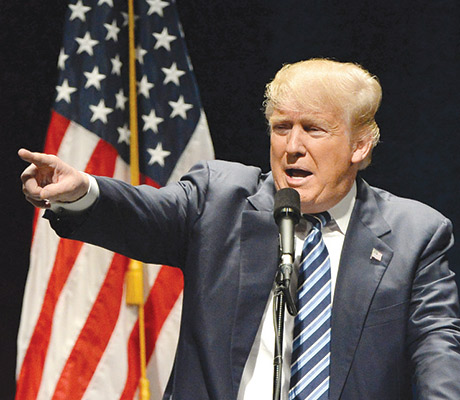
Because of tariffs, the war with Iran, and other White House policies, New Hampshire families have had to spend an additional $4,800 or more on goods and services, according to U.S. Sen. Maggie Hassan, D-NH.