Fed rate hike not likely to impact NH economy
Interest rate hike? What interest rate hike? The move by the Federal Reserve to hike a key interest rate by a quarter of a percentage point (0.25%) has provoked a big yawn in the New Hampshire economy.
Inflation is back.
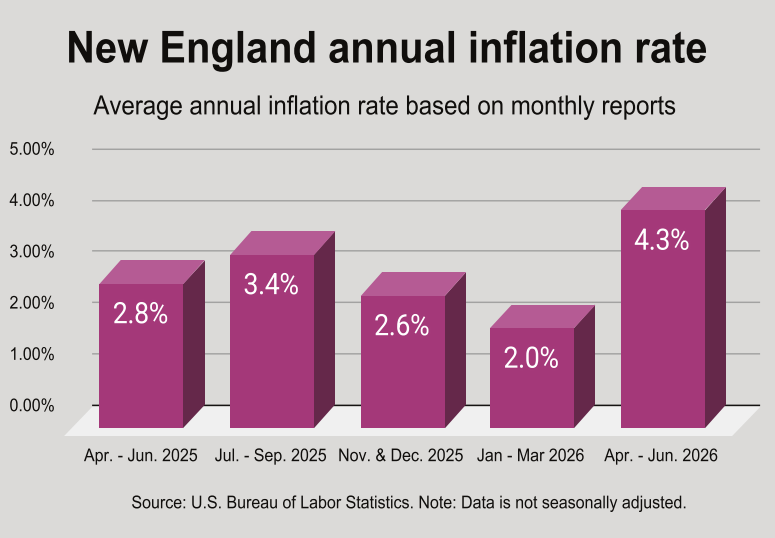
Driven by higher fuel prices, inflation in New England shot up to a 4.3% annual rate in the spring quarter. That is more than double the rate of 2%, the target rate for the Federal Reserve nationwide, recorded in the first quarter of 2026.
Meanwhile, just about every other economic indicator shows a robust economy in New Hampshire. Blue-collar wages are up more than the rate of inflation. Unemployment is low. Housing starts are at a two-plus-year high. Economic growth and travel are stable.
“Overall, all of our data points look pretty good. The only thing you could complain about is inflation,” said Gregory Randolph, an economics professor and chairman of the Southern New Hampshire University Department of Finance and Economics.
The spike in energy prices, brought on by the Iran war, was the main ingredient for the jump in inflation. But even core inflation has been high.
In June, year-over-year shelter costs were up 4.3%, a rate higher than overall inflation for the same 12-month period, Randolph said.
The biggest fear about inflation is that the Fed will raise interest rates and intentionally slow the economy to fight inflation, Randolph said.
Tariffs add another component to inflation, according to Mark Manuel, co-founder of Industrial Marketing, which offers marketing tools and workforce development strategies to manufacturers.
Some manufacturers have had to raise prices because of tariffs. But manufacturers are growing accustomed to the new trade environment, and some work is returning onshore, he said.
He believes disengagement from Iran will be the biggest factor in reducing inflation.
“If inflation is here a year from now, I think there will be a different feeling, but the expectation is inflation will go down,” Manuel said.
Under traditional economic theory, inflation becomes embedded in an economy when demand grows for resources and workers faster than the supply.
In fact, one of the key factors the Federal Reserve uses to gauge inflation is the size of the workforce and wage growth.
In that case, New Hampshire is pushing hard on the door to sustained inflation. The seasonally adjusted June unemployment rate was 2.9%; the unadjusted rate was even lower at 2.5%.
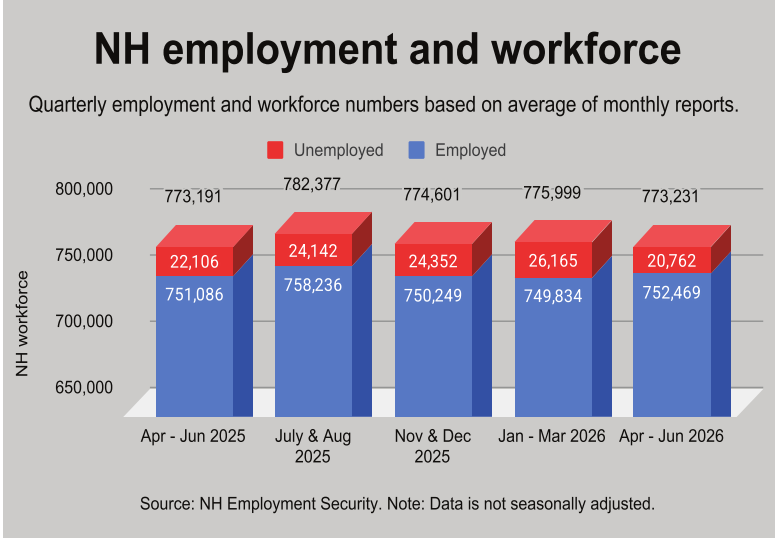
Year-to-year, the size of the workforce in the state is stagnant at 773,200 in both the second quarter of 2025 and 2026.
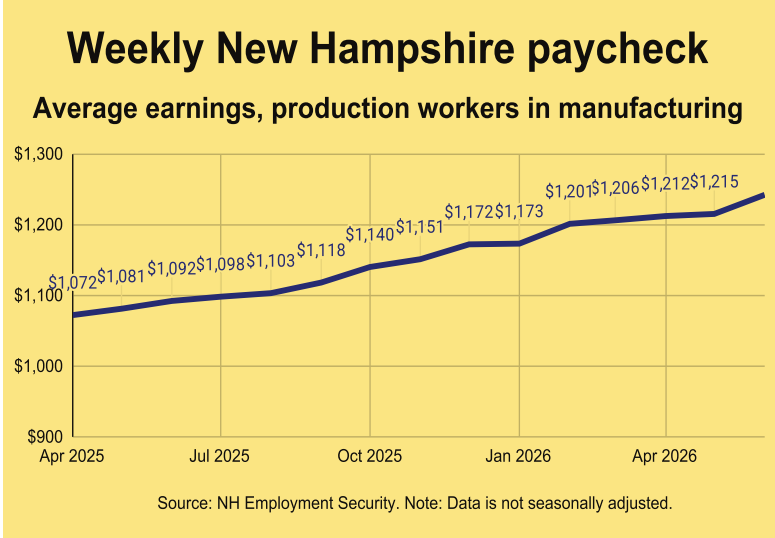
Meanwhile, the weekly average wage for a blue-collar factory worker was $1,242 in June. That wage, which is closely tracked by the New Hampshire Department of Employment Security, rose 5.8% over just six months.
“People are paying more money to keep their staff,” Manuel said. They will match the salary of a worker who plans to leave for higher pay elsewhere, he said.
Manufacturers back legislation to address issues of housing and child care. And manufacturers are going to high schools to try to convince students to consider a career in manufacturing.
On the other hand, companies are taking advantage of recent tax incentives and are investing in innovation, which reduces the need for workers, he said.
He has a new interpretation on the “no-hire, no-fire” economy — a term that economists use to describe the slow growth earlier this year. “We want to hire, but we can’t find anyone.”
Overall, the New Hampshire economy grew at a 1.8% annualized rate for the first quarter of 2026. (The U.S. Bureau of Economic Analysis is a quarter behind in reporting gross state product.)
It also issued a significant revision for the first quarter of 2025, revising a negative growth rate of -0.1% for New Hampshire to a healthy growth rate of 2%.
The New Hampshire growth rate was lower than Massachusetts (2.4%) and the United States as a whole (2.1%), but higher than Maine and Vermont.
The biggest drivers in the gross state product were the sectors of manufacturing; professional, scientific and technical; wholesale and retail trade; information and government.
Residential housing was strong this spring.
The Census Bureau reported that 676 building permits for apartment units and houses were issued in June, the highest monthly total in more than two years.
Business interests have said they need more and less expensive housing in order to address workforce issues in the state.
Each quarter, The Pulse adds a “wildcard” economic statistic to its five regularly tracked indicators. Turnpike traffic was basically flat — 0.6% growth — in the 12-month period that ended on June 30.
That compares to more sustained growth in the previous periods. For example, the previous 12 months had a 1.4% growth rate.
Nicholas Alexander, administrator for the state Bureau of Turnpikes, said his agency’s long-term projections call for growth less than 1% per year. Also, they do not analyze turnpike traffic and gasoline prices.
But Randolph said that, with higher gasoline prices, a reduction in turnpike traffic could be expected.
“Maybe stable is not too bad,” he said.
“The Pulse” is an exclusive feature of NH Business Review that examines local and national data to track New Hampshire’s economy.
Each month, the series examines an economic trend based on the latest data. On a quarterly basis, “The Pulse” will report key economic indicators such as employment, inflation and economic growth for the New Hampshire economy for a more expansive review that includes several informational graphics.
“The Pulse” focuses on three key indicators: prices, output and labor. It will also feature a wild card category. One of the six will change every quarter in an effort to capture data that gives additional insight.
Interest rate hike? What interest rate hike? The move by the Federal Reserve to hike a key interest rate by a quarter of a percentage point (0.25%) has provoked a big yawn in the New Hampshire economy.
As the price tag of power grows in New Hampshire, so does the expectation that demand will grow in the state as well as the region.
Inflation is back. Driven by higher fuel prices, inflation in New England shot up to a 4.3% annual rate in the spring quarter. That is more than double the rate of 2%, the target rate for the Federal Reserve nationwide,…
New Hampshire businesses seem to be hitting the summertime blues. Over a two-week period ending June 28, the percentage of businesses describing their performance as above average or better tumbled 5 points, and only 47% of businesses said they were…
NH residents are curbing the urge to ‘scratch’
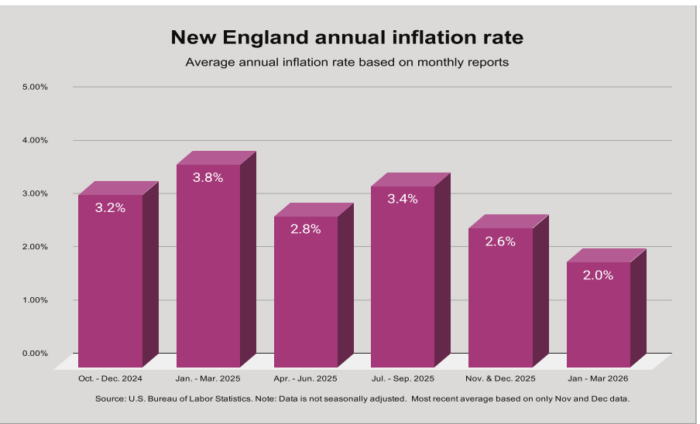
It was brief, even fleeting, but for the first three months of 2026, the average, annualized rate of inflation in New England was 2%.
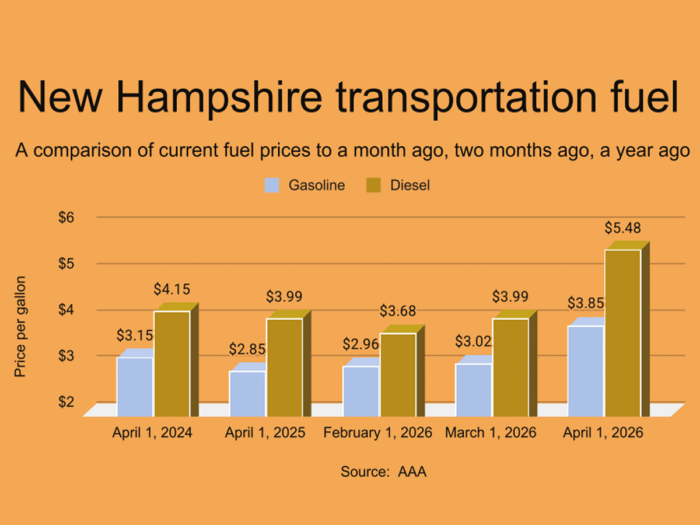
A gallon of gas has jumped about 25%