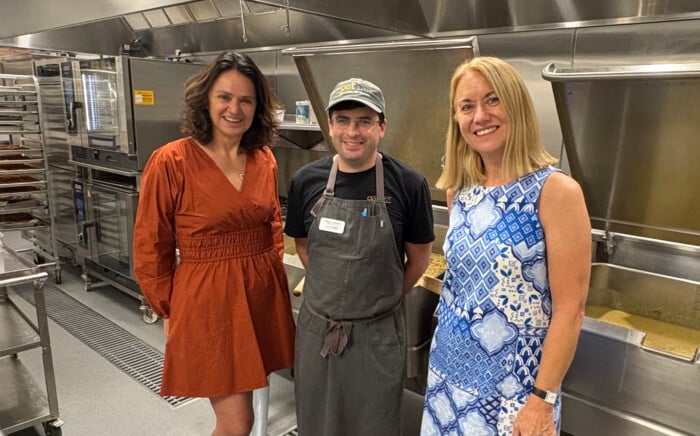
Shown in the commercial kitchen at their new quarters in Portsmouth, from left, are Gather team members Tania Marino, deputy director; Nathan LeBrecque, production chef; and Anne Hayes, executive director. (Photo by Paul Briand)
When the folks at Gather speak to the job they do to address hunger in New Hampshire, they talk about “serving the line.”
The line is the people who queue up every day to make use of any one of Gather’s many services to address their food insecurity needs, be it the food pantry, its mobile markets, and delivery of prepared meals across swaths of southern New Hampshire to name a few.
“There’s a chunk of our programming — the core of our programming that’s been around forever — is around serving the line, meeting the immediate hunger need, meeting the immediate need for food,” said Anne Hayes, Gather’s executive director. “What can we do to solve the systemic problems here? The bottom line is people are hungry right now and they need our help right now.”
That’s serving the line.
An equally important component to Gather’s work is shortening the line, creating ways for people to be less reliant — or perhaps not reliant at all — on Gather’s services.
One path in that respect is Gather’s new culinary education program, in its pilot infancy this year as a way to teach people with employment challenges the kitchen skills and life skills they need to have a career in the food service industry.
“The purpose is to reduce the line at our door by providing a pathway to employment, to move people out of the line into employment,” said Tania Marino, Gather’s deputy director. “ We focus on individuals that are facing fairly severe barriers to entry into employment, being able to get a job and sustain a job for a period of time.”
Marino heads up the culinary workforce training program, which was established this year.
Gather’s free culinary training program — called Fresh Start — runs for eight weeks, Tuesday through Friday, 9 a.m to 4 p.m. It accommodates between six to eight students.
The first cohort of three students finished in April and after a mandatory four-week internship with a potential employer each was offered a full-time food service position. Another cohort graduated in June — four of five got placements.
Knife skills, life skills
For students, there are kitchen skills to learn, naturally, but life skills as well — being on time, proper dress, socialization, etc.
The biggest life skill challenge for these students? Self-regulation, according to Marino, especially in a restaurant kitchen, which, any viewer of “The Bear” television series can tell you, can get quite chaotic.
“For a lot of students, the work that they do through the life skills program brings up challenges that they’ve had in the past, which is difficult, but it also helps them identify why they’ve not been successful in being able to hold a job and come up with ways to overcome that,” said Marino. “So we do a lesson on emotional triggers, identifying your emotional triggers in the kitchen.”
The Knife Skills Life Skills program runs out of Gather’s home base on Heritage Avenue in Portsmouth, newly occupied since October of last year, replacing space off West Road that was smaller and disconnected.
The new space — at 18,000 square feet, up from 5,600 square feet — is not only larger but much more efficient and updated with a warehouse, cold storage, freezer, commercial kitchen, offices, meeting rooms, pantry and community room.
From it, Hayes and her team, which includes upwards of 65 volunteers daily, operate a variety of programs, which in 2025 distributed 1.6 million pounds of food, provided to more than 90,000 people, prepared 114,000 to-go meals, and fed 3,500 children with 53,500 breakfasts, lunches and snacks when they were out of school.
It offers a place to access help from a variety of providers: domestic violence services, healthcare navigation, fuel and electric assistance, mental health outreach and job counseling, just to name a few.
The culinary program kitchen is set apart from the commercial kitchen that prepares the to-go and grab-and-go food.
Led by chef Nathan LaBrecque, the commercial kitchen serves two primary populations: seniors and the unhoused.
“The people that tend to take most advantage of that are seniors. Definitely, they come in. Some of them come in every day. They no longer cook for themselves or have facilities to cook for themselves,” said Hayes. “The other group is the unhoused population that doesn’t have access to kitchens, but all of our members take advantage of the meals, because they’re nutritionally balanced.”
Donated duck legs
LeBrecque came to Gather in June, having worked as the banquet chef at the Cliff House resort in York, Maine.
Hayes said LeBrecque is “leveling us up a bit on our food,” adding, “He’s able to look at what we have on a Friday and think about what we’re going to be able to produce for the next week, select the recipes, and balance it out over the course of the week.”
Some 93% of the food used in the kitchen is donated, from a variety of sources — grocery stores, restaurants, etc. — all within acceptable limits of freshness and usability. The nearby Chipotle restaurant, for instance, may have a large quantity of unused rice. Or a local fish market might have some leftover shrimp, or, as happened recently, they received a delivery of 150 pounds of duck legs.
“In terms of what is my menu going to be? What do I have available? Requires you to be a little more inventive,” said LeBrecque. “If you’ve ever watched the show ‘Chopped,’ it’s pretty much that every day here, which you know is so much fun.”
The culinary program kitchen is run by Tim Barr, the chef instructor. It was thought out and laid out with the help of Catalyst Kitchens, a national network of social enterprise and nonprofit organizations with teaching kitchens leading a movement to end joblessness.
Marino worked directly with Catalyst personnel at their headquarters in Washington, D.C.
“I went to a couple of their summits and I networked with people, and I learnt about best practices on how to do this because we don’t want to reinvent the wheel, would much rather follow a model that we know works and has worked,” she said. “So they informed everything from how we designed the teaching kitchen all the way through to our curriculum.”
She tells the story of a program grad, now working at Wentworth by the Sea, who walks to and from the Crossroads shelter off Lafayette Road to each shift, about a 3.5-mile walk. He’s not only providing for his family for the first time, but is in a position to buy a scooter to get to work.
Even after only a few training programs, Hayes and Marino can see the difference, how it’s helping shortening the line.
“I think the really great thing about this program is that you can see an immediate impact on people’s lives, an immediate change,” said Marino.
Adds Hayes: “It’s kind of a win-win, because a lot of these food service organizations — restaurants, caterers, cafeterias and so on — are looking for help, and being able to match someone who really wants to get their life together and get a full-time, well-paying job, that’s a real opportunity.”