Big power, small package
As the price tag of power grows in New Hampshire, so does the expectation that demand will grow in the state as well as the region.
New Hampshire businesses seem to be hitting the summertime blues.
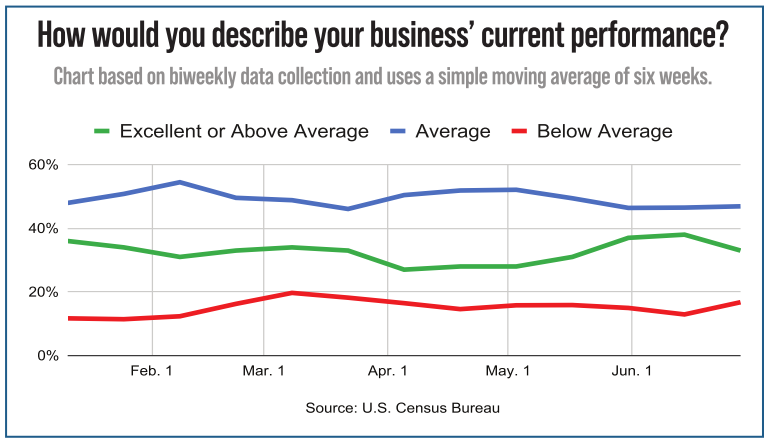
Over a two-week period ending June 28, the percentage of businesses describing their performance as above average or better tumbled 5 points, and only 47% of businesses said they were performing at an average level, the second lowest level of the year, according to U.S. Census data.
Meanwhile, Citizens Bank reported that only 17% of small business owners in the northeastern United States, which includes New Hampshire, are extremely or very confident in the national economy, the lowest percentage in the United States.
Richard Testa, business banking market executive for Citizens Bank New England North, said the data shows less confidence in market demand, cost stability and national policies going forward.
“It suggests a movement from a period of broadly strong growth to one of dispersion and caution,” said Testa, who works for the second largest bank in New Hampshire.
This month, The Pulse retrieved data from the U.S. Census Business Trends and Outlook Survey.
The continuous fielded survey asks business owners 38 questions about employment, business conditions, costs, expectations and artificial intelligence.
Data is broken down by states, economic sectors, employer size and top metropolitan areas.
And it is reported quickly, less than weeks after collection.
To reduce the possibility of sampling error, The Pulse calculated a six-week moving average on the data.
In a nutshell, the percentage of high-flying New Hampshire businesses has fallen, from a 2026 high of 38% in mid-June to 33% in late June. The number of businesses performing below average has grown, 4 percentage points over the same period.
And the percentage of average-performing businesses, 47%, is on a glide path.
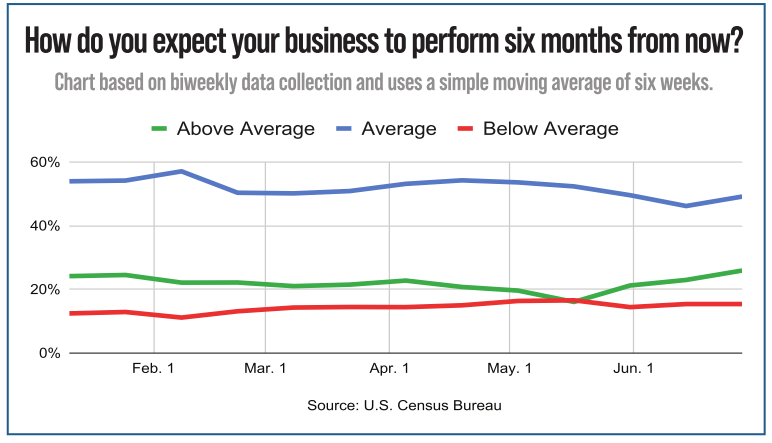
Yet, there appears to be more optimism when businesses look to the future. The share that expects to be doing better than average in six months has risen 9 percentage points since mid-May, while the percentage that expects to be doing poorly remains in the mid-teens.
Such findings resemble an annual survey the New Hampshire Business and Industry Association took of its members last year.
In general, New Hampshire businesses felt good about their individual performance in 2025, but they were uncertain about the macro economy and hard-to-address issues such as workforce availability, said Mike Skelton, president and chief executive of the 450-member business advocacy group.
“It’s something that weighs on them when they consider hiring, investment and exposure,” Skelton said.
As for consumers, the University of New Hampshire Survey Center in late May detected a significant drop in consumer confidence in New Hampshire. The Survey Center attributed the drop to the spike in gasoline prices brought on by the Iran War.
But 55% said their personal financial situation was the same or better than a year before. And a stronger majority, 60%, expected the same or better financial situation in the next 12 months.
While consumers generally have low confidence in the economy in its entirety, they seem more optimistic about their own situation, Skelton said.
“The question is, at what point does their views about the economy affect their personal decisions on spending or getting a new job,” he said.
In business, the lower confidence in the economy is prompting owners to invest more, Testa said.
The Citizens Bank survey found 36% of small businesses in the Northeast are investing in technology, the largest percentage across the country.
“The numbers are not as contradictory as they look,” Testa said.
If business owners don’t think economic conditions will result in higher revenues, they will look to maintain their margins through technological investments to reduce fixed costs, including labor costs.
“Most business owners are betting on themselves,” he said. “Their confidence in themselves is typically higher than their confidence in the overall U.S. economy.”
New Hampshire, however, shows hesitancy in one of the biggest current technology investments: AI.
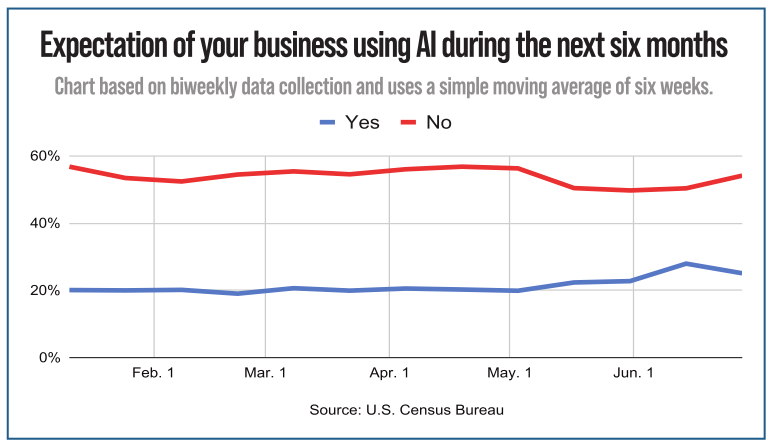
The percentage of businesses that expect to be using AI in the next six months fell from mid-June to late June, from 28% to 25%. Likewise, throughout 2026, a majority of New Hampshire businesses rejected the thought of integrating AI in the future. The percentage stood at 54% in late June.
“They’re not entirely sure how to integrate it into their operations,” Testa said.
“As time goes on, we’ll see greater adaptation.”
“The Pulse” is an exclusive feature of NH Business Review that examines local and national data to track New Hampshire’s economy.
Each month, the series examines an economic trend based on the latest data. On a quarterly basis, “The Pulse” will report key economic indicators such as employment, inflation and economic growth for the New Hampshire economy for a more expansive review that includes several informational graphics.
“The Pulse” focuses on three key indicators: prices, output and labor. It will also feature a wild card category. One of the six will change every quarter in an effort to capture data that gives additional insight.
As the price tag of power grows in New Hampshire, so does the expectation that demand will grow in the state as well as the region.
Inflation is back. Driven by higher fuel prices, inflation in New England shot up to a 4.3% annual rate in the spring quarter. That is more than double the rate of 2%, the target rate for the Federal Reserve nationwide,…
New Hampshire businesses seem to be hitting the summertime blues. Over a two-week period ending June 28, the percentage of businesses describing their performance as above average or better tumbled 5 points, and only 47% of businesses said they were…
NH residents are curbing the urge to ‘scratch’
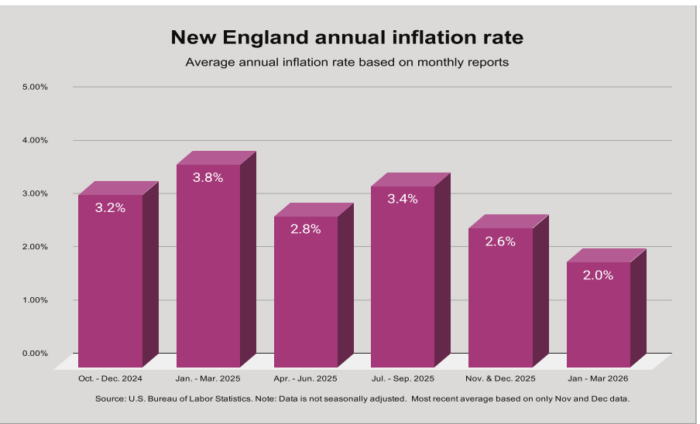
It was brief, even fleeting, but for the first three months of 2026, the average, annualized rate of inflation in New England was 2%.
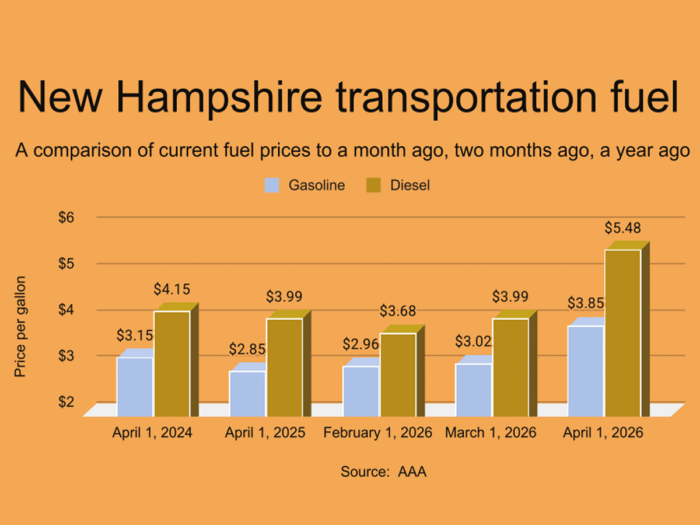
A gallon of gas has jumped about 25%
Federal Reserve report shows cautious optimism about the future