Hometown Financial Group to acquire Primary Bank
Bedford-based Primary Bank is merging with Easthampton, Mass.-based Hometown Financial Group in a transaction valued at $160 million in cash and stock.
Granite Staters, especially younger ones, are very skeptical about artificial intelligence (AI) and how it affects everything from the environment to jobs.
At the other end of the spectrum, however, are a group of young people, college students interning for an Exeter investment advisory firm, who are making use of AI in a way that enhances, not substitutes, the work they do, making them very positive about uses of AI.
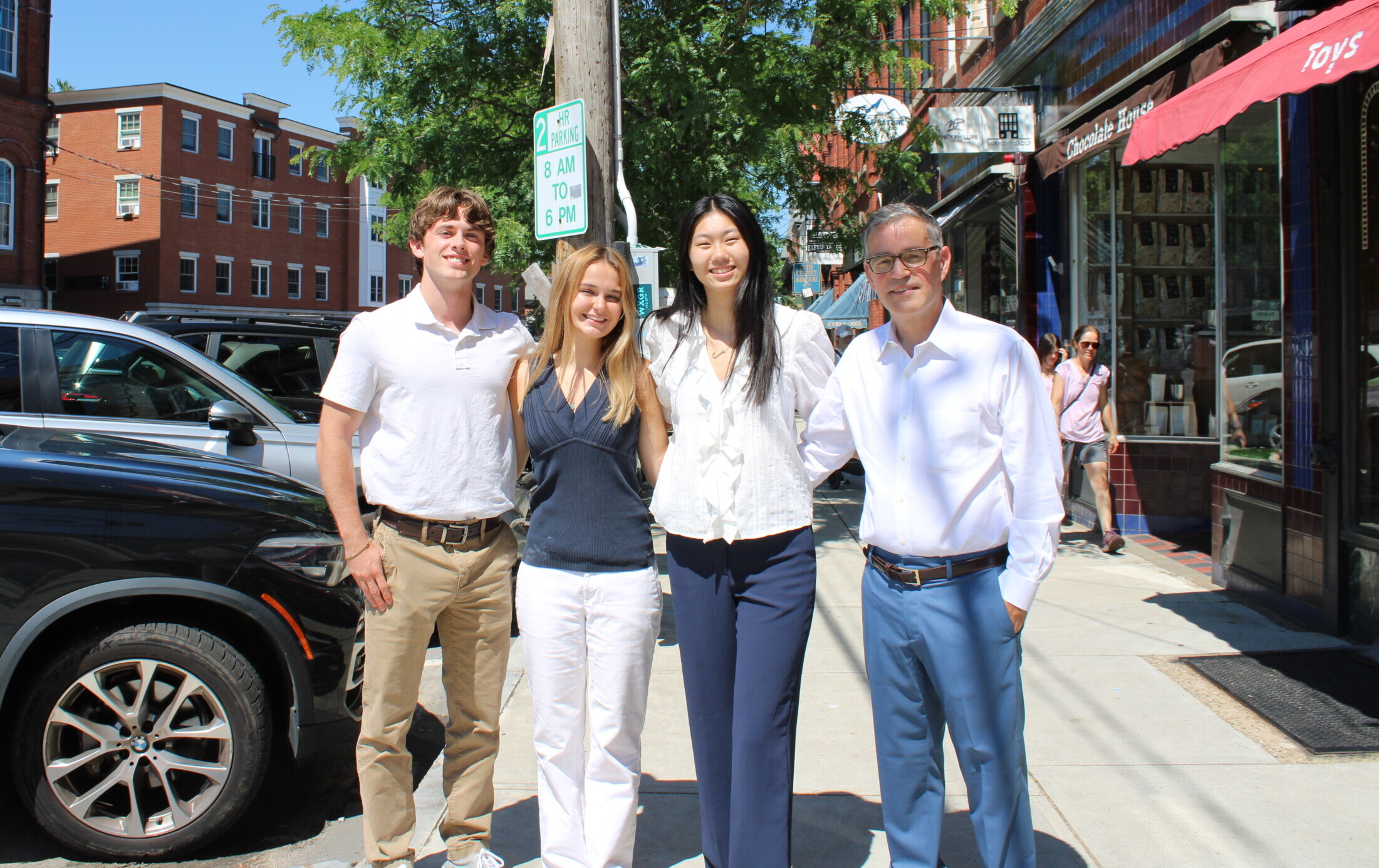
College interns, from left: Josh Berry from the University of New Hampshire, Katie Crowley from the University of Rhode Island, and Jia Patten from UNH are helping Blueline Advisors in Exeter make use of artificial intelligence. Frank Sabin, right, chief investment officer, calls the AI opportunity for business improvement “probably one of the most exciting things in my career.” (Courtesy)
“Knowing that it’s not going to go anywhere, the only thing you can do is really try to capitalize on AI and integrate it to make yourself more efficient,” said Jia Patten, who’ll be starting her junior year at the University of New Hampshire.
She is one of four college interns at Blueline Advisors in Exeter, where chief investment officer Frank Sabin is embracing AI, with the help of the students, to better serve his clients, who have entrusted about $250 million in assets in his care.
“The introduction of AI, in terms of what we can do and how we can scale the business, is something that’s immediately and incredibly exciting,” said Sabin, noting it is helping him expand and customize the tools he uses, improve the services he offers to clients, and grow the business He calls the AI opportunity for business improvement “probably one of the most exciting things in my career.”
In general, artificial intelligence is viewed with distrust, particularly here in the Granite State, as evidenced by a June poll released by the UNH Survey Center.
“Nearly two-thirds of New Hampshire residents believe artificial intelligence will have a negative effect on the country over the next ten years, particularly young people,” the survey center said in its abstract. “New Hampshire residents are very pessimistic about the effect of AI on jobs, elections, the cost of utilities, personal relationships, the environment, and the news.”
The uncertainty is especially pronounced when it comes to the workplace.
According to the polling, 8% of residents believe AI will lead to much more or more jobs in the U.S. over the next 10 years, while 72% believe AI will lead to much fewer or fewer jobs in that period. Some 14% believe AI will have no effect on jobs and 6% are unsure.
The survey center said Democrats, young people 18 to 34, and women are the most concerned when it comes to AI and jobs.
Sabin is using his young interns to help him leverage the technology.
He used two interns last summer, doubled that number to four this summer, specifically for the purpose of first educating himself in the use of AI, then using that education to improve and scale his business.
“The orientation was two interns, myself, a laptop, and as a collaborative effort it was great,” he said. “Fast forward one year, one summer later, and it worked really great. The tools, the technology had grown even more over one year, and my excitement only grew over that period. So, in line with that, I said: Let me do a search for four really, really capable interns that each in their own right will be additive to both the mix and how we leveraged it.”
Intern Josh Berry, a rising UNH sophomore, cited examples of how they’ve been using AI to strengthen the business, how they use AI as more than a tool to just answer questions put to ChatGBT, one of the ubiquitous AI programs available to the public.
“If you don’t understand something, you can kind of further your knowledge in that regard, but we’ve used it in more of an ability to create things,” he said. “For example, we’ve used it to help us with our website, and actually build the kind of the things that go on behind the scenes with the website.”
“We use it to make internal tools, we’ve used it to make client-facing tools,” he added. “We created agents and started exploring kind of how we can create different documents and Powerpoints and things of that nature, and use AI as basically assistance in being more efficient with that.”
Sabin and Patten spoke of the collaboration they engage after their AI research is complete.
“With more AI, you do need more collaboration,” Patten said. “We each independently work together, and then bring it to the table to show what we find.”
Sabin is impressed by how quickly they can work.
“There’s a problem in terms of conceptualizing something and actually implementing it,” Sabin said. “These students are great at actually executing it, so the speed just goes up. That’s one project, but we have 10 that are going on at the same time, so the execution, I found, is much quicker.”
Among the concerns expressed in the UNH survey have to do with AI and the environment, in particular the large-scale data centers that are required to power current and future computing needs and the water and electric resources they’re bound to consume.
According to the survey results, 60% of residents believe AI will have a negative effect on the environment, and 61% believe it will have a negative effect on the cost of utilities.
When it comes to data centers, 45% of residents strongly or somewhat strongly support a half on new data center construction, 34% strongly or somewhat oppose such a move, 14% are neutral and 7% are unsure.
Efforts to enact a statewide ban or moratorium on data center construction here failed during the 2026 session of the state Legislature. Lawmakers introduced and debated multiple bills addressing data center growth, but none resulted in a construction ban, nor did any bills pass that encouraged their construction with eased zoning.
Blueline intern Katie Crowley sees a cause and effect between lazy ChatGPT use and the effect it has on the environment.
The rising sophomore at the University of Rhode Island recalled the time a friend was making banana bread, and, instead of reading the instructions right on the box, engaged an AI chat to ask how long the bread should cook in the oven, “making ChatGPT run its wheels, waste water, and that’s where the environmental scare is coming from.”
Crowley sees it as part of a social learning process.
“When we were younger, and we were just coming out with iPhones, we were glued to them. I got an iPad, and after school, in fifth grade, I would go on it all day,” she said. “It comes down to just managing your own life, what you want to depend on. We shouldn’t be depending on social media, like we shouldn’t be depending on ChatGPT. I think society just needs to get used to this as well.”

Bedford-based Primary Bank is merging with Easthampton, Mass.-based Hometown Financial Group in a transaction valued at $160 million in cash and stock.

5 tips for creating an estate plan that reflects all of your legacy

As we close out Q2 and review the year so far, there are several interesting dynamics at play.

As Service Credit Union (SCU) seeks a new chapter of federal bankruptcy for an unfinished senior living campus in Littleton, it filed a lawsuit in state court last month against the owners and lenders, whom it accuses of coordinated fraud and embezzlement involving a $30 million SCU construction loan.

Whether you are planning for long-term growth, managing income needs, or preparing the next generation, wealth management often involves balancing multiple priorities.

At Blueline Advisors in Exeter, chief investment officer Frank Sabin is embracing AI, with the help of the students, to better serve his clients, who have entrusted about $250 million in assets in his care.

Successful investing takes a lot of patience. Risk tolerance and time horizon are important factors in determining an appropriate investment strategy. For example, some investments would be unwise to choose if the principal is…

During the last three months, hundreds of thousands of Granite Staters filed federal income taxes for Tax Year 2025.

Business growth is exciting. A big contract comes through, a new customer relationship takes off or marketing is delivering the results you expected. Financing can be a critical resource to sustain the growth. But from a lender’s perspective, growth financing is about more than momentum. The real question is whether the business can support that growth — and repay the debt that may come with it.