Big power, small package
As the price tag of power grows in New Hampshire, so does the expectation that demand will grow in the state as well as the region.
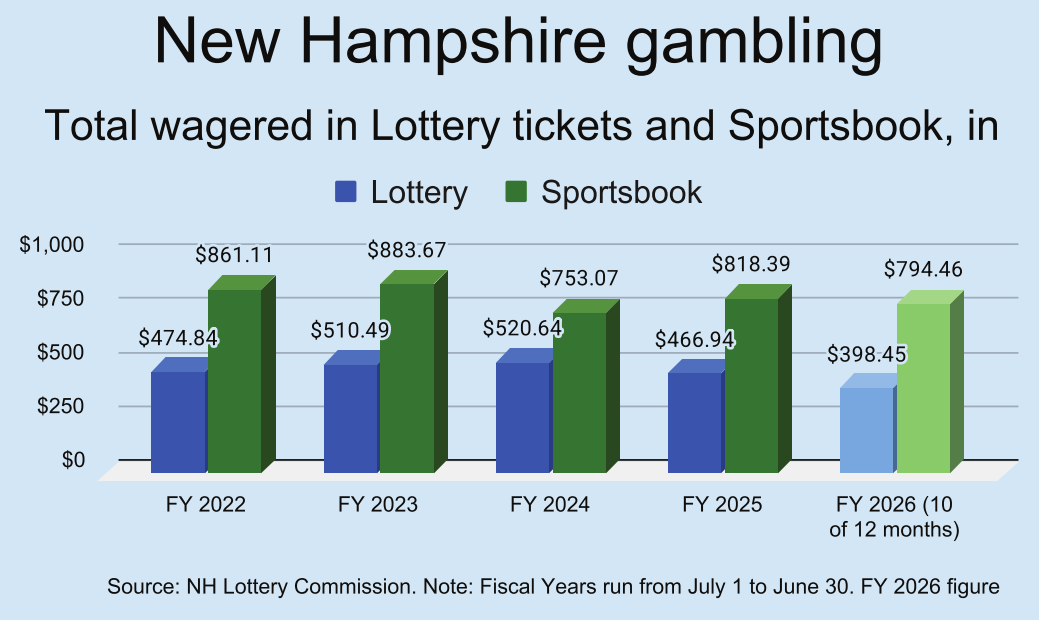
In what can be a sign that an inflation mentality is taking hold in New Hampshire, sales of the most popular lottery tickets, scratch tickets, are down 4% over these past 10 months.
The drop in scratch-ticket sales mirrors a 4% drop in the previous state fiscal year, a 12-month period that ended June 30, 2025.
Charlie McIntyre, executive director of the New Hampshire Lottery and Gaming Commission, said similar sales reductions are being felt across the country. And with oil-related products one of the primary drivers of inflation, lottery customers are pinched every time they fill up their tank, he said.
That hurts the lottery, because half of ticket sales locations also sell gasoline.
“You have less money, you’re at the pump. What used to cost $40 now costs $60, so you’re less inclined to go into the store,” McIntyre said.
Inflation has steadily climbed in New England over the past two months. In March, the 12-month inflation reading measured 2.9%. In April it surged to 4%.
Lottery sales are big in the Granite State. According to the financial research organization Motley Fool, New Hampshire ranks 11th in the United States at $401 a year in per person lottery sales.
Our neighbor to the south, Massachusetts, more than doubles that figure at $856 and is the leader among all the states.
McIntyre said he’s seen lottery sales fall off in the past due to economic conditions — during the subprime mortgage housing crash in 2007 and a jump in oil prices in late 2010, early 2011.
Overall New Hampshire lottery sales were down even more than scratch tickets — 7.5% for the 12-month period ending June 30, 2025.
What does that say about the economy? Some say a bad economy is good for the lottery.
A 2017 study in Maine found that higher sales of draw-lottery tickets such as Powerball and Mega-Millions coincided with increases in the unemployment rate.
Last year, The Daily Lotto Result, an online publication that bills itself as “your best source for daily lotto information, lotto analysis and news,” said lower-income individuals may view lottery tickets as a “hope” investment during economic downturns and buy more.
Richer people see scratch tickets as cheap entertainment during times of economic stress, the website said.
But Victor Matheson, an economics professor who specializes in sports and gambling, downplayed the notion of lottery sales as an economic indicator.
Some say lottery sales increase during bad times out of desperation. Others say sales increase during good times because people have more money to spend, he said.
“We don’t have consistent data on which one of these things dominate,” Matheson, a professor at College of the Holy Cross in Worcester, Mass., told NH Business Review.
Some of his work shows that sports betting is a substitute for lottery sales, so the reduction in lottery ticket sales could be nothing more than gamblers migrating to a newer product.
A study in New York state found fairly clear evidence that sports betting coincides with a fall in lottery sales, Matheson said.
Yet, sports betting and scratch tickets, which comprise the vast majority of lottery sales, have significantly different customer bases.
Scratch ticket buyers are mostly low-income, less educated people.
Early studies show that sports betting customers are mostly young, college-educated males.
New Hampshire legalized sports betting in 2019, and its overall handle has overtaken combined lottery sales.
However, New Hampshire sportsbook handle dipped by $130 million in 2024 and even with a slight increase in 2025, it remains below its 2022 level.
In the meantime, another form of gambling has surged in New Hampshire. In just the month of March alone, 14 New Hampshire casinos raked in $44.88 million, according to reports filed by the NH Lottery Commission.
“They (revenues) have been consistently going up, even with inflation and other economic factors,” said Dick Anagnost, a Manchester developer involved in several casinos.
He said growth will only level off after four or five years, and New Hampshire is realistically only in Year 2 of casino expansion.
He believes New Hampshire casinos will be recession proof for several reasons: New Hampshire does comparatively well during recessions; the state’s casinos are small, local operations that are inexpensive compared to destination casinos; and their financial relationships with charities draws some patrons who want to contribute to the charities they favor.

“The Pulse” is an exclusive feature of NH Business Review that examines local and national data to track New Hampshire’s economy.
Each month, the series examines an economic trend based on the latest data. On a quarterly basis, “The Pulse” will report key economic indicators such as employment, inflation and economic growth for the New Hampshire economy for a more expansive review that includes several informational graphics.
“The Pulse” focuses on three key indicators: prices, output and labor. It will also feature a wild card category. One of the six will change every quarter in an effort to capture data that gives additional insight.
As the price tag of power grows in New Hampshire, so does the expectation that demand will grow in the state as well as the region.
Inflation is back. Driven by higher fuel prices, inflation in New England shot up to a 4.3% annual rate in the spring quarter. That is more than double the rate of 2%, the target rate for the Federal Reserve nationwide,…
New Hampshire businesses seem to be hitting the summertime blues. Over a two-week period ending June 28, the percentage of businesses describing their performance as above average or better tumbled 5 points, and only 47% of businesses said they were…
NH residents are curbing the urge to ‘scratch’
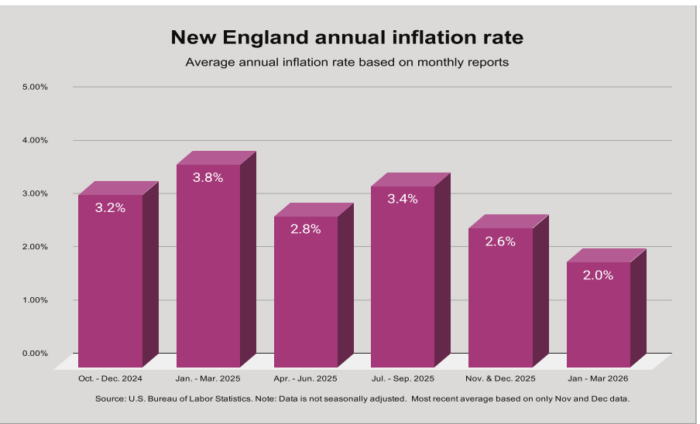
It was brief, even fleeting, but for the first three months of 2026, the average, annualized rate of inflation in New England was 2%.
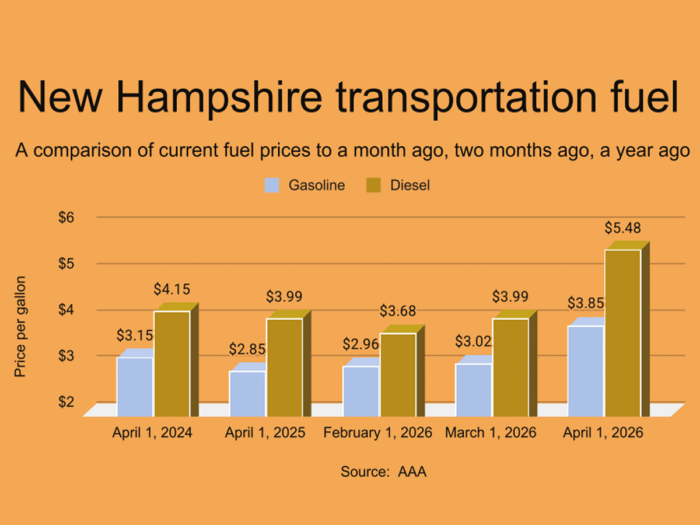
A gallon of gas has jumped about 25%
Federal Reserve report shows cautious optimism about the future