Navigating NH’s new solid waste site eval. committee
Anyone who has taken a transmission line or a wind farm through New Hampshire’s Site Evaluation Committee knows the process is long, expensive and can be fraught with complication.
As a rule of thumb, residential real estate buyers should gauge the affordability of a home by what’s called their “debt-to-income ratio” of about 28%. Everything that goes into owning a home (mortgage payments, mortgage insurance, property taxes and homeowner’s insurance) should be within 28% of a household’s income.
Nationally, after the first quarter of 2026, a new analysis shows that, in about 70% of counties in the United States, monthly home expenses exceeded that guideline.
And all of the New Hampshire counties in that analysis, done by ATTOM, a national property data analyst, exceeded that 28% by a lot.
In addition, according to a separate analysis by the New Hampshire Fiscal Policy (NHFPI), it will take a multi-pronged effort, including state funding that is currently largely non-existent, to begin to address the problem.
ATTOM included New Hampshire’s most populous counties — Merrimack, Hillsborough, Strafford and Rockingham — in its Q1 2026 analysis of affordability.
The study showed buying a home in Rockingham County, which consistently has had the highest median-priced, single-family homes over the years, would require 56.6% of wages. Strafford was next at 54.4%, then Merrimack at 50.2% and Hillsborough at 45.2%.
Joshua Greenwald, president of the New Hampshire Association of Realtors, noted that the statewide median sales price of a house in March was $530,000, what he called “a modest 1% increase from the same month last year. That marks the smallest year-over-year monthly gain since May 2023 and may suggest that price growth is beginning to ease.”
But a broader look at the market, he said, “tells a more complicated story.”
“For the first quarter of 2026, which includes January through March, the median sales price for a single-family home also stood at $530,000. That figure represents a 3.9% increase over the first quarter of 2025, indicating that home values continue to trend upward overall,” said Greenwald, owner broker of the Greenwald Realty Group in Keene.
“Market conditions in the coming months will help determine whether March’s slower rate of growth signals a lasting shift or simply a temporary pause in what remains a competitive housing market,” he added.
Part of the complication of the New Hampshire real estate housing market lies in the fact that prices can vary — by a lot — from county to county.
During the first quarter, according to new NHAR data, Carroll County ($520,000, up 10.5%), Cheshire County ($402,00, up 7.9%), and Grafton County ($437,500, up 6.7%) posted the largest increases compared to the first quarter of 2025.
Meanwhile, it said, prices declined in Coos County ($231,500, down 6.5%), Sullivan County ($355,000, down 5.3%), and Hillsborough County ($540,917, down 1.7%). Rockingham County remained unchanged at $650,000.
Lack of a robust housing inventory puts pressure on prices — fewer homes for sale means higher prices for the homes that are for sale. That’s improved lately, according to Greenwald, but only slightly.
“We are seeing more homes on the market than in recent years,” said Greenwald. “But we still have fewer than half the number of homes for sale than we did before COVID. In the first quarter of 2026, there were about 1,400 homes for sale on average each month. Compare that to the first quarter of 2019, when there were roughly 3,600 homes for sale, and in our last sign of a balanced market (October 2016) there were over 7,100.”
A balanced market has a 6-month supply of houses to sell. NHAR’s March data shows a months supply of 1.4.
“That lack of inventory continues to keep prices high,” he added.
A NH Business Review look at first-quarter price averages over the last few years shows the following:
Q1 2023 average price for a single-family home = $427,833
Q1 2024 average price for a single-family home = $473,000
Q1 2025 average price for a single-family home = $513,300
Q1 2026 average price for a single-family home = $531,700
That’s a 24.3% increase from 2023 to 2026.
According to a recent NHFPI analysis of the real estate market, housing costs continue to outpace income growth, with households needing an income of $158,000 to make purchasing a house affordable and avoid being cost-burdened in 2025.
The pace of increase in housing costs is faster than the increase in household income, creating a problem for homeowners and renters alike.
From 2019 to 2024 (the most recent years of data available), according to NHFPI, the statewide median household income increased by about 28%. By comparison, the median price of a single-family house rose by 71.7% during this time. Renters have faced the same challenge with the statewide median income among renter households rising by 30.2%, compared to a 36.1% jump recorded in the median price for a two-bedroom rental unit.
NHFPI also noted that staying within the benchmark debt-to-income ratio is difficult for many in New Hampshire.
“Based on the statewide median single-family house sale price ($535,000), the average statewide property tax rate ($15.83 per 1,000), the average 30-year fixed mortgage rate (6.6%), and a 5% down payment ($26,750), a homebuyer in 2025 would have faced a mortgage payment exceeding $3,950 per month, not including any purchasing fees, homeowners’ insurance and other costs that come with owning a home,” said the report’s author, Jessica Williams, a senior policy analyst.
“In order to avoid being cost burdened, or pay over 30% of income on mortgage payments, a household would have needed to earn over $158,000, or $76 per hour in a 40-hour workweek, in 2025. As of the most recent data from 2024, only about a third of households in New Hampshire had incomes over $150,000,” she added.
The New Hampshire Legislature has taken on the housing issue with several bills aimed at deepening the supply pool — allowing detached accessory dwelling units (ADUs) where they were allowed before, allowing residential development in commercial zones, and allowing manufactured homes where they were allowed before, just to name a few.
But the NHFPI notes a stark lack of state funding that can also help create residential development.
The fiscal year 2024-25 state budget under former Gov. Christopher Sununu included $10 million for the Invest New Hampshire program, originally funded with $100 million in pandemic-related federal dollars, to support developers building multifamily housing, as well as $25 million for the Affordable Housing Fund to provide loans for projects supporting those with low and moderate incomes.
But the fiscal year 2026-27 budget under Gov. Ayotte zeroed out those accounts.
“… this reduction could constrain future projects and development,” said Williams in her analysis.
“Several multi-pronged approaches will be needed to address New Hampshire’s ongoing affordable housing crisis, including immediate assistance for Granite Staters struggling to afford housing, regulatory changes to help provide more opportunities for new housing developments, and financial investments to help support production and affordability,” she added.
A contributing factor to the squeeze on housing and affordability is President Donald Trump’s tariff policy and the resulting uncertainty for businesses in the housing sector. U.S. Sen. Maggie Hassan, D-NH, said this has slowed construction of housing in the United States, which exacerbates the affordable housing shortage.
Hassan is ranking member of the Joint Economic Committee, a bipartisan committee of the U.S. Congress established by the Employment Act of 1946. To measure the impact on housing by the tariffs, imposed by Trump immediately after he became president in January 2025, the committee reached out to home builders, multifamily housing developers and real estate professionals.
Materials and other products that are used to build and furnish homes — steel, copper and lumber, for example — have become more expensive over the past year, according to a new minority party JEC report.
“Home builders are sounding the alarm about the ways in which the president’s tariffs are driving construction costs higher,” said Hassan. “This report shows how the president’s policies are leading to fewer houses and apartment buildings being built in America, which is the last thing we need when facing a severe shortage of affordable housing.”

Anyone who has taken a transmission line or a wind farm through New Hampshire’s Site Evaluation Committee knows the process is long, expensive and can be fraught with complication.
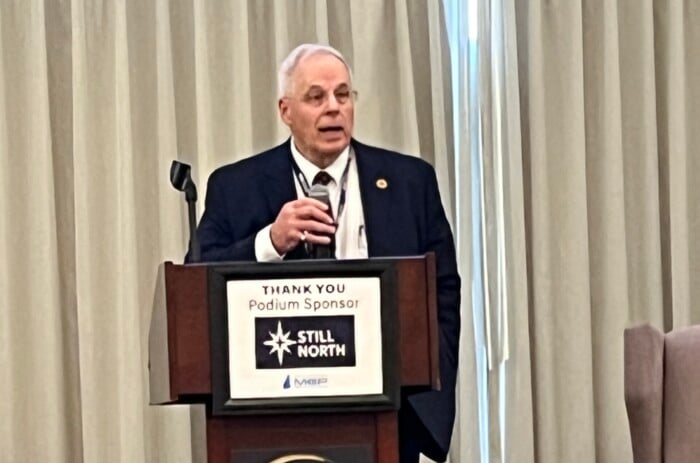
This year’s Advanced Manufacturing and High Technology Summit kicked off with a topic universal to all employers: how to build the workforce of tomorrow. The 24th annual event organized by the New Hampshire Manufacturing Extension Partnership on Oct. 9 featured a keynote panel discussion featuring representatives from the state’s university and community college systems.

Agritourism has become an important business option for many farms in New Hampshire and across the country. Exactly what is agritourism?

On a recent Friday at the Easterseals NH Military & Veterans Campus in Franklin, I found myself about 30 feet in the air. I was holding onto a pole and contemplating what suddenly seemed like a rather narrow log stretching out over a great deal of empty space toward another pole, which also seemed remarkably distant.
In recent years, New Hampshire families have faced persistent and growing challenges with affordability and accessibility as they navigate the early care and education landscape.

Published annually, “The Best Lawyers in America®” is an exhaustive search for the country’s top attorneys. Here is a compilation of the top attorneys who practice in New Hampshire in dozens of legal specialties related to the needs of businesses,…

Ramy Rahimi is the new vice president for research and development at the University of New Hampshire.

This year, NH Business Review marks the 24th anniversary of our Business Excellence Awards, which celebrate the initiative, creativity and tenacity of the Granite State’s business community.

Back in 1992, political strategist James Carvell came up with the phrase, “It’s the economy, stupid,” to help Democrat Bill Clinton defeat incumbent Republican President George H.W. Bush.