Take 5: living wages, language learning and school cellphone bans
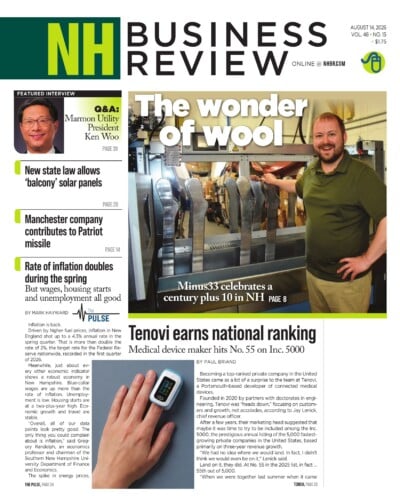
NH Business Review's biweekly snapshot of business and industry statistics
IN WalletHub’s 2026 Most and Least Innovative States study, New Hampshire ranked at No. 12. Methodology weighed the state’s human capital (number of STEM professionals, math and science student performance, projected STEM job demand, and science and engineering graduates) versus innovation environment (share of tech companies, R&D investment, invention patents per capita, entrepreneurial activity, etc.). In NH, the innovation environment ranked higher, No. 6, than its human capital segment, No. 15.
THE U.S. Bureau of Labor Statistics released a new report that shows employment declined in the three largest counties in New Hampshire from September 2024 to September 2025. Among the three largest counties, Merrimack County had the largest over-the-year decline in employment (-1.4%). Hillsborough County had the largest average weekly wage gain (+6.4%), followed by Rockingham (+3.4%) and Merrimack (+2.8%) counties. Nationally, hires were unchanged at 5.3 million while total separations changed little at 5.1 million.
ACCORDING to Remote.co’s 2026 Financial Flexibility Report, nearly two-thirds (62%) of workers say they do not feel financially secure in their current role, while only 38% report feeling financially stable. The survey found two in five professionals (40%) said they have quit or seriously considered quitting their job to pursue a side hustle full time. Baby boomers are also the least likely of the generations to have ever participated in side work, with 45% saying they have never had a side hustle, compared to 27% of millennials and 33% of Gen X who said the same.
NEW Resume.org data revealed that 57% of hiring managers say an employee with strong creative thinking, communication and storytelling skills is now more valuable than one with strong technical skills, such as coding. Additionally, 57% say creative employees are harder to replace with AI than technical workers.
IN a Pew Research Center survey from January, data showed that 55% of U.S. adults say they would prefer to live in a community where “houses are larger and farther apart, but schools, stores and restaurants are several miles away.” Forty-four percent would prefer a community where “houses are smaller and closer to each other, but schools, stores and restaurants are within walking distance.”

NH Business Review's biweekly snapshot of business and industry statistics
NH Business Review's biweekly snapshot of business and industry statistics
NH Business Review's biweekly snapshot of business and industry statistics
NH Business Review's biweekly snapshot of business and industry statistics
NH Business Review's biweekly snapshot of business and industry statistics
NH Business Review's biweekly snapshot of business and industry statistics
NH Business Review's biweekly snapshot of business and industry statistics
NH Business Review's biweekly snapshot of business and industry statistics
NH Business Review's biweekly snapshot of business and industry statistics