State of artificial intelligence in New Hampshire
Forum at Saint Anselm's Center for Ethics in Society explores the impact of AI and its potential to boost profit margins
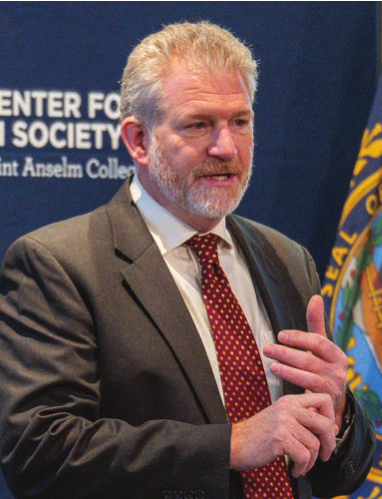
Attorney Cameron Schilling, who chairs the cybersecurity and privacy group for McLane Middleton, presents a keynote talk about artificial intelligence at the NH Institute for Politics on Dec. 9. Schilling will lead a webinar on AI hosted by NH Business Review on Jan. 22 from 10:45 to noon. (Photo by Kim Casey, Saint Anselm College)
Cameron Schilling bookended his keynote about artificial intelligence with a dramatic PowerPoint image: sun bursting through dark clouds, small boats anchored in the bay, calm waters that could get choppy soon.
“The dawn of AI is not coming sometime in the future. It’s here today, right now,” the attorney told a group of business people and educators gathered at the New Hampshire Institute of Politics on Dec. 9.
You don’t need to take his word for it. Since 2013, investors have put nearly $1.6 trillion into artificial intelligence, already far surpassing the wartime Manhattan Project ($30 billion in today’s dollars) and NASA’s Apollo program ($298 billion), according to Reuters.
This month, Disney invested $1 billion into OpenAI, becoming the company’s first major content provider for Sora, its short-form generative AI video platform.
AI already fuels enterprise resource planning systems (the software that automates business processes like finance, accounting and human resources), as well as design and engineering tools, Schilling said.
“It’s being integrated or probably already has been integrated into applications that businesses use every day in every industry,” said Schilling, who chairs the cybersecurity and privacy group for McLane Middleton.
Schilling’s presentation kicked off “The State of AI in the Granite State,” a forum hosted by the Center for Ethics in Society at Saint Anselm College and NH Business Review. The event also featured a panel discussion with industry pros and roundtable discussions, during which participants addressed how AI is affecting their businesses.
Schilling offered a primer on the core principles of implementing AI that focused as much on how to use artificial intelligence responsibly as it did on how the technology can improve business systems and increase profit margins.
Both Schilling and industry panelists noted said AI will complement work performed by people rather than replace them.

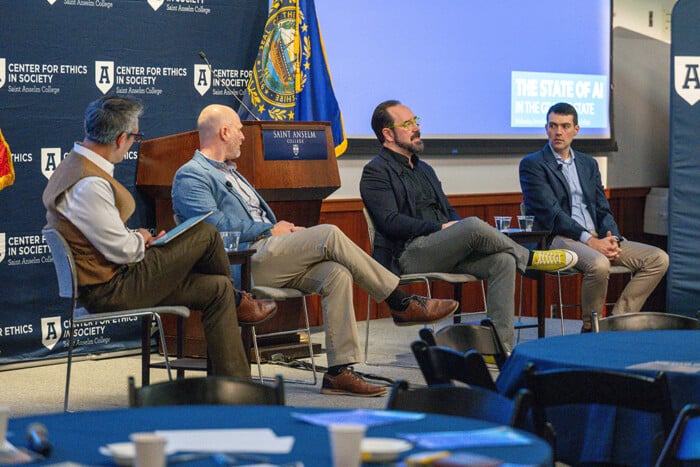
Chris Toppin, chief service officer for Mainstay Technologies, talks about AI in the workplace during a panel talk Dec. 9. At right is Leo Schrantz, chief AI and innovation officer for Vestmark. From left, Ernesto Burden, publisher of NH Business Review, and Steve Leone, publisher of the Concord Monitor. (Photo by Kim Casey, Saint Anselm College)
“AI doesn’t replace what humans do best. We exercise judgment, sometimes good judgment. We’re creative. We build strategies, and we innovate,” Schilling said. “We need to learn how to combine those strengths with AI, because when we do that, we can release both the power of technology and the power of humanity.”
Health care providers in New Hampshire and Massachusetts are incorporating AI into their patient care and diagnostic systems, Schilling noted. Elliot Hospital in Manchester uses AI to record and transcribe patient meetings, helping to reduce physician burnout.
“What that means is that clinicians can review, edit and approve their notes in a fraction of the amount of time it would have taken them to create the notes. This has resulted in hours of tedious paperwork being eliminated for every clinician,” he said.
Radiologists at Mass Brigham General in Boston are using AI to help diagnose lung cancer, using a system that has a 94% accuracy rate, increasing early detection and leading to better patient outcomes, he said.
“It reduces the cost of health care. But most importantly, this is AI and human interaction at its most consequential,” Schilling said.
Other examples he noted show the breadth of industries that have adopted AI.
Salmon farmers on the coast of Maine are integrating AI into their fisheries to both advance environmental stewardship and increase profits.
Service Credit Union has integrated AI into its credit-making decisions, which led to a 25% higher approval rate and reduced the bank’s credit risk, Schilling said.
He emphasized that the credit union took considerable care educating customers about the change.
“It decidedly achieved transparency by telling its consumers that it was using AI, how it was using AI, and what the outcome of AI was,” Schilling said.
AI in the workplace
During a panel discussion moderated by Ernesto Burden, publisher of NH Business Review, industry representatives from technology and media talked about how their companies are using AI.
While AI has already infiltrated systems in many industries, the technology is still in its infancy. The large language models that learn patterns from massive data sets are frustratingly inconsistent, rarely performing functions the same way twice.
That means leaders have to encourage their employees to experiment with AI with the knowledge that it likely will mean taking more time rather than less to perform a task, with the ultimate goal of finding the most efficient path.
Steve Leone, publisher of the Concord Monitor, says his company has used AI to create headlines and summaries of news stories on the web but not to generate the stories themselves. They’ve also used AI to create sales presentations.
“Eventually you got to start playing around with it, because it does have the ability to make you more capable,” Leone said. “And that’s all we’re looking for, is becoming more capable to do things that we otherwise wouldn’t do. But getting people to adapt is always a challenge, because you’re trying to get them to spend time, invest time, so that they can save time.”
Mainstay Technologies, an IT and cybersecurity service company, seeks workers for entry-level positions who relish that kind of challenge.
“We’re always looking for folks that are curious and experiment with technology,” said Chris Toppin, chief service officer. “But as long as they have that and then have some experience with that community, like relationship-side communication, customer service, that’s actually more important.”
Leo Schrantz, chief AI and innovation officer for Vestmark, in Wakefield, Mass., said AI’s tendency to take multiple paths to perform the same function runs counter to traditional software engineering.
“We’re used to designing systems. And then you test them and they execute every time. And that’s exactly what you want.
You ship to production. You’re done,” said Schrantz, whose company makes software for the finance industry, But AI’s weakness can be turned into a strength. You can work out the bugs in real time, as AI tries different approaches to complete a task, he said.
“That is an incredible opportunity to actually allow it to self-discover how to do things efficiently,” Schrantz said.
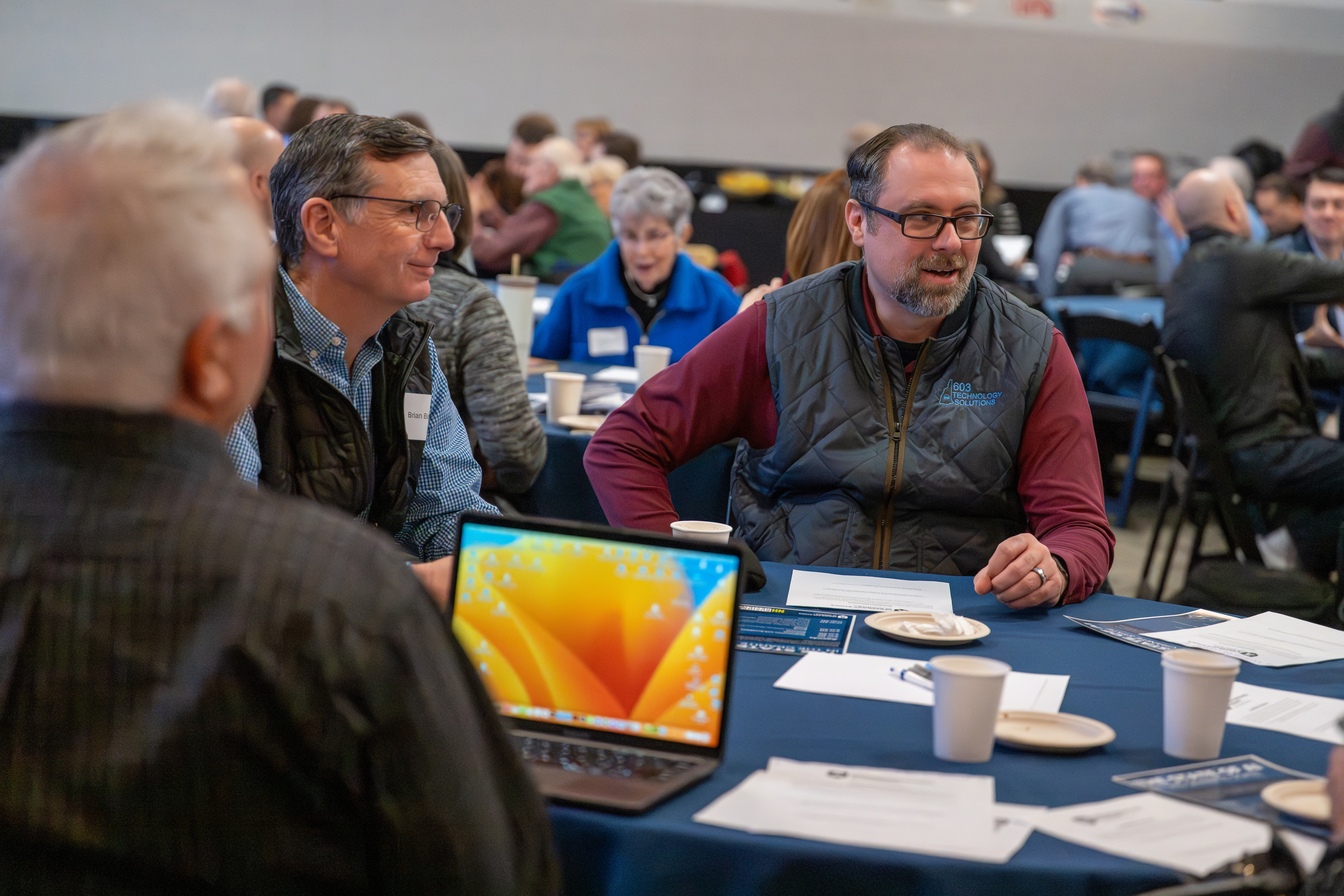
From left: Brian Baily, managing director of Shaw Data Security, and Shane Pouliot, owner of 603 Technology Solutions, talk about how AI affects their businesses during a Dec. 9 forum on AI at the NH Institute of Poltics. (Photo by Kim Casey, Saint Anselm College)
Roundtable wisdom
At one of the roundtable discussions, participants downplayed the threat AI presents when used by criminals.
Zak Mei, a database systems veteran currently pursuing a master’s degree in geographic information systems, said AI will help people who need protection more than it will help the “bad actors.”
Brian Baily, managing director of Shaw Data Security, said the bigger threat was negligence, that companies won’t invest the time it takes to be diligent about their use of AI.
He’s worried businesses will treat their AI systems like they once treated computer hardware, as something they buy and don’t worry much about.
Shane Pouliot, owner of 603 Technology Solutions, said he thinks AI will “make the world smaller” in the same way the internet and social media has done.
While he doesn’t think AI will replace people, it will require them to adapt their skill sets.
“Do I need a full-time admin? I don’t, because I can use AI to streamline those processes for me,” he said.
Forum at Saint Anselm's Center for Ethics in Society explores the impact of AI and its potential to boost profit margins
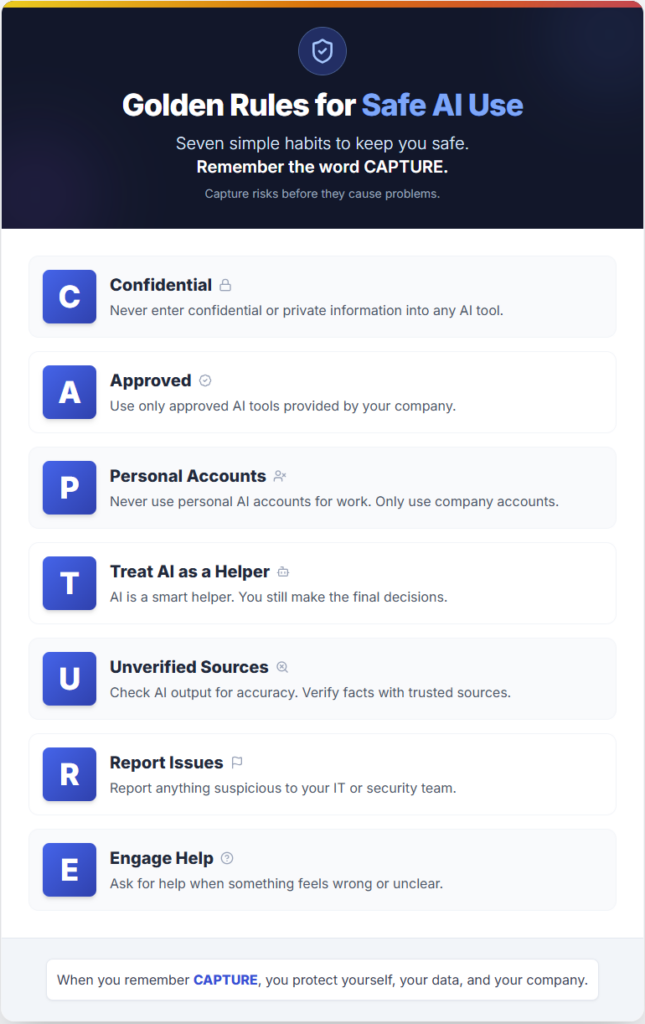
Practical tips to help you avoid the most common AI usage mistakes cybersecurity professionals see today
Cybersecurity isn’t just a defensive measure; it’s a strategic asset that can significantly enhance enterprise value

Significant cyber events exposed the failure of fragmented security tools and established that point solutions can no longer protect against modern threats

The Cybersecurity Maturity Model Certification (CMMC) isn’t some distant regulatory cloud looming; it’s here, it’s already appearing in contract language

A phishing scam, ransomware attack or data breach can turn an ordinary Tuesday into a flat-out disaster if businesses avoid basic, consistent cyber care

For businesses in the United States, AI governance will soon become a compliance imperative, not just a best practice

The ever-evolving digital world we operate in each day offers infinite opportunities for business growth and development, but it also presents many risks.
Overwatch Foundation is helping the state and school districts protect critical systems