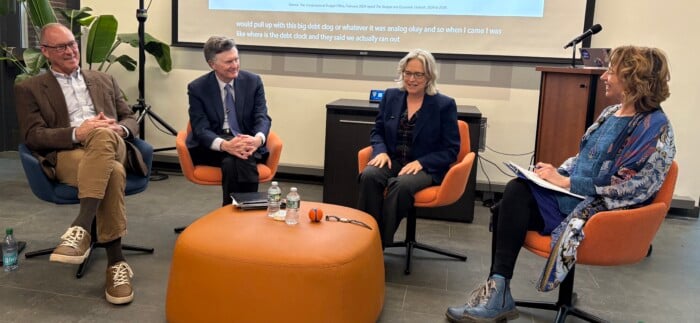
Q&A with the Executive director of the NH Lottery and Gaming Commission Charlie McIntyre

‘What I learned is if we wanted to have a product or a program in New Hampshire that was successful, it had to mirror the illegal product, because if it was too greedy, if it was too burdened with bureaucracy, it wouldn’t compete.’
Charlie McIntyre can’t share any Powerball secrets with you, but he knows a lot about games of chance.
Since 2010, McIntyre has overseen the state’s gaming operations, which was recently renamed the New Hampshire Lottery and Gaming Commission to recognize how the state has expanded into other areas over the last several years.
That includes the charitable gaming casinos that have sprung up all over the state, and the commission’s partnership with Boston sports gambling company DraftKings, whose software development group is based in Nashua.
“If you place a bet in the state, you’re doing it through some version of us,” says McIntyre, who has worked under four governors.
Prior to his career working for lotteries in Massachusetts and New Hampshire, McIntyre worked as a prosecutor fighting organized crime — experience that helped shape his future career.
“What I learned is if we wanted to have a product or a program in New Hampshire that was successful, it had to mirror the illegal product, because if it was too greedy, if it was too burdened with bureaucracy, it wouldn’t compete,” he says.
McIntyre recently visited NH Business Review to appear as a guest on the “Down to Business” podcast with Managing Editor Amanda Andrews, from which this article was adapted. Listen to the complete interview at nhbr.com or on your favorite streaming service.
Q. Can you share with us your background with the lottery, how long you’ve been here and what that journey was like for you?
A. I’ve been in New Hampshire for a little over 15 years. I’ve been the executive director of the lottery, now the Lottery and Gaming Commission. Prior to that, I was the assistant director, general counsel, for the Mass. lottery. And ironically, before that, I was an organized crime prosecutor. I chased bad guys.
I was starting a family, and my life had been threatened a bunch. My wife was like, ‘You got to leave, you know? … I went to have a safer job, which was the general counsel of Mass. lottery, chief lawyer. The defense bar howled. They said, “You’ve been chasing bookies forever, and now you’re going to be the largest one in the state.”
The job opened up here to be the director, and my wife got her undergraduate degree at Dartmouth and loved New Hampshire. The neighborhood I was living in with my kids, which was a nice neighborhood, there was a drive-by shooting in the next town. Boston was getting a little too dangerous. I wanted a place to raise my boys, so that’s how I ended up in New Hampshire as the director.
Q. Between Mass. and New Hampshire, is it a different ball game?
A. “The Mass. lottery is a factor of 15 times larger. When I started here, there were 44 employees. When I left Mass., there were 430. So as the chief lawyer, there’s just 100 problems every day that have to do with people and stuff and buildings and cars and whatnot. Also, the Mass. lottery at the time was the most profitable lottery in the world per capita. One of the worst things is taking over lottery that’s the best at what it does, because all you can really do is screw it up.
Whereas when I took over New Hampshire, they really were in the early stages of development. They had a lot of places to grow. My job was quite literally as explained to me by (Gov.) John Lynch, grow revenue — responsibly — but grow revenue. And so that’s what we set about doing.
Q. That’s a good segue into the recent news that you broke an all-time revenue record.
A. When I first started, my first revenue year was $62 million, and this year we’re on pace to hit $245 million. But there’s always a demand for services and money. One of the difficult parts of government is when need is at its most, its revenues are its least. And so that’s part of the issue. And then certainly when revenues are their best, need is the least.
During COVID when you had all that money flowing in, there wasn’t much need because everyone was being satisfied. Not everybody, certainly … And now if we go into a downturn, which I don’t know that we are, but if we do, the services that are required are higher, and the revenue gets lighter.
When the Powerball jackpot gets high, foot traffic accelerates into stores. “I’m here, I’ll buy a bag of chips and a soda and a Powerball ticket.”