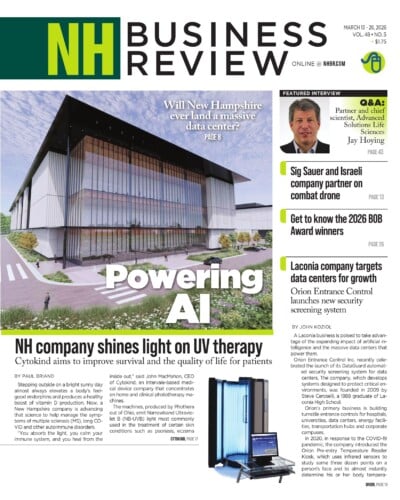
Powering AI
Will New Hampshire ever land a massive data center?
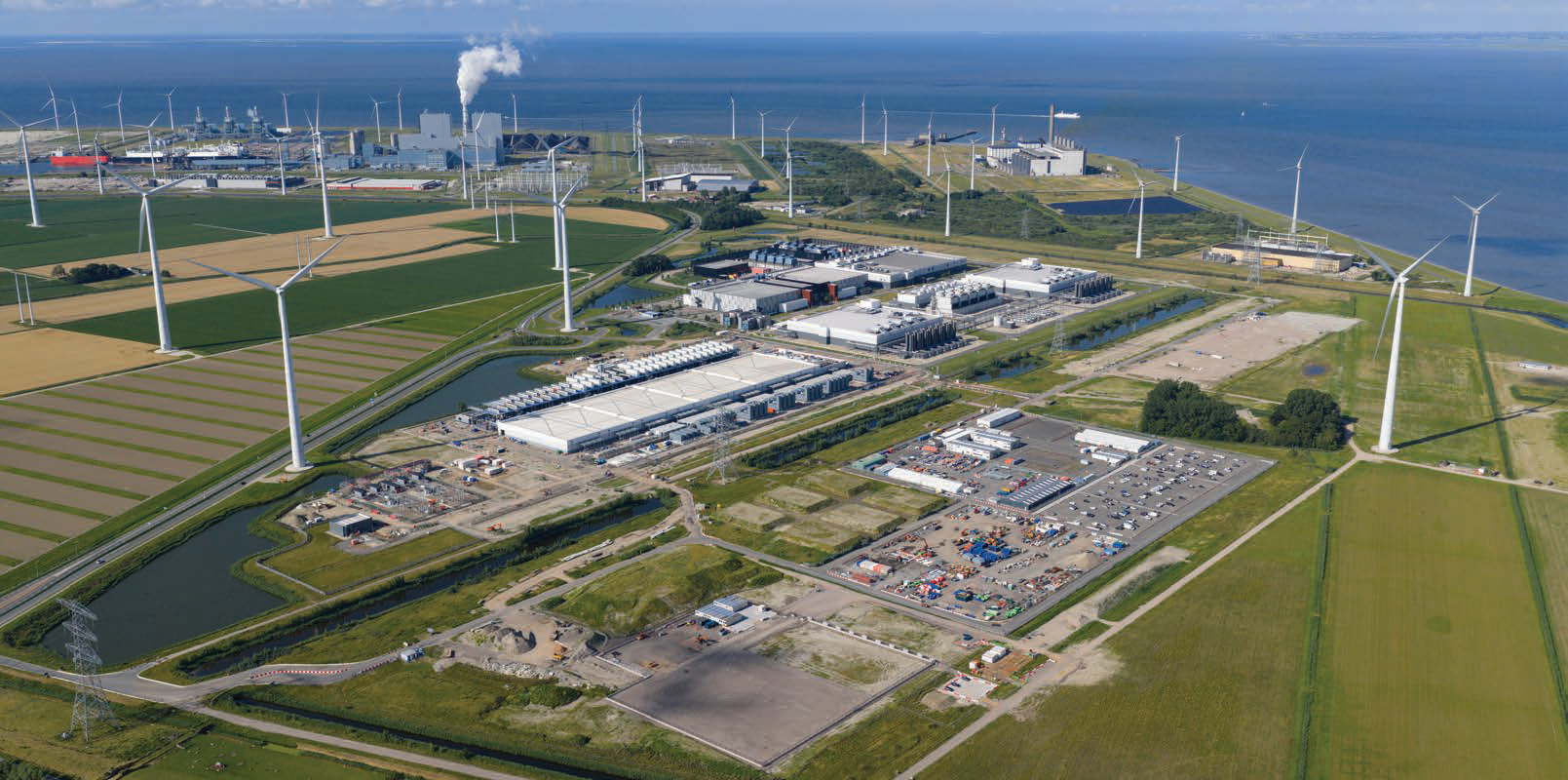
PowerHouse Arcola, a 37-acre campus in Loudon County, Virginia, will feature two two-story data center buildings totaling 615,000 square feet and is designed to support up to 120 MW of utility capacity to support AI, cloud, and high-performance computing workloads, the developers say. (Rendering from Powerhouse Data Centers)
Across the country — even across the world — the frenzy is on to build massive data centers to run the artificial intelligence that is embedding itself into the 21st-century economy.
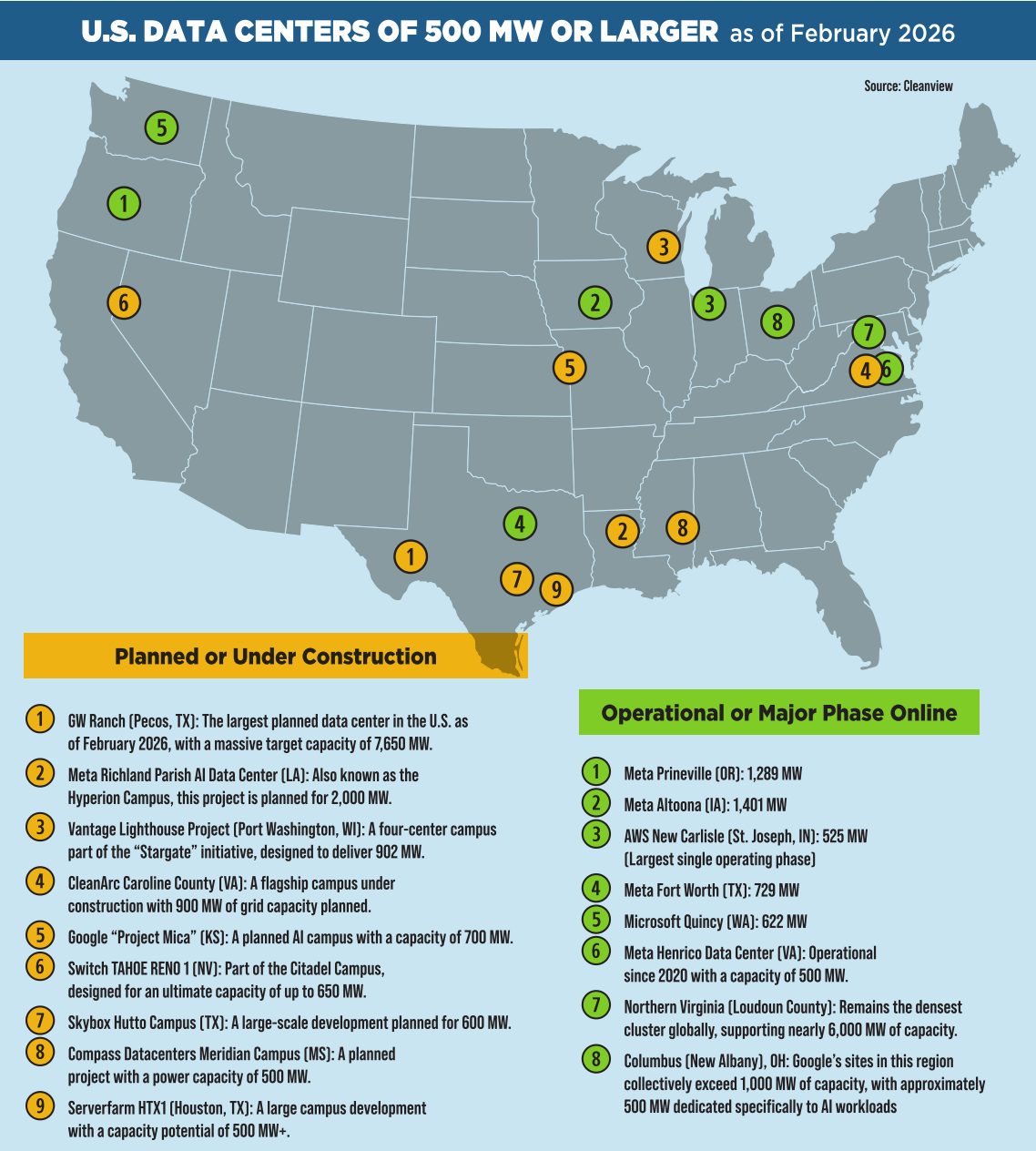
Oregon, Iowa and Ohio already host data centers that absorb more than 1,000 megawatts of power — about half of the power necessary to meet New Hampshire’s electricity appetite during peak demand periods.
In northern Virginia, a single county hosts data centers backed up by 6,000 megawatts of power.
And data centers that exceed 500 megawatts of electrical demand are found in several other states, fueled by tax incentives, abatements and infrastructure buildouts, according to AbitOs, a Florida-based accounting and advising firm.
But in New Hampshire, and New England as a whole, there has been little talk until recently about massive data centers. A developer’s proposal to build a large data center in southern Maine is receiving close scrutiny by government officials, according to reports by the Portland Press Herald and other sources. Some are already calling for a moratorium on them.
New Hampshire is peppered with tiny data centers — they burn from a couple of megawatts up to 20 megawatts of power — that are used mainly as cloud servers.
But massive data centers where AI functions? “We’re not looking for them,” said Taylor Caswell, who served as New Hampshire commissioner of business and economic affairs until last year.
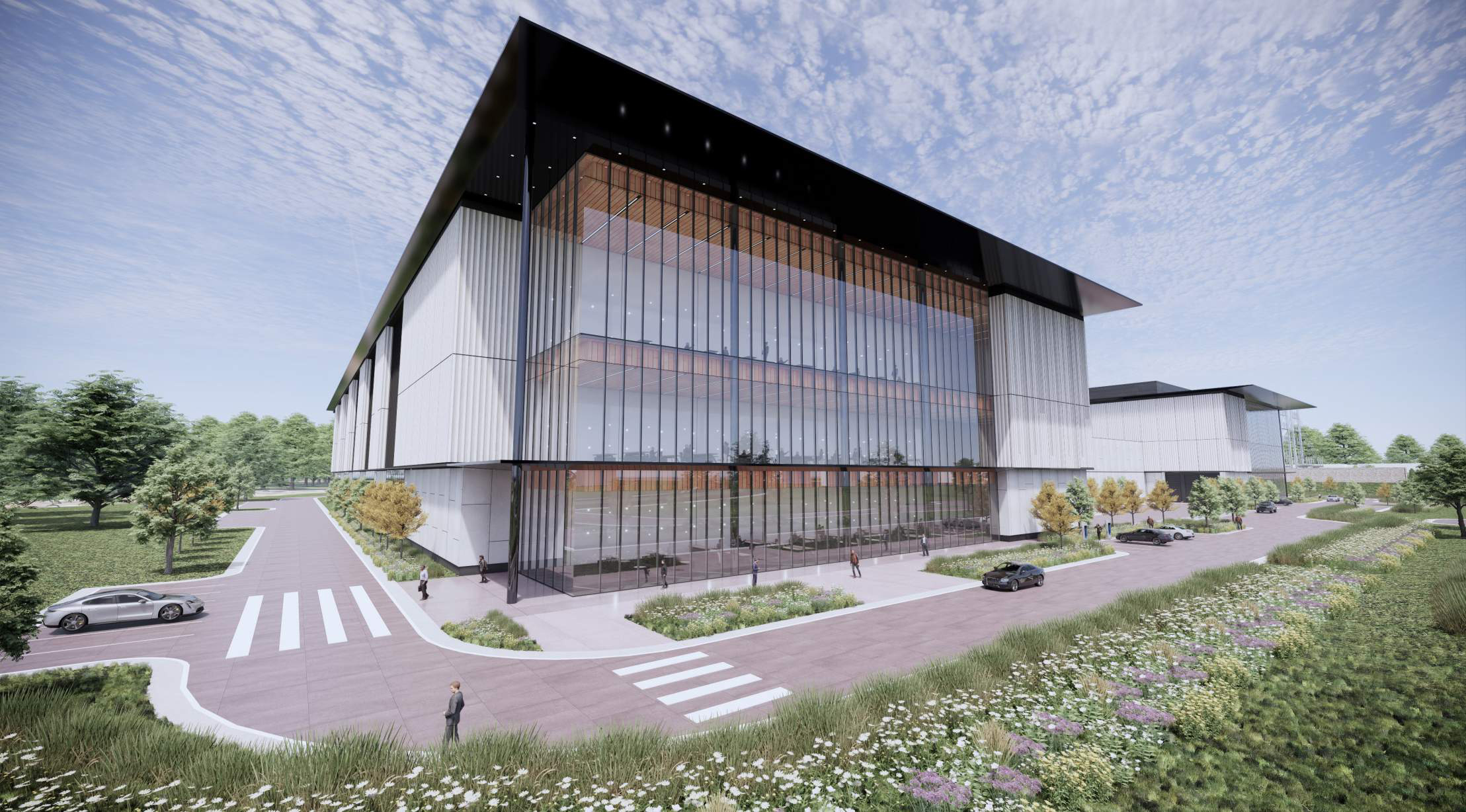
This sprawling data and computing center is located in Eemshaven, Groningen, The Netherlands. (Adobe Stock/Sepia 100)
At the helm of economic development in New Hampshire for eight years, Caswell would occasionally field inquiries about data centers. The issue quickly came down to space, which New Hampshire doesn’t have a lot of, and power, which is expensive and hard to generate in the Granite State.
And he sees downsides. The power and land dedicated for a data center, which employs relatively few people, would be better used for a factory, Caswell said.
But the need grows for data centers. The commercial real estate/investment firm JLL predicts that demand for data centers in the Americas will grow at a compounded annual rate of 17% from now until 2030. That is leading some to say that New Hampshire has to at least strongly consider mega-data centers.
“If you’re in the business of computing, you will want to locate facilities closer to where you use them,” said Jeremy Hitchcock, founder and former CEO of the tech company Dyn, which Oracle acquired in 2016. “You don’t want to be dependent on a company outside the planet.”
For security reasons, some users want dedicated fiber lines to a data center, which can best happen if the data center is nearby, said Patrick Coughlin, whose firm Goodcap Advisors consults on telecommunications and data center development. He also said data quality improves with proximity to centers, and the future may demand proximity.
“What are the applications we don’t know about?” Coughlin said. In the future, a grant for the University of New Hampshire may be tied to data center proximity, he said.
So if you’re Meta or Google and want to open a 500-plus megawatt data center in New Hampshire, here are some considerations.
Power cost and availability
By far, the biggest issue facing any mega-data center is a power source. As chips grow smaller and more compact, they demand more power to operate.
That includes power to keep them cool, although modern designs are relying more on water — an advantage that New Hampshire has — rather than air conditioning for cooling.
Last fall, Eversource, the largest electrical utility in New Hampshire, received requests from data centers that added up to 1,500 megawatts of power, said Digaunto Chatterjee, senior vice president of engineering.
Eversource’s role is pretty basic: Chatterjee assesses grid reliability and transmission (Eversource does not generate power) and hands a would-be developer an invoice for upgrades.
But he worries what effect such a huge power demand would have on New Hampshire. Unlike other New England states, New Hampshire power producers generate about 4,500 megawatts of electricity, about half of what the state uses. The power is mostly clean, and prices are stable, Chatterjee said.
“You have a system that is stable. Don’t mess it up is what I’m getting at,” he said. Had New Hampshire embraced the 1,200-megawatt Hydro Quebec transmission project, which the state rejected in 2018, power would not be a problem for a data center, he said.
Yet transmission became less of an issue last year, when Gov. Kelly Ayotte signed a bill that allowed for off-grid power plants in the state. And in his state of the union address, President Trump called on data centers to build their own power plants. Doing so would skirt the questions of any impact to the grid.
Options for power generation could run the gamut, including nuclear. Even New Hampshire-made nuclear.
Hitchcock, a longtime venture capitalist, has launched Star Cube, which could have “low consequence” micro nuclear reactors ready for commercial use in three to four years, he said. In February, the U.S. Energy Department announced that such reactors would bypass lengthy environmental reviews, although they would still need licensing by the Nuclear Regulatory Commission.
“We’re running out of options,” Hitchcock said, noting previous opposition to high-voltage power lines and natural gas transmission lines.
The physics for a small reactor is not complicated, and a single reactor would only generate between five and 10 megawatts, Hitchcock said. But multiple reactors could be located on a single site.
Data lines
Just as important as power for any data center is the capacity for quick, reliable flow of information in and out of the location.
Unlike the power challenge, New Hampshire is in good shape for data transmission. The state used COVID-19 money to invest heavily in broadband expansion, Caswell said. As of October, only about 3,000 addresses across the entire state lacked access to high-speed internet.
“The good news is, in a lot of New England states there is a good amount of recently built fiber,” said Coughlin, the fiber and telecommunications consultant.
The average fiber in southern New Hampshire amounts to 144 or 288 strands. That compares to strand counts that exceed 1,000 in northern Virginia, but Coughlin said the difference wouldn’t be material for a single mega-data center.
“If someone wanted to invest, I don’t think fiber connectivity would be an issue,” he said.
Most data centers want at least two fiber providers coming into the building for diversity’s sake, he said.
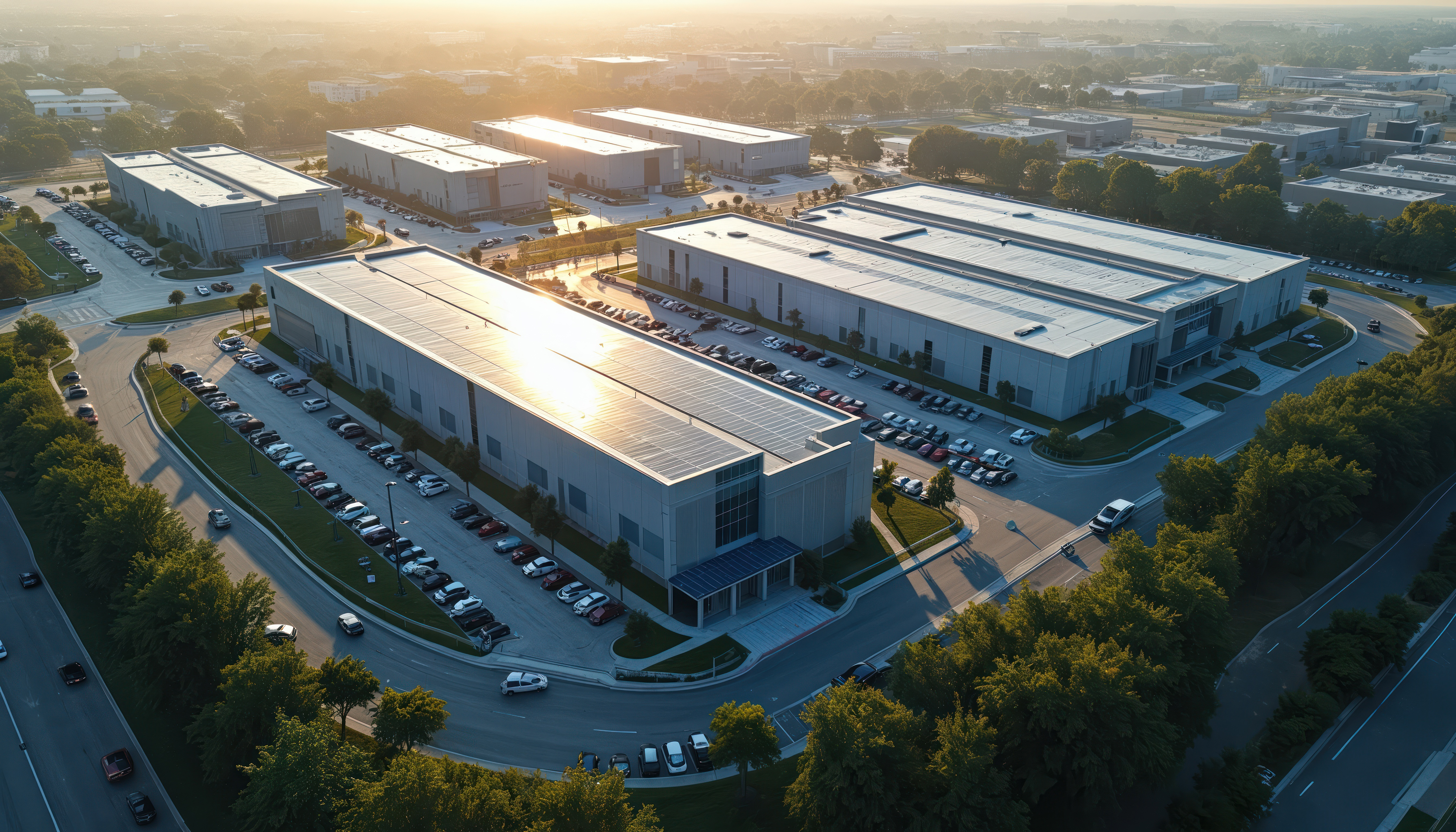
This image — generated by artificial intelligence — underscores the massive footprint of data centers that are needed to power AI computing. (Adobe Stock)
Location, location, location
Barring an on-site generator, a megadata center would have to be located near power generators and high-voltage power lines, and most sources are in the Manchester-Nashua-Portsmouth triangle.
Power lines that are now designed at 115 kilovolts of electricity would have to triple in design capacity, meaning higher towers and wider rights of way, Chatterjee said.
Even with no data center on the drawing board, opposition is forming.
In December, state Rep. Wendy Thomas co-wrote an op-ed piece with California congressman Ro Khanna warning about the effects a mega-data center would have on the landscape, wildlife habitat, energy and water consumption.
“None of this is to say that New Hampshire should ban data centers outright,” the Democrats wrote. “But it does mean that we must approach these projects with great care, strong regulations and transparency.”
Two weeks later, the deputy ranking Democrat on the New Hampshire House Science, Technology and Energy Committee chimed in with his own op-ed. He mentioned some of the same concerns, and worried that off-grid generators would rely on diesel power.
“We don’t need them (data centers) here,” wrote Rep. Thomas Cormen of Lebanon.
The press officer for Ayotte did not respond to an email asking where she stands on the issue. Nor could the NH Business Review obtain comment from the outgoing commissioner of Business and Economic Affairs, James Key-Wallace.
“I really don’t think it’s as bad as some folks make it out to be,” Coughlin said. But he said any effort to build a megadata center in New Hampshire would involve a significant effort of public education and transparency.
Caswell, who served under former Republican Gov. Chris Sununu, said the state never developed a firm yes or no policy when it came to data centers.
“I never had them fully explain to me why they had to be in New Hampshire. I still don’t feel it’s been fully explained to decision-makers,” he said.
Coughlin believes a serious attempt will eventually happen.
“There’s just too much money to be invested,” he said, “to not have someone kicking the tires.”
By far, the biggest issue facing any mega-data center is a power source.

Will New Hampshire ever land a massive data center?
Bow could become the first town to withdraw from the Community Power Coalition of New Hampshire as residents confront high energy costs.
New Hampshire’s energy officials are asking the state’s Supreme Court to review a decision by utility regulators that raised rates for Eversource customers last summer.

Residents debated a proposed $2.66 million wastewater project during a town deliberative session at Pittsfield MidCadle High School, with discussion focusing on costs, long-term planning and who should pay.

Innovation is promising for builders, loggers and rural communities
For the last several years, housing and commercial development have been under the spotlight in New Hampshire. Building professionals have had to be creative to address challenges in infrastructure, resilience in the face of a changing climate and a focus on sustainable design. Our expert weighs in on engineering innovations and trends.

Dublin is considering whether to join 27 other New Hampshire towns in a statewide Styrofoam recycling program and will host a trial foam collection event on Saturday, Jan. 31, with a snow date of Feb. 7.
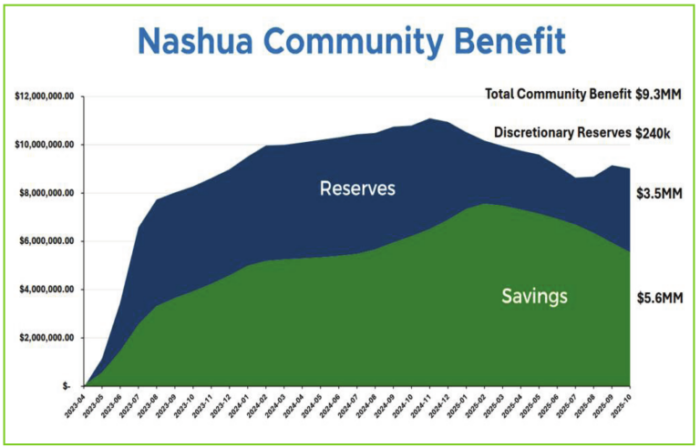
Following news of Nashua Community Power’s increased electricity rate for the next rate period, Community Power Coalition of New Hampshire (CPCNH) gave a presentation to the Board of Aldermen (BOA) during a special meeting to discuss the rate change and give an overview of Nashua Community Power.

Winter in New England can be unforgiving. Throughout the bitter cold mornings, seemingly constant snow and early sunsets, we hear the steady hum of heating systems reminding us they are working overtime to keep our homes warm.