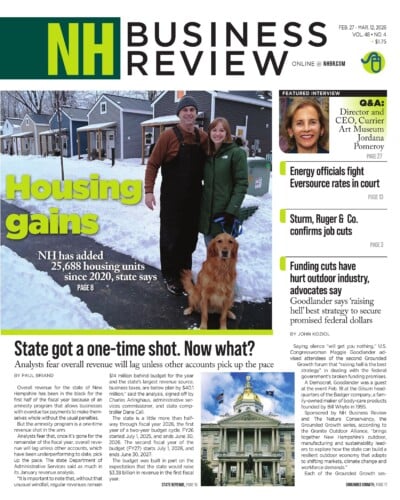
Lebanon. Keene. Nashua. Antrim. Newmarket. Salem.
Those are just a handful of New Hampshire communities that are taking innovative approaches to create more housing, as cited during a forum Dec. 12 at Saint Anselm College in Manchester.
The ideas ranged from cottage courts to pattern zoning, mortgages tuned to accessory dwelling units to zoning overlay districts of commercial/residential mixed use.
The ideas came from presentations at the eighth annual “Housing We Need” forum presented by Saint Anselm’s Center for Ethics in Society and its Initiative for Housing Policy and Practice. More than 150 people attended the event at the school’s New Hampshire Institute of Politics building.
Manchester Mayor Jay Ruais underscored the supply and affordability issues that affect the state’s residential housing market.

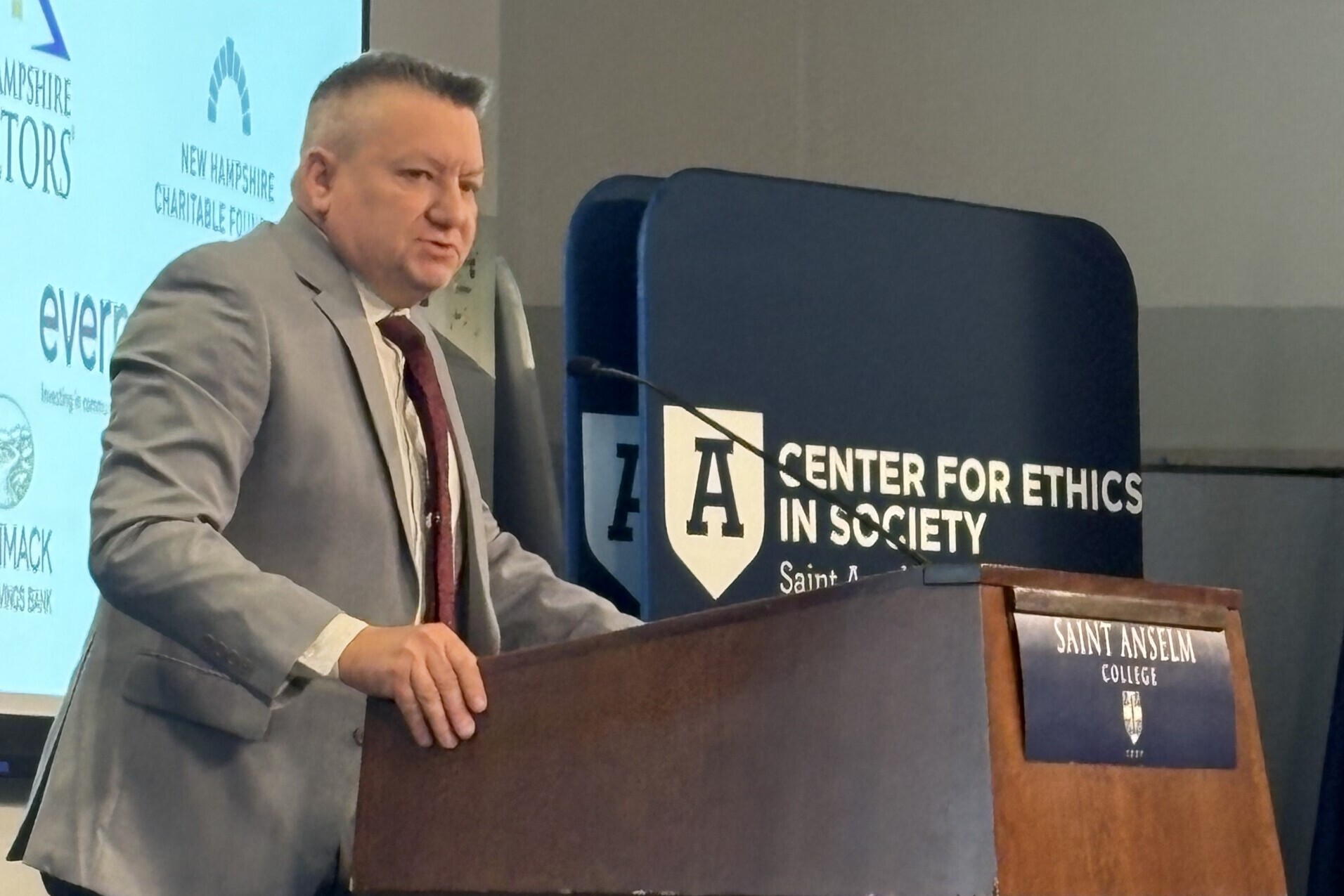
State Sen. Keith Murphy, R-Manchester, was one of several speakers at the Dec. 12 housing forum sponsored by the Saint Anselm College Center for Ethics in Society and its Initiative for Housing Policy and Practice. (Paul Briand photo)
“I’m not an economist, but I understand that when you have very limited supply and very high demand, costs are going to skyrocket,” he said. The most recent data from the New Hampshire Association of Realtors show the current median price for a house is $525,000, 5% more than it was a year ago.
His own home in Manchester, purchased in 2018 for $239,000, is now worth more than $500,000 based on what he sees on Zillow, he said.
“I’m the mayor of the state’s largest city, and I’ve effectively been priced out of my own city,” Ruais said. “I could not make that same purchase today. That is not a long term recipe for success for the city of Manchester, for the state of New Hampshire.”
The underlying theme of the forum was supply — how to create more of it and more of it in the range that the workforce can afford.
State Sen. Keith Murphy, R-Manchester, decried “absurdly complicated, tedious and redundant permits at both the state and town level.”
“There has been outright intentional obstructionism posed by many town planning offices and planning boards,” he said.
“Not all towns,” he added. “Several communities have done a great job of welcoming new housing.” He cited Salem in particular for creating with developer Joe Faro the Tuscan Village mixed commercial/retail/residential community at what was the Rockingham Park horse racetrack property.
One part of the forum presented innovations that have unlocked housing in certain communities.
In Lebanon, Tim McNamara, former mayor and current at-large member of the City Council, discussed the creation of a cottage court on Barrows Street. A cottage court — also known as a pocket neighborhood — is a cluster of detached, relatively small homes around a courtyard or green space.
Through a process that started in April 2022, the city of Lebanon identified two parcels totaling about 2 acres that could be used for cottage development. McNamara said the hope is to create on the half acre of buildable land six, two-story cottages of about 1,000 square feet with two bedrooms and a bath and a half.
The challenge, according to McNamama, is to make them affordable.
“We’re struggling to get these in under $400,000,” he said. “We’re going to know within the next month whether we have a project here or not, and our backup is we just sell the lot to the market and let somebody build one single-family home. But that’s really not what we want to do. So our goal here is to create a very attractive, affordable pilot project for single family homes.”
Keene is using leftover money from the federal Department of Housing and Urban Development (HUD) from discontinued housing to create new housing with a project called Roosevelt School East and West, creating initially 30 apartments.
“What it essentially means is that PHAs (public housing authorities), who in the past have disposed of public housing units, have those units suspended in amber in D.C.,” said Joshua Meehan, executive director of Keene Housing. “And what this program allows us to do is to build new housing, go to HUD and say, ‘We want those units back.’ We get a hammer to crack open the amber and free that subsidy, and then plug it into the units that we build.”
Architect Anne Ketterer, founder and owner of Novo Studio, talked about her work in Nashua to create Jackson Square, a mix of 24 stylish one and two-bedroom apartments in the downtown area. Her challenge: “How do we make urban infill and then remove the stigma of affordability, and then also make it affordable?” The project won a design award from the New Hampshire American Institute of Architects (AIA).

Mike Kingsella, CEO of Up for Growth, was the featured speaker at a Dec. 12 housing forum at Saint Anselm College. He advocated for a greater federal role to coordinate disparate housing policies. (Paul Briand photo)
The town of Antrim created an overlay district that allows for cottage court creation. This district is unique, according to Noah Hodgetts with the NH Department of Business and Economic Affairs, because the overlay encompasses an area with sewer and water and an area that does not have sewer and water. He called it “a great example showing that it’s possible to permit new housing on smaller lots.”
Hodgetts also credited Newmarket for creating new downtown districts that allow incremental development of different building types.
There was discussion of pattern zoning. The idea is to create a set of modular plans (patterns) for a particular neighborhood or district that fit local conditions and zoning requirements. These patterns can then get approved by zoning officials more quickly at a cost that developers can more easily budget for. The idea is currently being discussed and developed in Lebanon.
The other innovative approach put on the table had to do with financing.
Jaime Frederes, senior vice president at Merrimack Savings Bank, talked about mortgage financing specifically available for accessory dwelling units. Once restricted in most communities to being attached to an existing dwelling, state legislation now allows for detached ADUs in all New Hampshire communities by right.
“We put together a program to create a construction draw loan specifically for ADU construction that would take a second position behind an existing first mortgage to allow our customer base to maintain the affordable financing that they had in place, as well as realizing their goals with an ADU,” he said.
The 2025 legislative session, in addition to making detached ADUs law, created other laws that seek to open more opportunities for residential development. They include allowing residential development in commercial zones, easing parking requirements for apartment projects, and creation of a new Special Commission on Zoning to study what laws can change to encourage housing.
Among the legislation that is proposed for the upcoming legislative session is one to allow manufactured homes in residential areas zoned for single-family homes.
But there is also pushback from communities that feel they’re losing local control when it comes to housing.
While there is legislation coming in the 2026 legislative session to add more housing, there is also legislation that would undo the advances — repeal detached ADUs, repeal housing in commercial zones, and repeal the zoning commission.
“To be sure, there is a vocal faction of House members that want all land use policy at the local level, but I don’t think that is the majority view,” said Jack Ruderman from New Hampshire Housing. “And I think that these repeal offers are unlikely to succeed.”
Speakers throughout the day cited several statewide polls that show strong public support for more affordable housing in their communities.
Sen. Murphy cited what he called a “real danger of becoming a state consisting entirely of wealthy homeowners over 50.”
“A healthy community has room for all classes, all professionals and all incomes,” Murphy said. “Excluding some on the basis of their station in life or their professions means excluding the teachers, firefighters, nurses and line cooks that serve us every time people venture out of their homes and into the community. This is not a left or right issue.”
The featured speaker at the forum called for a greater federal government role to better coordinate housing policy right down to the local level.
Mike Kingsella, CEO of Up for Growth, a think tank for housing strategies and policies, described the current housing policies as fragmented, often working at cross purposes to each other.
“It creates an accidental architecture assembled over decades without any design for alignment or predictability,” Kingsella said. “When you try to line all these elements up in sequence. They do not reinforce each other. They collide. The system was simply never built to convert national capital and investment in regional demand into local approvals at the pace that our communities deeply need.”
A cohesive housing policy needs to come from the federal government, according to Kingsella.
“What we need instead is a national housing strategy backed by legislative structure, a recurring federal framework focused on outcomes, a system that ties federal resources to performance and rewards collaboration across jurisdictions, a system with a spine in practical terms architecture that connects capital, permitting, planning and accountability,” he said. “This isn’t about ideology. It is about function.”