Littleton company aims for a big bite of the outdoor business
Adventure Ready Brands makes health and safety products at North Country industrial park
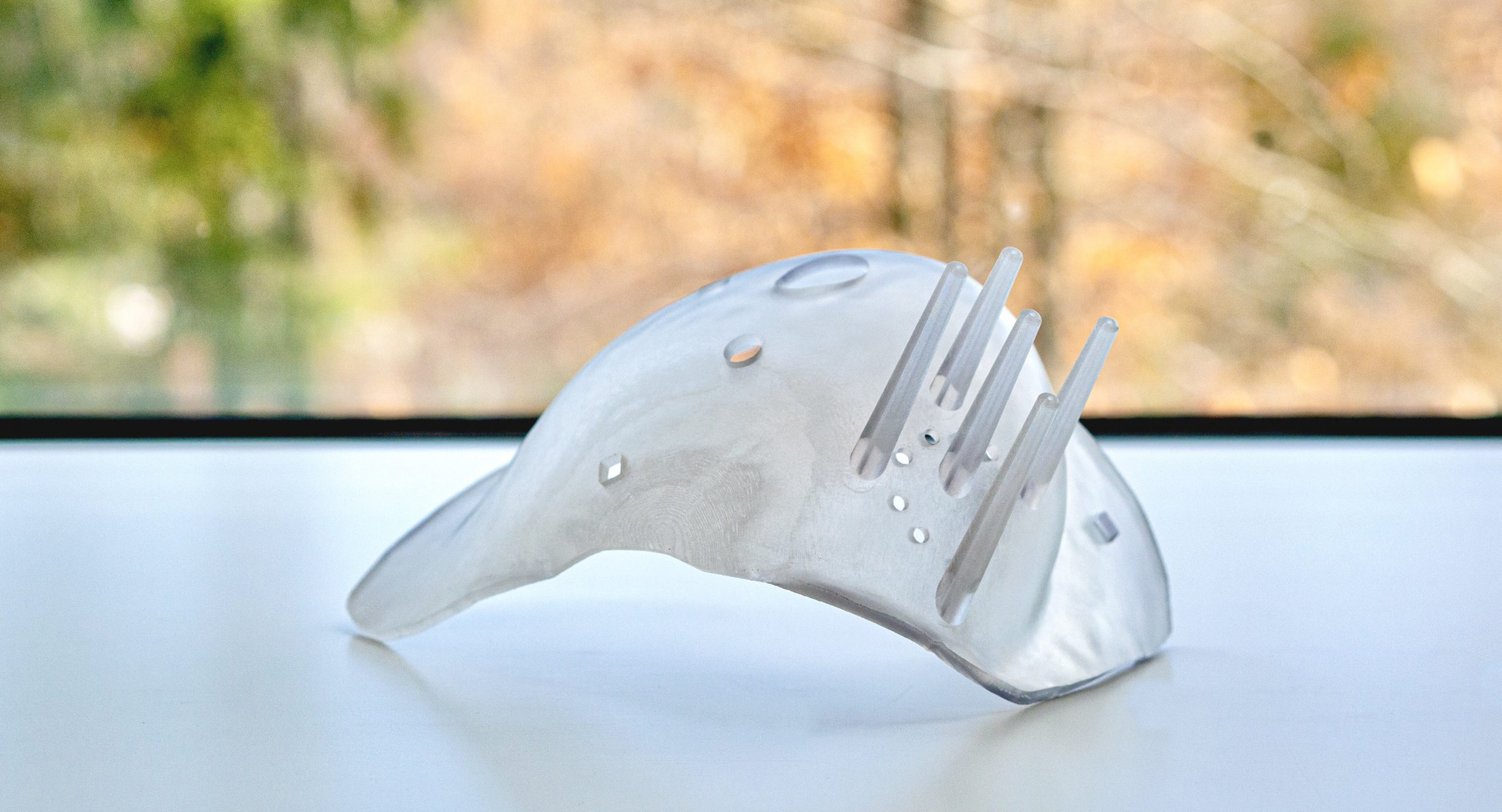
CairnSurgical’s Breast Cancer Locator System includes a custom 3D-printed shape that the surgeon places over the patient’s breast while the woman is under anesthesia in the operating room. (Courtesy of CairnSurgical)
Breast cancer often does not come in a neat little package of a tumor, with a symmetrical shape that is easy to detect. Instead, the tumor might have irregular edges and spikes that threaten to invade nearby healthy tissue.
In a lumpectomy, a surgeon tries to preserve healthy breast tissue while removing all of the tumor plus a small margin of normal tissue that surrounds it. The trick is knowing where exactly to aim the scalpel, especially when faced with a tumor that has ill-defined edges.
It’s a problem that has plagued breast surgeons and patients since the inception of breast-conserving lumpectomies some 40 years ago, says David Danielsen, CEO of CairnSurgical, a medical technology firm and Dartmouth spinoff based in Lebanon, NH. About 20% to 25% of lumpectomies fail to remove the entire tumor, requiring the patient to undergo a second surgery.
A study published November 2025 in the “Annals of Surgical Oncology” showed that surgeons who used Cairn-Surgical’s innovative Breast Cancer Locator (BCL) System, which is designed to improve the precision of lumpectomies, successfully removed breast tumors with negative margins — meaning no cancer cells were detected in the outer edges of the removed tumor —in 94% of patients.
Last month, CairnSurgical announced that patient enrollment has been completed in a U.S. pivotal trial for the BCL System, NH Tech Alliance’s 2021 Product of the Year. The BCL System is already being used in Europe through a limited launch.
The BCL System consists of two tools, the BCL form and the Visualizer, that provide detail on tumor size, shape and location, with physical and virtual guidance for surgeons so that even the most irregularly shaped tumors are better defined.
Prior to surgery, magnetic resonance imaging (MRI) data from the patient is used to design and fabricate the BCL form, a surprisingly simple-looking, custom 3D-printed shape that the surgeon places over the patient’s breast while the woman is under anesthesia in the operating room.
Unlike traditional methods in which only a single wire or “seed” marks the area of a tumor, with the BCL approach, the surgeon places multiple wires through openings in the personalized 3D form to create a sort of visual fence or guideposts that delineate the tumor’s shape and edges. New Englanders might think of it as akin to placing driveway markers at the start of winter so that the driveway’s edges are understood even when snow renders them invisible.
The surgeon removes the BCL form, leaves the wires behind, and voila — where to aim the scalpel is clearer than ever, especially because the 3D form reflects the positioning of the patient when the woman is on her back, just as she is during surgery. This is key, because traditional imaging methods for evaluating breast cancer often involve a mammogram of the woman in a standing position, an ultrasound while she’s on her back, and an MRI while she’s face down on a table, says Jessica Ryan, MD, FACS, medical director of the Catholic Medical Center Breast Care Center and NH state chair of the American College of Surgeons Commission on Cancer.

From left, Dr. Richard J. Barth Jr., Keith D. Paulsen and Venkat Krishnaswamy co-founded CairnSurgical in 2015. The Dartmouth spinoff company’s Breast Cancer Locator surgical device was voted as Product of the Year by the NH Tech Alliance in 2021. (Courtesy of CairnSurgical)
“We’re not solid statues,” Ryan notes; the lay of the land changes depending on how the breast is manipulated and how the woman is positioned. Although multiple companies have tried to address the problem of 20% to 25% of patients needing a second lumpectomy, Ryan says, CairnSurgical’s approach is unique in that “it takes a step back to the point at which patients are being positioned and imaged and then translates that information into the OR.”
The “Visualizer” companion piece to the BCL form is software that provides an interactive, visual representation of the patient’s tumor. “Just imagine,” Danielsen says, “being told, ‘Go get this tumor out, but you’re not allowed to see what shape and what size it looks like in that patient.’ Well, now we’re letting them look at it … ahead of time” as well as during surgery on a screen. “The surgeon can move (the image) and can see the tumor in its exact location and dimensions.”
Ryan, who has used the BCL System as part of the pivotal trial, says that CairnSurgical’s technology “is helping us to navigate more precisely in the operating room using what presumably and what many see as the most sophisticated level of imaging of breast tumor, which is a breast MRI.”

David Danielsen, CEO of CairnSurgical, talks about the Lebanon company’s Breast Cancer Locator during a livestreaming of the NH Tech Alliance’s Product of the Year competition in 2021, during which the company’s product earned the top prize. (Screenshot image)
Overall, Danielsen says, surgeons praise the BCL System’s intuitive design while patients are understandably excited about having a reduced risk for another round of surgery.
Ryan says her patients also “love the Visualizer because it helps them better understand their tumor and what I’m planning to remove. … The more patients understand what’s happening and what to expect, the more confident they are, and the better the outcomes.”
Indeed, the BCL System’s potential benefits are many. By increasing the odds of a sort of Goldilocks lumpectomy — one in which the surgeon removes not too little, not too much, but just the right amount of tissue — it could spare women from the emotional distress and financial cost of a second surgery, as well as a possibly displeasing cosmetic result.
It’s particularly helpful in cases that involve more complex tumors, Ryan says, “the ones we can’t see or feel, the ones that are shaped (irregularly) and are branching out. That’s something that we don’t have visible guidance for in the operating room.”

Adventure Ready Brands makes health and safety products at North Country industrial park

The NH Executive Council paused the approval of $773 million in federal spending contracts for the “GO NORTH” rural health program Wednesday, March 4, putting the brakes on a major initiative of Gov. Kelly Ayotte after councilors said the contracts were rushed and needed more scrutiny.

Employer health benefits costs are rising faster than inflation and wage growth, putting continued pressure on employer-sponsored plans. According to KFF’s 2025 Employer Health Benefits Survey, per-employee benefit costs increased 6% in 2025, with another 6.5% increase projected for 2026.

When families face a cancer diagnosis, mental health crisis, or any unexpected change in their health, the last thing they should worry about is navigating a complicated health care system. But for many, that is exactly what they face. Complex benefits, rising out-of-pocket costs and uncertainty about where to turn can add stress to already difficult moments.

The country’s declining pool of health care workers is a threat to the functionality of the U.S. health care system

Started in 2021, Cytokind describes itself as 'the global leader in using UVB light to treat immune disorders and improve survival and the quality of life for patients'
Lebanon company’s technology helps surgeons pinpoint size, shape of tumors
Amid statewide shortage, schools and hospitals aim to increase workforce

Some state officials and lawmakers are concerned that New Hampshire’s incoming Medicaid premium system may conflict with provisions in Congress’ One Big Beautiful Bill Act.