Navigating New Hampshire’s new solid waste site evaluation committee
Anyone who has taken a transmission line or a wind farm through New Hampshire’s Site Evaluation Committee knows the process is long, expensive and can be fraught with complication.

His phone ever at the ready, David Choate estimates he’s done 2,500 plus transactions throughout the region representing a total value of more than $561 million as a commercial real estate broker in New Hampshire. (Photo by Paul Briand)
In his 35-plus years as a commercial real estate broker, David Choate has seen the effects the burst dot-com bubble of the early 2000s, the burst housing bubble and Great Recession of 2008, and the 2020-23 COVID pandemic had on industrial and office properties.
While the commercial real estate market showed resilience through each of those economic challenges and others, the COVID pandemic has had the most lasting effect, according to Choate, particularly on office buildings.
“People stopped going to the office, and that office market still hasn’t recovered, in my opinion. We’re seeing life in it, but it still has a lot of vacancies,” said Choate, who retired in February as executive vice president of Colliers International.
NH Business Review interviewed Choate at the International Marketplace, located at the Pease International Tradeport, where Choate helped negotiate many deals over the years.
At the Tradeport, most buildings were constructed by commercial developers, then leased to tenants through deals negotiated by commercial brokers, such as Choate, who was based in Portsmouth and brokered leases and sales through the Seacoast and other regions in the state.
“I’d say, as I look around, almost every building I’ve done deals in,” said Choate, noting that some were new lease deals, while others were lease renewals.
In fact, by Choate’s figuring, since 1993 he’s done 2,500-plus transactions throughout the region representing a total value of more than $561 million.
“Over more than three decades with Colliers, David has played a meaningful role in the growth of the firm and in shaping the commercial real estate landscape throughout New Hampshire’s Seacoast region,” Bob Rohrer, managing director of Colliers in New Hampshire, said in announcing Choate’s retirement.
“Known for his professionalism, extensive market knowledge and unwavering commitment to clients, his contributions have left a lasting impact on both the organization and the broader business community,” Rohrer added. “As a longstanding principal and shareholder, David has contributed significantly to Colliers’ performance and presence in the market.”
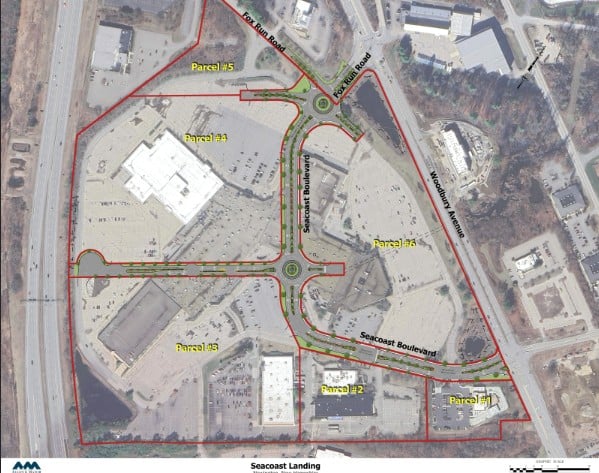
Choate ran what was then the Portsmouth Chamber of Commerce in 1981, when, looking for an opportunity to remain in the area, he was approached to help with the creation of an indoor/outdoor outlet mall in Portsmouth, what was going to be called the OMNE (the Outlet Mall of New England).
Located in the area of what is now the Home Depot off Woodbury Avenue in Portsmouth, it struggled and failed for a variety of reasons, including the nearby location of the burgeoning Kittery Outlets just over the border in Maine.
He became a licensed broker in 1983, and along the way he worked for a residential land developer then a variety of commercial real estate companies, Coldstream and Grubb & Ellis among them, affiliating with Colliers in 2013.
Choate recounted how New Hampshire wasn’t the draw for commercial/industrial enterprises that it ultimately became to be.
The development of the Pease International Tradeport starting in 1995 from what was the Pease Air Force Base helped flip the switch, in Choate’s estimation, to what was available both on the Seacoast and throughout the rest of the Granite State.
“We had the inventory of space but also the employees,” he said. “Even though it’s a small state, there was access to the employees, probably better than it was in Massachusetts.”
Also making a difference in the appeal of commercial development to the southeast region was the build-out of Route 16 (the Spaulding Turnpike). The state project, which started in 2006 and continued for almost 10 years, transformed the Spaulding from a cramped, traffic-stalling four-lane road to a more traffic-accommodating highway between Portsmouth and Dover and bridges over the Piscataqua River/Little Bay. The project included a new exit that fed right into and out of the Tradeport.
“I think it convinced CEOs that it’s okay for me to build or relocate my company north of the bridge, because that’s where my employees are anyways, but it’s also where employees said, ‘Well, I can actually now live up there and get down here in a reasonable time, because that’s where now the so-called affordable housing is.’”
The savings and loans crisis between 1986 and 1995 put a lot of financial stress on the commercial market — values plummeted and buildings went into foreclosure as banks failed.
“The bank collapse really drove everything. Then Pease came along,” said Choate. “Obviously, it was a big gamble: Is it going to be successful? History shows that it was the most successful base conversion in the country.”
But he also cautions that employer needs are changing — industrial space is what’s needed, which Pease doesn’t have at the ready.
“I kind of think that the bloom is off that rose, because I don’t hear a lot of buzz about Pease anymore,” said Choate. “There’s not much industrial space there, and that’s really where it’s been driving the economy in the last several years.”
When Choate looks at the current commercial market, he sees the most potential for growth in the industrial market sector, which includes manufacturing and warehousing.
“We have a lot of service providers that have moved in — HVAC companies, electrical contracting companies, electrical display companies and things of that nature that are servicing all the new development, the residential development,” he said.
A new trend report from Colliers for the first quarter of 2026 bears this out.
“Small and mid-sized space continues to see the strongest interest, with blocks under 20,000 square feet in limited supply across most submarkets,” said Kristie Russell, research director for Colliers International in New Hampshire and Maine.
“The most active users in the market right now are logistics and distribution companies, trade businesses looking to expand, and a growing number of recreation users such as batting facilities and pickleball venues looking to find a home in industrial space,” she added.
Lack of this supply has pushed rental rates up by 4.8% compared to the same period last year, 62.4% more over the last five years, according to the report.
The challenges in the office sector rest with the fact that there’s too much unused space. People are working; it’s just a matter of where they’re working these days.
“They’re only maybe going in two or three days a week, so you don’t need as much space,” said Choate. “We don’t have all these people coming in, so we’re going to go to hoteling space, or we’re going to have mostly cubicles and not offices. Now I’m hearing that there’s more demand for private office space, going back to private offices and less hoteling.”
The trend might indeed be turning. Fidelity Investments, which has a campus of offices in Merrimack, has announced employees will get back to their offices five days a week starting in September.
The Colliers Q1 report for office building trends cites data that indicate a gradual recovery with vacancy rates on the decrease after reaching a high in mid-2025, while rent rates are inching a little higher, an indication of greater demand.
“Vacancy is trending in the right direction, rents have held firm and tenant activity signals that quality space continues to attract users even in an uncertain environment,” said Russell in her office space analysis. “Leasing activity has been driven primarily by renewals and tenants upgrading to better space, rather than an influx of new businesses to the market — a reflection of the flight-to-quality trend that has defined the past year.”
In retirement, Choate is using decades of accumulated skills to volunteer for SCORE, the Service Corps of Retired Executives, a nonprofit organization mentoring small businesses in partnership with the U.S. Small Business Administration (SBA).
A dog dad, he is a member of the board of the New Hampshire Society for the Prevention of Cruelty to Animals (NHSPCA), and he remains involved in Realtor-related boards and groups.
A resident of the town of Rye, he is a member of its Demolition Review Committee.

Anyone who has taken a transmission line or a wind farm through New Hampshire’s Site Evaluation Committee knows the process is long, expensive and can be fraught with complication.
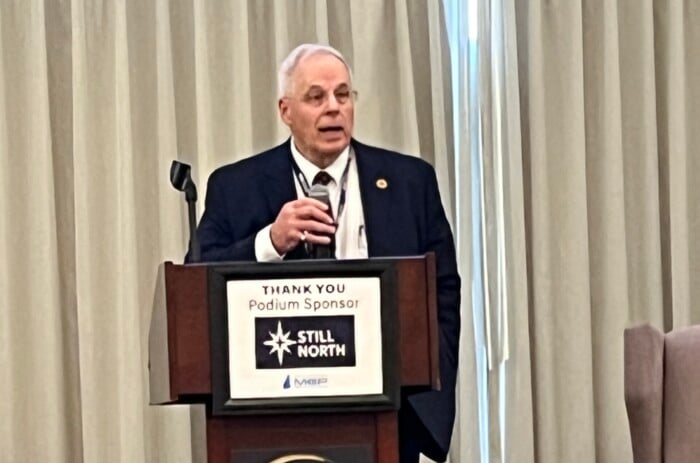
This year’s Advanced Manufacturing and High Technology Summit kicked off with a topic universal to all employers: how to build the workforce of tomorrow. The 24th annual event organized by the New Hampshire Manufacturing Extension Partnership on Oct. 9 featured a keynote panel discussion featuring representatives from the state’s university and community college systems.

Agritourism has become an important business option for many farms in New Hampshire and across the country. Exactly what is agritourism?
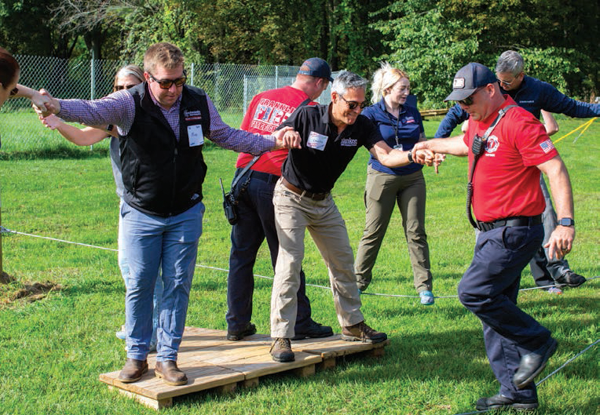
On a recent Friday at the Easterseals NH Military & Veterans Campus in Franklin, I found myself about 30 feet in the air. I was holding onto a pole and contemplating what suddenly seemed like a rather narrow log stretching out over a great deal of empty space toward another pole, which also seemed remarkably distant.

In recent years, New Hampshire families have faced persistent and growing challenges with affordability and accessibility as they navigate the early care and education landscape.

Published annually, “The Best Lawyers in America®” is an exhaustive search for the country’s top attorneys. Here is a compilation of the top attorneys who practice in New Hampshire in dozens of legal specialties related to the needs of businesses,…

Ramy Rahimi is the new vice president for research and development at the University of New Hampshire.

This year, NH Business Review marks the 24th anniversary of our Business Excellence Awards, which celebrate the initiative, creativity and tenacity of the Granite State’s business community.

Back in 1992, political strategist James Carvell came up with the phrase, “It’s the economy, stupid,” to help Democrat Bill Clinton defeat incumbent Republican President George H.W. Bush.