Strength in numbers
UNH is creating a hub for collaboration with business and government
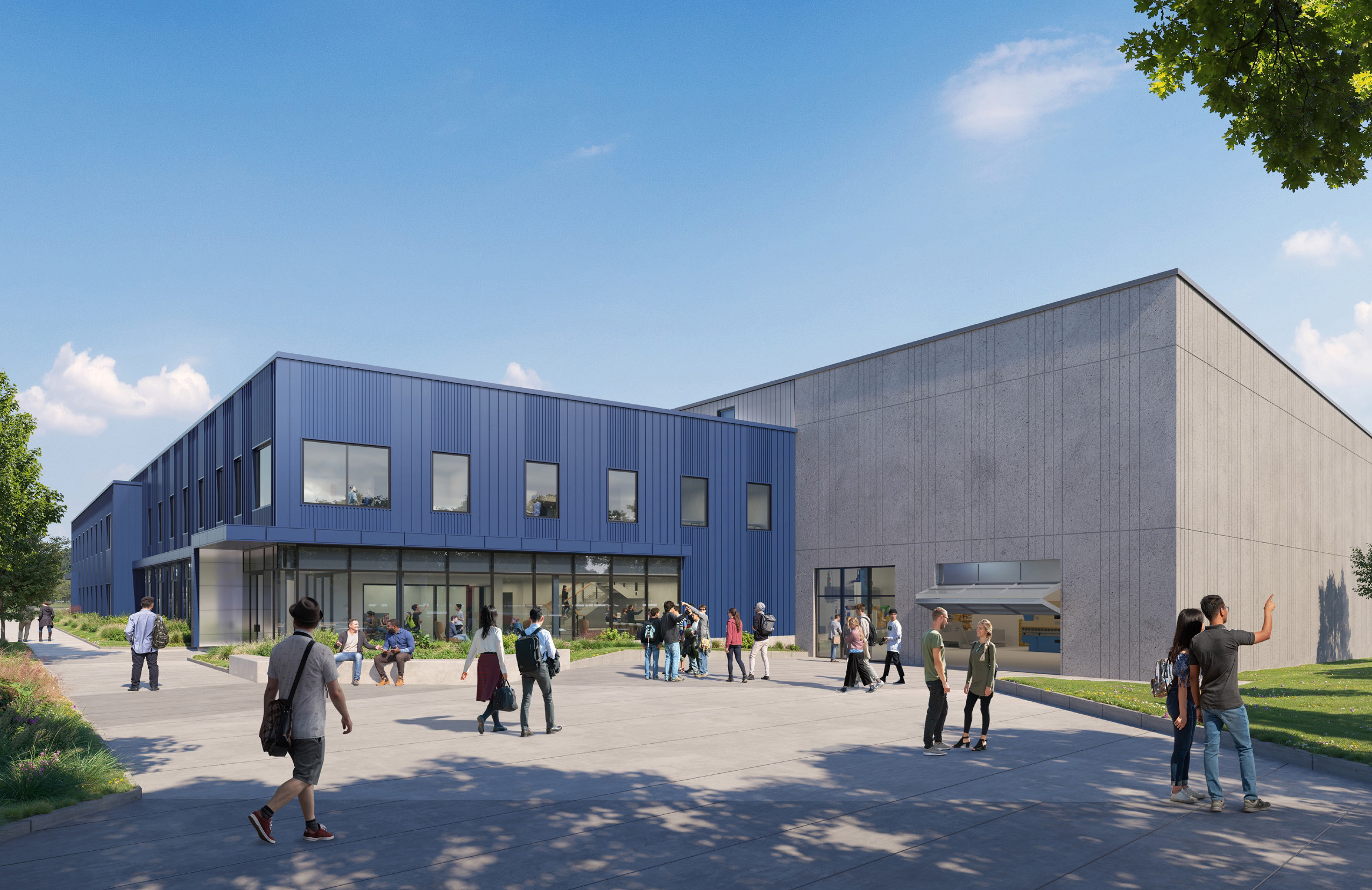
This rendering from the University of New Hampshire shows the new 70,500-square-foot building that will house the Center of Excellence for Operational Ocean and Great Lakes Mapping, the first piece of The Edge at West End project of research facilities, industry partners, housing, retail and dining.
Location, location, location” is often used in real estate parlance to highlight a property’s unique placement relative to other properties.
The University of New Hampshire has another take on that mantra: “Co-location, co-location, co-location.”
UNH is leveraging its designation as a premier research institution to also become a premier location for co-location, a place where businesses and government enterprises co-mingle their work not only with faculty and staff but with each other.
“From a company perspective, do you want to be in the midst of a campus where you have access to students, you have access to thought leadership, you have access to equipment, you come in and you have this community of innovation and development right at your hand? Or do you want to be somewhere in a research or an industry park where you’re more or less solo, not really interacting with others?” said Marc Eichenberger, UNH vice president and chief business development and innovation officer.
The co-location notion is one of cross-pollination of effort that is evident at several locations across the UNH Durham campus — at Parsons Hall and Rudman Hall on the University campus in Durham, and most particularly at the John Olson Advanced Manufacturing Center.
The co-mingling of people and work will be further enhanced within the next decade by The Edge at West End, a 60-acre project on UNH’s western campus designed to blend research facilities, industry partners, housing, retail and dining into an “innovation neighborhood.”
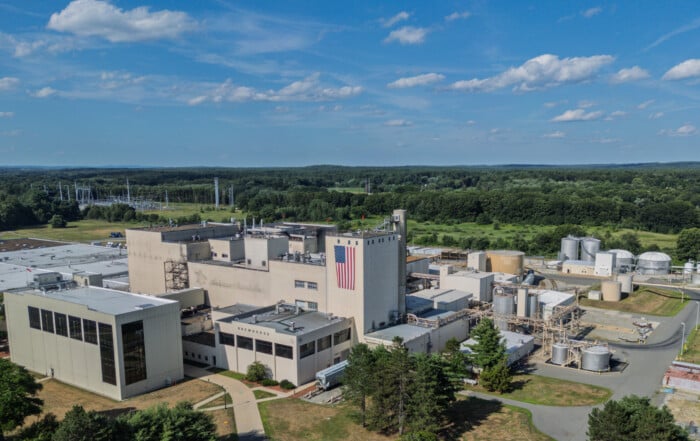
The 500,000-square-foot Olson Center is the building of the former Goss International, maker of production equipment for the printing industry. It is now owned by the R.J. Kelly commercial development company, which has been improving and expanding the infrastructure since its purchase of the building in November 2021.
“It is most definitely a beehive of activity,” Eichenberger said. “We do have about six companies there. And as we were speaking, they hire our students, they have internships with the students.”
When UNH promotes itself as a premier research institution, it’s not just marketing bluster — it’s a real thing. In 2019, it received the highest-tier rating (known as the R1 status) for U.S. research universities from the Carnegie Classification of Institutions of Higher Education.
That designation has helped leverage its reputation as a prime location for co-location. According to the university, a total of 10 companies currently co-locate at UNH in Durham, a 400% increase since 2022, with more in the offing.
Among them:
• Airtho, a controlled environments developer.
• SPEE3D, an Australian 3D metal manufacturing company that made the Olson Center its first U.S. location.
• Exail, a French maritime robotics innovator.
• Klein Marine, sonar technology company.
• Johnny’s Selected Seeds, plant seed producer and merchant, which also does research to produce new vegetable varieties.
• RexChem, provider of pharmaceutical laboratory services.
• Madco3d, a 3D concrete construction firm.
• Integer, a defense technology and software company, which will establish a presence at UNH in spring 2026 to develop advanced acoustic technologies that enhance U.S. Navy capabilities.
“Moving to UNH has given me a more accessible pool of talented people and that has helped me grow the business pretty significantly,” said Airtho president Brandon Bogart, adding that the company has doubled its revenue year-over-year since co-locating. “We’re excited to be a part of this collaborative environment and to be close to the latest research, engineering talent and emerging technologies that help inspire the next generation of innovators.”
He added that its UNH location gives the company more credibility than “an industrial park in some small town in New Hampshire.”
There are many examples of how the co-location fosters the co-mingling of people, work and research. Here are some examples:
Johnny’s Selected Seeds collaborates with plant geneticists at the university’s Macfarlane Research Greenhouses, site of breeding research that’s likely to yield new, disease-resistant variety of zinnias that Johnny’s hopes to produce. “This expertise is basically in our backyard,” said Kevin Cook, Johnny’s vice president of research and development.
RexChem shares lab space with professor of chemistry Erik Berda at Parsons Hall.
“Very quickly we came to understand that (students) provide a fantastic opportunity for us,” said RexChem founder Mark Spyvee, who has hired nine undergraduates in the two years RexChem has been at UNH.
“Without them, we wouldn’t have been able to do what we’ve done, which has helped us advance several drug discovery programs,” Spyvee added.
A good portion of the co-location emphasis is on ocean research, given the expanding relationship between UNH and the National Oceanic and Atmospheric Administration (NOAA).
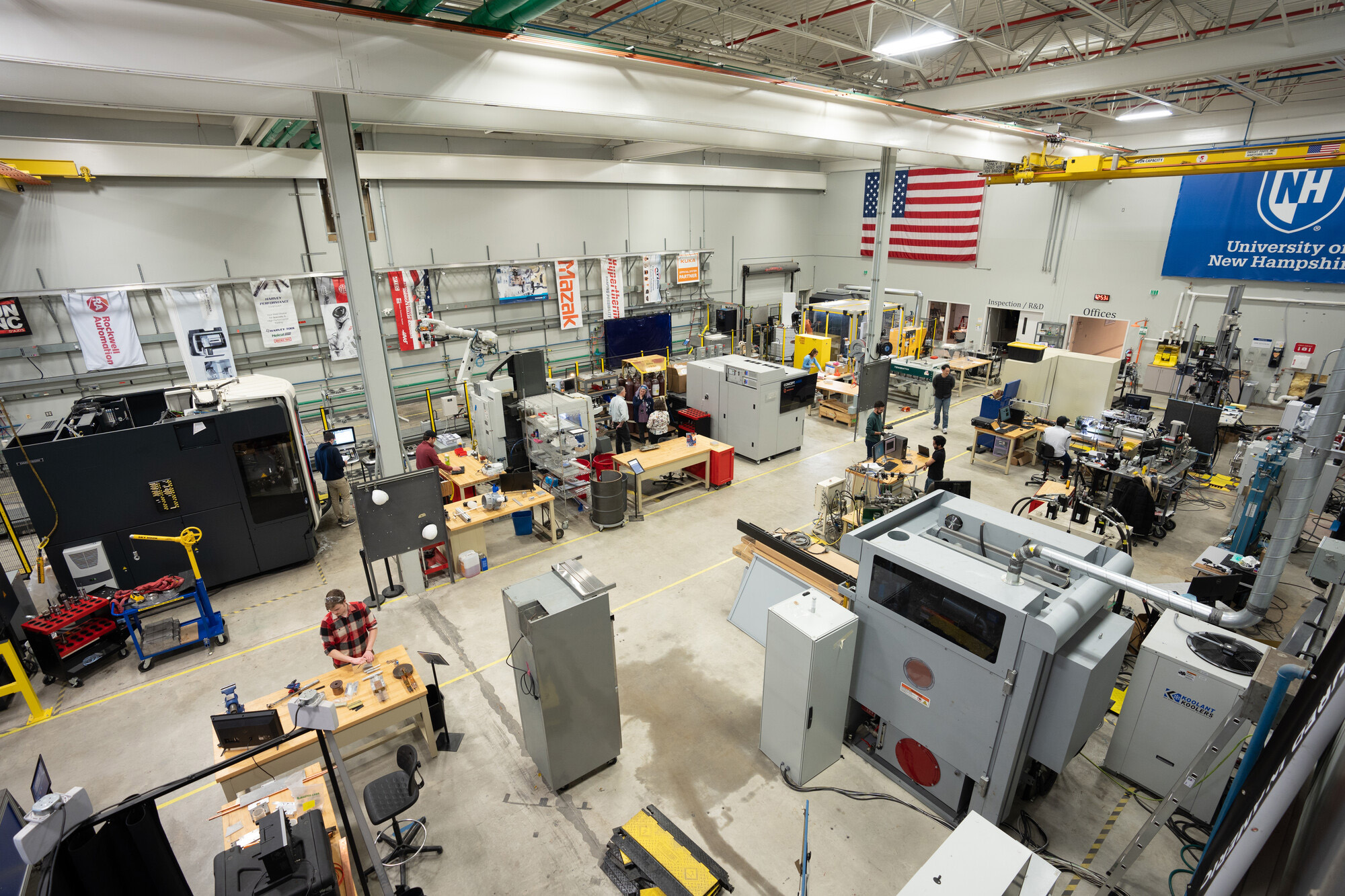
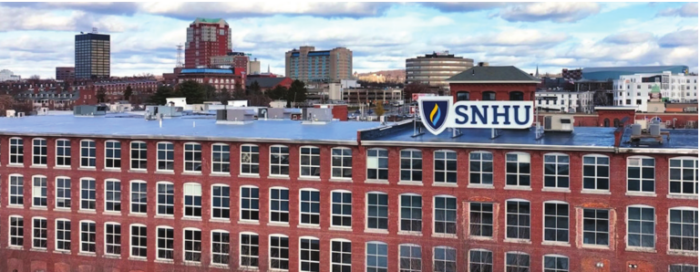
The John Olson Advanced Manufacturing Center is a “beehive” of co-location activity at the University of New Hampshire, according to Marc Eichenberger, UNH vice president and chief business and innovation officer. (UNH)
Since 1999, NOAA and UNH have collaborated under a cooperative agreement that enables NOAA to operate the Joint Hydrographic Center and Center for Coastal and Ocean Mapping on the UNH campus.
Since its inception, the university says the center has mapped more than a million square kilometers of ocean floor, discovered shipwrecks, helped the federal government respond to natural and manmade disasters, and pioneered the use of autonomous vehicles to map and collect data from the ocean floor.
In February, officials broke ground on a new 70,500-square-foot building that will house NOAA’s Center of Excellence for Operational Ocean and Great Lakes Mapping. It is the first piece of The Edge project.
“Engaging with industry collaborators from New Hampshire and across the globe creates high-impact opportunities for our students, boosts the state’s economy and provides companies with access to state-of-the-art facilities and resources that help them to succeed,” said UNH President Elizabeth Chilton.
“These public-private partnerships are a critical piece of the university’s strategic plan,” she added. “As we continue planning for the potential development of The Edge innovation district, this new facility will be a cornerstone of that effort at UNH.”
Some Olson Center occupants — such as Exail and Klein Marine — are expected to relocate once the new building at The Edge is ready for occupancy. Eichenberger doesn’t see it as moving pieces on a chess board; he sees it as opening the board up for more growth.
“We look at it as very complementary,” he said. “We’re gonna kind of buttress up each other as we go. In fact, I think it’s going to be a net positive for both.”
The new NOAA center’s expected completion is in 2027, while complete build out of The Edge is expected to take some 10 years, to include not only commercial and academic enterprises, but dining, retail and housing, a vital component as officials assess challenges while also looking at opportunities.

Much of the co-location work at the University of New Hampshire centers on ocean research as evidenced by the joint work shown here by the Exploration Vessel (E/V) Nautilus, owned and operated by the Ocean Exploration Trust, and the unmanned surface vehicle DriX, made by Exail, a French maritime robotics maker located at the John Olson Advanced Manufacturing Center. (Ocean Exploration Trust)
“One of the things that The Edge project incorporates is new housing, and that’s being done in partnership with the town, because this housing isn’t going to be just university housing. This housing will be open to the community,” said Jennifer Miksis-Olds, UNH interim vice president for research and innovation.
“That is one of the biggest challenges that we face right now, and that is being addressed as part of The Edge but also part of the local community in partnership with Durham,” she added.
Durham’s town administrator, Todd Selig, is looking at what he sees as a symbiotic relationship between what is envisioned for The Edge and the need for some vibrancy in downtown Durham, which has stagnated somewhat in terms of commercial interest.
“Physically and programmatically linking the two helps ensure they function in a symbiotic way — activity and employment at West End can feed customers, residents and visitors into downtown, while a healthy, vibrant downtown strengthens Durham’s overall appeal as a place to live, work, invest, enjoy and attend college, thereby attracting potential students helping to stabilize UNH enrollment,” Selig said.
The real strength of co-location, according to Miksis- Olds, lies with the people involved in it.
“When you look at a university, especially UNH, its greatest resource are its people: its researchers, its faculty and its students,” she said. “So when a company colocates on campus, they tap in and become part of that community and that resource.”