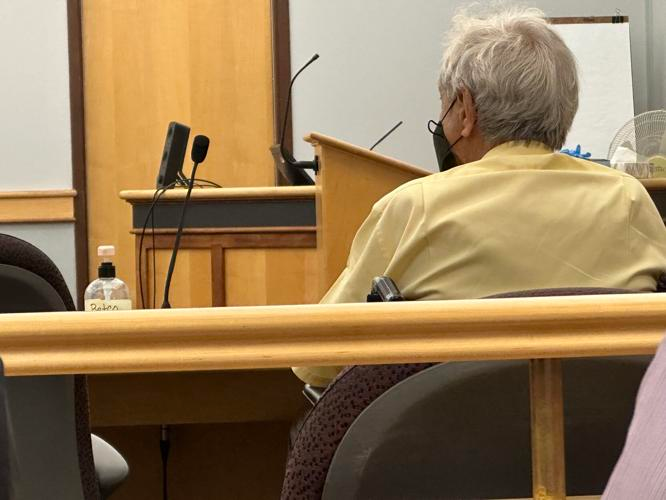
Participants in the Jan. 14 Seacoast Board of Realtors roundtable on housing advocacy included, from left: Beth Moreau, Portsmouth City Council; George Reagan, New Hampshire Housing; Maggie Randolph, GSD Communities; John Randolph, GSD Communities; and Jessica Williams, New Hampshire Fiscal Policy Institute. (Photo by Paul Briand)
Rockingham County has long held the distinction of being New Hampshire’s most expensive area in which to buy a home, driven in large part by the Seacoast region, where the median cost of a single-family house in 2025 was $849,900.
In an effort to address this issue, the Seacoast Board of Realtors on Jan. 14 convened a panel to discuss housing affordability, supply and solutions to address both concerns.
Some of the best on-the-ground observations about the state’s housing crisis — and solutions to fix its multi-layered challenges — came from John and Maggie Randolph, contractor and architect, respectively, of GSD Communities, who design and construct senior living accommodations and workforce housing.
“Think about how many people you know that are either child care workers or repairing your car or doing anything else making $20 to $30 an hour. That’s the backbone of our workforce in the Seacoast. They’re working in assisted livings. They’re working in your schools. They can’t live in the Seacoast. They just, point blank, can’t live in the Seacoast,” said John Randolph.
The Randolphs own and operate two assisted living facilities in Durham. They also developed on-site housing and daycare to provide affordable services to their employees. As well, they designed and developed what’s considered a model tiny home community in Dover as a concept that can be used in other communities.
Called the Cottages at Back River Road, there are 44 affordable rental units for essential workers, featuring energy-efficient 384-544-square-foot homes with lofts, targeting around $1,000-$1,200/month rent to combat the local workforce housing shortage.
For every unit that might be up for rent, there are 200 people on the waiting list, according to John Randolph.
The unaffordability of the Seacoast region requires long daily commutes outside the area, affecting their quality of life, affecting their connection to a community in which they might work, said Randolph.
“Their quality of life is decreasing, and we’re essentially driving them out of the Seacoast, which is harming our businesses, the ability for businesses to grow the business, businesses to pay taxes to be part of our community,” he said.
For the entire state in 2025, the median-priced home sold for $535,000, up 3.9% from 2024.
By contrast, the median-priced home in 2025 sold for $670,000 in Rockingham County, up 4.2%. The median-priced home in neighboring Strafford County was $515,000, up 5.3%.
The $849,000 for the Seacoast-specific region in 2025 represented a 6.2% increase over 2024, according to data from the Seacoast Board of Realtors. The board takes its sales data from 13 sample communities: Exeter, Greenland, Hampton, Hampton Falls, New Castle, Newfields, Newington, North Hampton, Newmarket, Portsmouth, Rye, Seabrook and Stratham, locales of some of the priciest neighborhoods in the Granite State.
For instance, according to data from the New Hampshire Association of Realtors (NHAR), the median sales price for a home in Rye in 2025 was $2,150,000, a 68% increase over 2024.
Others included: Hampton, $1,000,000, up 60.0%; North Hampton, $690,000, down 53.5%; Portsmouth, $773,500 down 17.7%; Greenland, $611,000, up 6.7%; Stratham, $925,000, up 13.5%; Exeter, $494,950, down 4.8%, and Seabrook, $610,000, down 9.6%. NHAR did not have data for Newington, New Castle, Newfields or Hampton Falls.
Maggie Randolph sees construction of accessory dwelling units (ADUs) — both attached and detached, as allowed by right — as a way to address housing availability not only for the state’s younger demographic but for the older demographic as well.
“If you have the opportunity, say, it’s a grown child that comes and lives on your property, you can switch units at some point, and then you can age in place,” she said.
The forum participants pointed out to about 60 attendees at the board’s Portsmouth office that the state is facing numerous demographic, political, societal, supply and affordability challenges when it comes to housing.
A New Hampshire Housing needs study showed that, in order to meet the demand, the state needs 60,000 new housing units between 2020 and 2030, 90,000 more units from between 2020 and 2024. That requires a 36% increase in the rate of approved building permits, according to George Reagan, director of community engagement at NH Housing.
The median price of a home in the state reached a record-breaking $565,000 in June, largely out of reach for any household in the state earning an average family income, noted Jessica Williams, a policy analyst with the New Hampshire Fiscal Policy Institute (NHFPI).
An average earning income for a family of four in Rockingham County is $120,836, and the mortgage payment on a median-priced home would be a little more than $58,000, almost half. After child care, food, health care expenses and utilities, that Rockingham household would have about $8,200 a year left for other expenses, according to Williams.
In Strafford County, where the household income median is $81,000 and where a mortgage runs about $30,000, the household comes up about $18,285 a year short after all other expenses.
“Many folks may be putting off entering into the housing market because they really cannot afford to pay for these medium-priced homes, and as prices continue to increase, that’s something we’re seeing a lot more,” said Williams.
Noted John Randolph: “We talk on a regular basis to teachers, for example, that are turning down jobs and superintendents of schools that are getting turned down because they can’t find housing close enough to the schools that they’re willing to commute to.”
Layered into the challenge of affordability is the fact that the state is old, according to Williams.
In terms of median age, New Hampshire is tied with Vermont as the second oldest state in the country, behind only Maine.
“More older adults are choosing to remain in their homes longer, and, in turn, this is reducing housing turnover,” said Williams. “Without more housing construction, more units being put on the market, this is really preventing younger generations who are maybe looking to start out looking to buy those homes.”
While 65-plus adults represent the largest percentage of Granite Staters, the next age block in terms of size are the millennials, those aged 30 to 40. “Those folks may be entering the home-buying market for the first time, really increasing the already constrained market and competing for available housing,” said Williams.
Besides ADUs, panelists pointed to initiatives that are helping or might help improve the housing situation.
Beth Moreau, a current member of the Portsmouth City Council and former member of the city Planning Board, cited a co-living development in the city that has recently been approved.
Developer Mark McNabb proposes 55 new co-living units and three studio apartments on Pleasant Street in a commercial building that was a bank. It is part of a large-scale redevelopment that will transform the site into a mixed-use residential and commercial property.
It’s a first-of-its kind in New Hampshire, according to Moreau. In a co-living arrangement, tenants sign leases on a per bed basis. For example, in a 4-bedroom 4-bathroom unit, each tenant may sign a lease for their individual bed and bath while sharing the common space with the other three tenants and having access to common areas and amenities.
“I know there’s been a lot of diverse opinions on whether or not it’s going to work, and I’m excited to have our first project come. But this is yet another way that we can look to diversify our housing,” said Moreau.
As a resource to municipalities looking to tweak their zoning to accommodate more housing development, Reagan said there are Housing Opportunity Planning (HOP) grants available. The state has allocated funds to provide grants to municipalities to analyze and update their land-use regulations. The NH Department of Business and Economic Affairs has contracted with NH Housing to administer the program.
In other housing-related news in New Hampshire:
Gov. Kelly Ayotte on Jan. 14 received a “Defender of Housing” award from the National Association of Home Builders (NAHB) for her work on New Hampshire’s housing crisis. “This was a joint effort with the Legislature and our private sector and nonprofit partners, and together, we cut red tape and expanded opportunities to build housing across our state,” said Ayotte. “ I’m focused on ensuring these new laws make building easier and faster so we can keep New Hampshire the best state for economic opportunity.” Among those initiatives in 2025 was the law to allow detached ADU’s by right.
U.S. Reps. Chris Pappas, D-1st CD, and Maggie Goodlander, D-2nd CD, have voted to support bi-partisan legislation in the U.S. House to deregulate certain federal rules on energy efficiency that drive up the cost of manufactured housing. “To bring down costs, we need to build more affordable homes in New Hampshire — and fast,” said Goodlander. “That’s exactly what our bipartisan Affordable HOMES Act will help us do.”