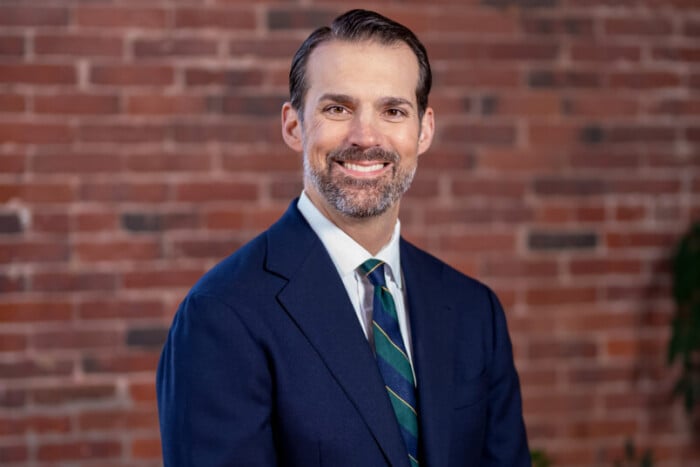
Phil Magnuszewski is founder of D!srupt AI and co-chair of the NH Tech Alliance’s AI Task Force, created to help guide policy as artificial intelligence becomes more embedded in government and society. (Courtesy photo)
The chair of a NH Tech Alliance task force wants to make sure certain guardrails, but not barriers, will help position the Granite State as a leader in artificial intelligence innovation.
Phil Magnuszewski, the founder of D!srupt AI, has an extensive background in the emerging and sometimes disquieting technology, and said the New Hampshire AI Task Force can be “a sounding board” for the state Legislature as it considers proposals that involve AI.
“This is new, and it’s evolving fast,” said Magnuszewski. “Our concern, as representatives of the larger ecosystem in the state, as well as our membership, is that the Legislature doesn’t do anything that will put the state at a competitive disadvantage from an innovation standpoint.”
He hopes legislators would reach out to him and task force members with questions as they ponder AI-related bills.
“We’re all aware that there are some guardrails and things that are just foundational and fundamental that we need to consider and think about,” said Magnuszewski. “But we also want to be here to say: Hey, look, let’s think through this stuff together, collectively, logically and think about the maybe unintended consequences of some of the legislation that might come through.”
The NH Tech Alliance is a statewide nonprofit that supports tech companies at all levels, from startups to established businesses. In July 2025, it announced the creation of the AI Task Force, which, it said, “brings together voices from government, industry, academia and the community to help guide responsible AI development and influence public policy across New Hampshire.”
“Artificial intelligence will transform how we live, work and grow businesses,” said Julie Demers, executive director of the NH Tech Alliance in announcing creation of the task force. “New Hampshire has an opportunity to lead, but only if we bring together those building, using, and impacted by AI to shape a thoughtful, innovation-friendly path forward.”
As it grows as a business tool, AI is a growing consideration when it comes to public policy, both how it might be used by government and how it might be regulated by government.
The current legislative session has several related AI-related bills it is considering. Among them:
- HB 1406: Ban insurers from using AI to alter clinical judgment.
- HB 1506: Allow exceptions to state agency AI ban.
- HB 1725: Regulate artificial intelligence use.
- HB 640: Regulate use of AI in providing services that require a professional license.
With several businesses and organizations represented on the task force, including the New Hampshire Association of Realtors (NHAR), HB 640 caught the attention of Robert Quinn, NHAR’s chief executive officer.
By its language, HB 640, for example, would prohibit anyone who is unlicensed as a Realtor in New Hampshire from using AI to buy/sell real estate.
“So you couldn’t sit in Texas and create a chat box that’s going to help someone buy or sell a home in New Hampshire unless you were licensed in New Hampshire to do it,” said Quinn.
Gov. Kelly Ayotte’s Commission on Government Efficiency (COGE) recommended the use of AI in government as what it called a “complement” to state employees.
“The goal is to use technology to handle time consuming, repetitive, or highly administrative tasks so that state workers can focus their time and expertise on work that requires human judgment, compassion and decision-making,” said the report, released Dec. 11, 2025.
The report cited the use of AI in Texas, where the city of Dallas contracts with a tech company to use AI for procurements — drafting solicitations, identifying vendors, highlighting local and small businesses, and ensuring compliance with legal requirements.
“For New Hampshire, the opportunity lies in applying AI to the routine but important tasks that slow down operations,” the COGE report said. “AI can help staff search and summarize complex regulatory documents, sort incoming correspondence, and flag potential errors or duplications in reports. In programs that require eligibility screening, AI can assist employees by cross-verifying information against existing records to reduce errors and speed service delivery.”
Magnuszewski agrees there can be a role for AI in government.
“I think looking at it from an efficiency perspective: How do we provide a better level of service to our constituents here in the state without adding or needing to add headcount?” he said. “Instead of it taking a week to do something, can we leverage the technology in a way that allows a citizen to get a response back on something in a day? Those kinds of things.”
Magnuszewski co-chairs the task force with Holly Neiweem of Apprentis Ventures. Its membership includes representatives from the University of New Hampshire, Elliot Health System, EnFi Inc., Hypertherm Associates, Fastly, Sheehan Phinney, NHAR, Darby Field Advisors, the Business and Industry Association of NH, and New Balance.
The BIA, the statewide chamber of commerce, in its assessment of the 2025 legislative session said that “lawmakers must continue to approach technology policy with thoughtfulness and restraint.”
Individually after the release of the COGE report, Magnuszewski sent a memo to Gov. Ayotte, offering some ideas on AI implementation in state government.
For instance, to better recruit state government workers, Magnuszewski suggested: “Use generative AI to instantly rewrite technical job descriptions into engaging, mission-driven narratives that highlight benefits and purpose.”
For procurement by the state, Magnuszewski advised: “Use AI spend-analysis tools to scan accounts payable data across all agencies, automatically flagging duplicate vendor spend that could be consolidated for bulk pricing.”
Magnuszewski is keenly aware that AI is sometimes responsible for incorrect and downright false content (particularly on social media). So, how can a resident be sure the AI-generated information they’re getting from the government is accurate?
He answered that the user needs a way to backtrack the information to see the source to determine whether the source and therefore the information are trustworthy.
“If there’s a way to validate with some kind of reference link or reference watermark, so that the user could then go back and say: Look, this looks a little suspicious to me, I want to go back and understand where that information came from, that, I think, is one of the first steps we should be thinking about,” he said.
Magnuszewski said of himself that he’s always loved “cutting-edge technology.”
“I have a number of different channels to express that curiosity. I’ve been working with AI since mid 2015, applied AI,” he said. “So I’m not a researcher, I’m not an algorithm developer, but I understand all those technologies in a way that allows me to then figure out: Okay, what’s the best way for individuals, governments, organizations to adopt them in safe, responsible ways?”
The task force co-chair is gleaning information from companies across the state on their use of AI.
“What we’re trying to establish is, across the state, what is the baseline in terms of perception, usage, with the intent of then sharing that information back,” he said.
The task force is asking about how AI is used, how much is AI used, is there governance and data protection strategies, is there a committee or workforce engagement in the AI use and policy, how much is the workforce itself being affected by AI?
He said he believes AI can be a resource for aiding an organization challenged by workforce hiring here in New Hampshire.
“I see organizations being thoughtful about it, bringing it in and using it as a collaborative tool, versus a replacement for workers,” said Magnuszewski. “This is still early. I’m optimistic in terms of what I’m hearing on the ground.”